Donate to the Grapevine

Express your thanks by leaving the pirate a tip!

January 6, 2011

Peter Finger - The Elf King: Acoustic Rock Guitar


Like Andres Segovia, John Fahey started a genre and inspired generations of musicians to take up his instrument and play it in a new way. This could have made him proud. Yet one thing always nagged at him. 90% of the people who claimed to be influenced by him were making pathetic, overly-sweet acoustic guitar ditties that bore little or no resemblance to the dark & mysterious depths he brought out of the guitar. And of those 10% that did actually incorporate his ideas and not just skim his style, most of them sounded like imitations of him (Peter Lang, etc.).

However, a few guitarists took the flame he had lit and brought it to new places, discovering new territories for the guitar just as he had. One of those was Peter Finger. With about 85 pounds of technique in his namesakes, this man could play the shit out of the guitar. And such a restless spirit, continually challenging himself and looking for new sounds to draw out of the guitar. This is his third album, and it's totally fantastic. Sounds nothing like Fahey, but is just as probing, unrepentant, steeled, and fascinating.

Biography
by Greg Prato
Acoustic guitarist Peter Finger was born in Weimar, Germany, in 1954 (his father was a conductor). Before beginning guitar lessons at the age of 13, Finger studied both violin and piano. Since the mid-'70s, Finger has been issuing albums (1975's Detlef & Finger and Bottleneck Guitar Solos, plus 1977's Acoustic Rock Guitar), and toured the world on a regular basis, including shows in his native Germany, as well as the U.S.A., Canada, Japan, England, Switzerland, Austria, Belgium, Holland, Luxembourg, France, Italy, Finland, Poland, Estonia, and Russia. The guitarist then branched out into other areas, including producing music for both TV, radio, and film, plus composing for orchestras. In 1988, Finger founded his own publishing company and record label (Acoustic Music Records), and in 1995, he became the publisher of Akustik Gitarre magazine. The '90s also saw further solo releases from Finger, including such titles as 1990's The Colors of the Night, 1995's Innenleben and Solo, 1999's Open Strings, and a ten-track 2001 compilation, The Collection.


Peter Finger - The Elf King: Acoustic Rock Guitar

Year: 1977
Label: Kicking Mule

Tracks:
1 Wishbone Ash
2 Hope & Memory
3 Just A One Man Band
4 A Berryman's Tune
5 Elf King, the
6 Sabine
7 For Ladies I Couldn't Get
8 Petermann's Polka
9 Magicians's Apprentice, the
10 Shepherd's Pie

Minstrel Banjo Style


Ok, so this is sort of the companion album to Rural Parlor Guitar. It's an album of music from the 19th century, which has laid the foundation for everything that we hear today. Like that one, it is an indescribable mix of African and European elements, mingling together like molasses and cornbread. The difference, perhaps, is that these musicians are resurrecting a dead form, doing their best to reconstruct it, while the Parlor Guitar album had musicians from the living tradition. That may contribute to some of the clean, dry feeling that accompanies all academic projects. Nevertheless, it's a very interesting, beautiful, and strange excursion into our shared musical past. You can really hear the African ngoni ancestors of the banjo coming through in the odd rhythms, deep notes, and furiously unexpected syncopations and cascades of pentatonic scales.


The early origins of the instrument, now known as the banjo, are obscure. That its precursors came from Africa to America, probably by the West Indies, is by now well established. Yet, the multitude of African peoples, languages, and music make it very difficult to associate the banjo with any specific African protoype. From various historical references, however, it can be deduced that the banjar, or bangie, or banjer, or banza, or banjo was played in early 17th century America by Africans in slavery who constructed their instruments from gourds, wood, and tanned skins, using hemp or gut for strings. This prototype was eventually to lead to the evolution of the modern banjo in the late 18th and early 19th centuries. Until 1800 the banjo remained essentially a black instrument, although at times there was considerable interaction between whites and blacks in enjoying music and dance—whites usually participating as observers. What brought the instrument to the attention of the nation, however, was a grotesque representation of black culture by white performers in minstrel shows.

The very essence of minstrelsy was black-face caricatures which became increasingly popular toward the end of the 18th century, leading to fully fledged black-face skits and songs on stage throughout white America by the middle of the 19th century. It was during this time that the banjo in all probability was first introduced to Ireland, when the Virginia Minstrels toured in England, Ireland and France in 1843, 1844 and 1845. The leader of the Virginia Minstrels was Joel Walker Sweeney who was born in Buckingham County, Virginia, in 1810. Sweeney, whose antecedents came from Co. Mayo, has become one of the most controversial characters in the history of the banjo, having been credited widely with introducing the fifth string, or chanterelle, to the instrument. In fact, there are early watercolour paintings well before Sweeney's time that show the fifth string on plantation banjos. [Note 2.] So Sweeney most certainly did not invent the 5-string banjo. What he did, however, with his minstrel show was extend the popularity of the banjo to an enormous audience all over the United States and Europe.

from The Banjo: A Short History by Mick Moloney


THUMBNAIL HISTORY OF THE BANJO
By Bill Reese

EARLY STAGES

Banjos belong to a family of instruments that are very old. Drums with strings stretched over them can be traced throughout the Far East, the Middle East and Africa almost from the beginning. They can be played like the banjo, bowed or plucked like a harp depending on their development. These instruments were spread, in "modern" times, to Europe through the Arab conquest of Spain, and the Ottoman conquest of the Balkans. The banjo, as we can begin to recognize it, was made by African slaves based on instruments that were indigenous to their parts of Africa. These early "banjos" were spread to the colonies of those countries engaged in the slave trade. Scholars have found that many of these instruments have names that are related to the modern word "banjo", such as "banjar", "banjil", "banza", "bangoe", "bangie", "banshaw". Some historians mention the diaries of Richard Jobson as the first record of the instrument.. While exploring the Gambra River in Africa in 1620 he recorded an instrument "...made of a great gourd and a neck, thereunto was fastened strings." The first mention of the name for these instruments in the Western Hemisphere is from Martinique in a document dated 1678. It mentions slave gatherings where an instrument called the "banza" is used. Further mentions are fairly frequent and documented. One such is quoted in Grove's Dictionary of Music and Musicians from a poem by an Englishman in the British West Indies in 1763: "Permit thy slaves to lead the choral dance/To the wild banshaw's melancholy sound/". The best known is probably that of Thomas Jefferson in 1781: "The instrument proper to them (i.e. the slaves) is the Banjar, which they brought hither from Africa."

MINSTREL ERA

White men began using blackface as a comic gimmick before the American Revolution. The banjo became a prop for these entertainers, either individually or in groups. By the early part of the 19th century, minstrelsy became a very popular form of entertainment. Joel Walker Sweeney and his Sweeney Minstrels were already popular by the 1830s. By 1843 the Virginia Minstrels began to do an entire show of this blackface entertainment and this is usually the date used to mark the beginning of the minstrel era. The Virginia Minstrels had 2 Banjo players, Dan Emmett and Billy Whitlock, a pupil of Sweeney. In addition Minstrel shows usually had a fiddler, a bones player and a drum/tambourine. We know from early Banjo instruction books by performers like Thomas Briggs, 1855, Philip Rice, 1858 and Frank Converse, 1865, that the minstrel style of playing was the "downstroke", what we call frailing today. This style was learned from the slave performers themselves.

Briggs in Banjo Instructor of 1855 describes playing as follows: "In playing the thumb and first finger only of the right hand are used; the 5th string is touched by the thumb only; this string is always played open, the other strings are touched by the thumb and first finger...The strings are touched by the ball of the thumb and the nail of the 1st finger. The first finger should strike the strings with the back of the nail and then slide to....."

Frank Converse in his Banjo Without a Master describes the style of playing as follows: "Partly close the hand, allowing the first finger to project a little in advance of the others. Hold the fingers firm in this position. Slightly curve the thumb. Strike the strings with the first finger (nail) and pull with the thumb."

THE FIFTH STRING

Joel Walker Sweeney of The Sweeney Minstrels, born 1810, was often credited with the invention of the short fifth string. Scholars know that this is not the case. A painting entitled The Old Plantation painted between 1777 and 1800 shows a black gourd banjo player with a banjo having the fifth string peg half-way up the neck. If Sweeney did add a fifth string to the banjo it was probably the lowest string, or fourth string by today's reckoning. This would parallel the development of the banjo elsewhere for example in England, where the tendency was to add more of the long strings with seven and ten strings being common. Sweeney was responsible for the spread of the banjo and probably contracted with a drum maker in Baltimore, William Boucher, to start producing banjos for public sales. These banjos are basically drums with necks attached. A number have survived and a couple of them are in the collections of the Smithsonian Institute in Washington. Other makers like Jacobs of New York or Morrell who moved his shop to San Francisco during the Gold Rush, helped to supply the growing demand for the instrument in the mid 1840s as the minstrel shows traveled Westward to entertain the gold diggers.

MINSTREL TO PARLOR

From the 1840s through the 1890s the Minstrel show was not the only place to see banjo players. There are records of urban Banjo contests and tournaments held at hotels, race tracks and bars, especially in New York to the enthusiastic cheering and clapping of sometimes inebriated crowds. Most of the contestants were white in the early contests but there are records of black players taking part in the post-civil war era. During this time (c. 1857) metal strings were invented. It seems they were cheaper than the normal professionally made gut strings and more long lasting then the home-made fiber or gut variety. Urban bar room players, minstrel show performers, slave performers, southern country players, all these performers were to come together during the Civil War (1860-1864). Regiments and Companies formed Minstrel groups and bands to entertain themselves during lulls in battle as did sailors aboard gunboats. The most famous of the Civil War banjoist was perhaps Samuel Sweeney, the younger brother of Joel Sweeney, who was an orderly of Jeb Stuart. Stuart apparently liked banjo music and when he wanted to relax he had Sweeney play for him. Sweeney also entertained Stuart's entire regiment.

After the War soldiers carried the knowledge and appreciation of the instrument home to almost every corner of America. During most of this time the banjo was looked-down upon by the more well-to-do classes of the population. Articles in the papers of the day like that in the Boston Daily Evening Voice of 1866, classified the Banjo of the 1840s and 1850s as an instrument in "the depth of popular degradation", an instrument fit only for "the jig-dancing lower classes of the community..." By 1866, however, the instrument had become a "universal favorite" with over 10,000 instruments in use in Boston alone. The cause of this sudden popularity was the introduction of the banjo as a parlor instrument. This is the somewhat misnamed "classical" period of the banjo. The banjo was played in the "classical" style which meant that it was picked with the fingers in imitation of the popular guitar players of the day. Many outstanding performers and teachers had banjos named after them that incorporated their own changes in the instrument in an attempt to make the banjo more refined and above all louder.

The Dobson Brothers and their sons were among the most active in the early stages. Henry C. Dobson is credited with adding the first frets about 1878. He is also credited with producing the first resonator and the first attempt at the use of a tone ring. Though the designs were his, many of the instruments were actually made by the Buckbee Company located on Webster Ave, in New York City until 1897, and later on 13th St. The company was later sold to Rettberg & Lange who went on to produce the Orpheum Banjo. Lange after leaving Rettburg would produce one of the finest sounding Banjos of the day, The Paramount. George C. Dobson, the son of H. C. Dobson continued to be active in the development of the banjo and continued performing almost until his death in 1931.

A.A. Farland (1859-1954) was another famous performer and was most outspoken about the development of the banjo. His banjos were also produced by Buckbee, and later by Rettberg and Lang. About 1915 he produced Farland's Patent Banjo Head made of "annealed steel, beautifully enameled" in an attempt to give more volume to his playing. He abhorred wire strings saying that "... the z-z-z- given by the final vibrations of wire strings is so offensive that I could not bear to use them." He claimed that "all but the deaf" in an audience of 12,000 could hear his banjo when he used his new "annealed" steel head !

Perhaps the most prolific of the banjo makers and enthusiasts of this period was S.S. Stewart of Philadelphia who made a whole range of instruments to fit every pocket book. He began in 1878 and produced banjos of all sizes and models, some made especially for ladies and for children. In 1898 SS Stewart was awarded the Sears contract and teamed up with the Mandolin maker Baur. Stewart died the same year but his sons teamed up with Baur to continue the Sears contract which ended in 1901. His sons continued making banjos until 1904. It is estimated that the Stewarts produced somewhere in excess of 25,000 banjos from 1878 to 1904. In addition Stewart published his own magazine for the banjo player were he regularly expounded his "philosophy" on banjo playing. It was Stewart who spread the story that Joel Sweeney "invented" the banjo by adding the fifth string.( Mike Holmes, banjo historian and editor of Mugwumps Online Magazine >http://www.mugwumps.com <>
If you're interested, read another article on Banjo History


VA - Minstrel Banjo Style

Year: 1994
Label: Rounder

Product Description
This is the first recorded anthology to present the sound of the banjo as heard in ante-bellum times. This compilation may very well provide listeners with initial exposure to this tradition-steeped music.

Review
by Steve Leggett
This intriguing album, which features contemporary banjo players Joe Ayers, Clarke Buehling, Bobby Winans, Bob Flesher, Bob Carlin, and Tony Trischka employing drop-thumb frailing techniques on gourd and hoop banjos in replication of the ante bellum minstrel style, somehow seems to fall short of what it might have been. Some of these performances are surprisingly lifeless and perhaps a bit too studied to really catch fire. Then there's the content problem of the minstrel canon itself, which was built on whites in blackface trying to mimic black life and attitudes, and in that context, songs like "Oh, I'se So Wicked," as performed here by Bob Flesher, are layered with subliminal cultural baggage and cruel ironies that are difficult to set aside even all these years later. Still, the minstrel era marks a period in the south when African approaches to rhythm and arrangement collided and eventually merged with European ones, and in what might be the largest irony, black musicians appropriated many of the minstrel tunes, which were in themselves parodies of black culture, into their own milieu, giving these songs another layer of the onion. All of this is more weight than this set is really intended to bear. The tunes are pleasant enough sounding on the surface, the banjo tones are round and gentle, and if one can set aside the ugly racial problems in America that really drove the minstrel phenomenon, then this set is a partial step toward cultural realignment.

Elderly Review:
We all know the good old 5-string banjo was popular way back in the previous century -- but who knows what the old playing styles were like, or the tunes? Here, miraculously, is a chance to find out. It's an anthology of 19th century banjo music, performed by many people who have been re-creating the old styles from printed tunebooks and methods of the era. A must for any banjophile, and if you're new to the banjo, why not start at the beginning?


Tracks:
1. Whoop Jamboree - Ayers - 2:54
2. Essence of Old Virginny - Ayers - 2:00
3. Sylphides Mazurka - Ayers - 1:40
4. Peeping Through de Cellar Door - Ayers - 3:25
5. Medley: Bully for All/St. Patrick's Day - Ayers - 2:35
6. Whoop Jamboree Reprise - Ayers - 1:45
7. Medley: Hobson's Jig/Briggs'Corn Shucking Jig - Buehling - 2:20
8. White Cat, Black Cat - Buehling - 1:34
9. Medley: Green Corn/Oh, What's de Matter, Suse Ann? - Buehling - 2:00
10. Anthony Street Reel - Buehling - 1:08
11. Clare de Kitchen - Buehling - 2:25
12. Medley: Whelpley's Jig/Buckley's Jig - Winans - 4:32
13. Medley: Johnny Boker/Matt Peel's Walk Around - Winans - 3:25
14. Medley: Phil Issac's Jig/Raccoon Jig - Winans - 3:00
15. Medley: Briggs' Jig/Brigg's Reel - Winans - 2:30
16. Medley: Harper's Jig/Kentucky Juba - Flesher - 2:30
17. Jim Along Josie - Flesher - 2:15
18. Medley: Rumsey's Jig/Modoc Reel - Flesher - 2:35
19. Oh, I'se So Wicked - Flesher - 2:40
20. Medley: Alabama Joe/Alabama Walk Around - Flesher - 1:45
21. Medley: Phil Rice's Excelsior Jig/John Diamond Walk Around - Carlin - 2:44
22. Richmond Am a Hard Road to Travel - Carlin - 3:47
23. Medley: Devil's Dream/DarkeyMoney Musk/Mrs. McLeod's Reel - Carlin - 3:02
24. Slave Narrative/Juba - Trischka - 1:49
25. Medley: Operatic Jig/Roast Beef - Trischka - 1:34
26. Yankee Doodle - Trischka - 1:40
27. New York March - Trischka - 0:47
28. Medley: Git up in de Mornin'/Sebastopol Breakdown - Trischka - 1:26

December 27, 2010

Ensemble Organum - Le Chant des Templiers


Ok, so I'm not much for Christian music, except the variety that has fiddles & accordions & banjos & other instruments of devilry, or screaming black people. Or at least some sort of mystery, and please keep it light on the preaching. And if you've been reading this blog a while, you're probably somewhat like me. But believe me, you do not want to pass on this. It is absolutely the most powerful, most mysterious, most gutwardly moving cd of chants I've ever heard. Hair-raising is the adverb. Like a feather and a sledgehammer rolled into one. I've always thought of latin as a logical language, but these chants blow it straight into the realm of post-apocalyptic riddlery of desperation. It feels like sticking a very sharp, very sacred knife into your lungs to force a gasp of air, which is actually a breath of wind, which is actually God.

It's like when you're a baby, laying in your crib, and the voice of the mighty one comes to you, and tells you you're going to live to see the death of all the world, and then rocks you to sleep saying "I know. I know little one. I know." And then you understand. Because you have heard, and you will never forget. Death is a mere point in the turning of the great wheel, and if midwinter isn't about resurrection, it isn't about anything. So if you don't think you'd like this music, it's especially important that you download it. And lock yourself in a room. And listen to this stuff on full blast. And when it's over, you'll be a changed person. And the look in your eyes will say "I know."

And even the Georgia Sea Island Singers won't be able to tell you any different. Because they're singing the exact same thing, in the exact same way, in a different iteration of the harmonic resurrection that is evolution, but don't let their skin fool you. These French singers have grain for grain every bit as much grit as the Sea Islanders, and every drop of mystique.

The Knights Templar were custodians of a secret. Though I cannot tell you the secret, I can tell you this: the Holy Grail is in this music, if you listen closely enough.

Crucem sanctam subiit,
qui infernum confregit,
accinctus est potentia,
surrexit die tertia. Alleluia.

Lapidem quem reprobaverunt
aedeficantes factus est
caput anguli, alleluia.


The Chant of the Templars
The Holy Sepulchre of Jerusalem in the twelfth century

It was towards the end of the second decade of the twelfth century that the idea of Hugh de Payns began to be realised: the creation of an Order of knighthood whose purpose was to guard the Holy Places and protect the many pilgrims who flocked to Jerusalem. In 1118 he obtained the assent of the Latin Patriarch of Jerusalem, Gormond de Picquigny. He gathered eight knights around him, and the undertaking was considered so important by Baldwin II, King of Jerusalem, that he granted them the use of part of his palace, what was left of the ancient Temple of Solomon. Thus the nascent Order took its name from its place of residence, and became known as Order of the Temple of Solomon.

This first period of the Order was modest and productive, it lasted until 1127. For these nine years, the Order’s membership remained fixed at nine knights. All were nobles, trained in the profession of arms, and this period – which might be described as a novitiate – was the crucible in which the specific spirituality of the Templars gradually took shape. The source of their spiritual consciousness is to be sought in the knights’ assiduous attendance at the Latin liturgy of the basilica of the Holy Sepulchre in Jerusalem. In 1128, when the Council of Troyes granted them a rule drawn up under the direction of Bernard of Clairvaux, their attachment to the liturgy of the Holy Sepulchre was clearly stated and became the distinctive and specific mark of their canonical condition. ‘You who have renounced your own will, and you others who, for the salvation of your souls, serve the Sovereign King with your horses and weapons, must with pure and pious longing follow Matins and the Divine Service in their entirely, according to the canonical institutions and the Uses of the regular masters of the Holy City.’

Over the next decade or so, the Order enjoyed a spectacular expansion: donations flooded in, and the Templars soon became key players not only in the Holy Land but also throughout Western Europe. Like all religious organizations, the Order of the Temple comprised two categories of brothers those particularly attached to the liturgy – and those charged more especially with the material tasks connected with the subsistence of the Order and its specific missions. However, even in times of war, the Templars were assiduous in their practice of the liturgy. During the siege of Damietta in the Fifth Crusade, a night raid by the Muslims was foiled because the Templars were celebrating the Office of Matins in the tent that served as the Order’s chapel. Thus were able immediately to repulse the attack. The Templars are often described as ‘soldier-monks’, but this term is improper, for it appear only in the nineteenth century. In ecclesiastical law the Templars did not have monastic status. Right from their origins, they were assimilated to the status of canons, taking as their model the Rule of St Augustine, with the obligation of scrupulously observing the liturgical order of the Holy Sepulchre. Nevertheless, although their activities did not permit them to hear the Office in its entirety, they were to say a certain number of paternosters at the hour of prayer in order to make up for their failure to attend the Office.

After the crusaders took control of Jerusalem on 15 July 1099, the organization of the Latin liturgy was entrusted to the clergy of the Church of France, who took the Use of Paris as their chief model. The first preceptor of the Latin Patriarchate was a certain Anselm, a canon of Paris who shaped the Latin liturgy of the Holy Sepulchre. The manuscript […] dates from the third quarter of the twelfth century and comes from the basilica of the Holy Sepulchre in Jerusalem. Having been purchased by the Duc d’Aumale in the mid-nineteenth century, it is now preserved at the Château de Chantilly. It is a breviary, written down when Parisian musical circles were just beginning to formulate square notation. All the vocal subtleties of the chant can be seen in it. In this respect the volume is quite exceptional, since few examples of French music from this period are still extant. Moreover, it contains a number of unique pieces, and others which are presented here in an unusual fashion. The musical notation of this breviary accurately reflects many decisive developments of its time, which were to have a profound influence on European techniques of notation down to the sixteenth century.

The French provenance of this manuscript is a precious indication, for we possess several concordant source of information enabling us to interpret the French notation of the twelfth century. It is necessary to combine the data provided by paleography with the art of making rhythm, which in religious chant has its own name, the tripudium. This essential element for understanding the rhythmic organization of the chant of this period has unfortunately not received sufficient attention from those who study the different types of plainchant. The way in which the theorists of the twelfth and thirteenth centuries describe the formation of the rhythmic architecture of polyphonic chant is a further fundamental element for deciphering this music.

[…] the antiphon Crucem tuam. Its text recalls the foundations of the Christian faith, centring on the resurrection of Christ, who by submitting to the torment of the Cross destroyed the infernal powers of death. This is the kind of multi-usage antiphon that could sometimes be sung outside the liturgical context in order to fan the flames of faith. It is followed by three chants for the Solemnity of the Transfiguration. The responsories Benedicat nos and Honor, virtus et potestas are taken from the Night Office, whereas the antiphon to the Magnificat comes from the Office of Vespers. The Feast of the Transfiguration was particularly observed by the Order of the Temple, which explains this solemn performance practice for the Magnificat, in which part of the antiphon is repeated every three or four verses .

Next comes the celebrated antiphon Media vita, sung for part of the year at Compline – the Office which leads up to nightfall – to introduce and conclude the Gospel canticle Nunc dimittis. This antiphon too was sometimes sung outside its liturgical setting. It was credited with magical powers, which often led the ecclesiastical authorities to control and limit use of it. After this, […] present the Kyrie chant, whose liturgical function, at the beginning of the Mass, is to exalt divine majesty, the only force capable of remedying the weaknesses and imperfections of the human soul. Once a year, the Kyrie was sung outside the Mass, to open Vespers for Easter Day. […] But the Kyrie could also be employed to fortify the souls of the combatants when an army deployed in order of battle. Here the chant alternates between monody and three-part polyphony, following the method of twelfth-century Parisian discantus as it has come down to us in the only extant work of Master Albert of Paris (precentor of the Cathedral of Saint-Étienne), preserved in the Codex Calixtinus: the Congaudeant catholici.

Then come two antiphons which set the spirituality of the Order in context. There is a frequent tendency to see the Templars only as warriors. This is to forget their fundamental condition as men of prayer, who took up arms only to defend peace and thus to allow mankind to hear the splendours of the Word of God. This is the meaning conveyed by the antiphon Da pacem domine in diebus nostris. It punctuates the recitation of Psalm 121, which conjures up all that Jerusalem at peace might reveal to men. Finally, just as each night before going to rest the Templars addressed a last invocation to the Virgin Mary, it is the great Salve Regina that concludes this brief survey of the liturgical life of the Order of the Temple. This antiphon, so wide-spread throughout Western Christendom, is presented here in an unusual form, with three verses which evoke the mystery of the Incarnation.

- Marcel Pérès


Ensemble Organum - Le Chant des Templiers
Manuscrit du Saint Sépulcre de Jérusalem XIIe siècle
Ensemble Organum - Marcel Pérès, dir.

Year: 2006
Label: Ambrosie

Anon., Chantilly, musée Condé, ms XVIII b12
1. Antiphona: Crucem sanctam
2. Responsorium: Benedicat nos deus
3. Responsorium: Honor virtus et potestas
4. Antiphona: Te Deum patrem ingenitum / Magnificat
5. Antiphona: Media vita in morte sumus / Nunc dimittis
6. Kyrie Eleïson
7. Antiphona: Da pacem Domine / Psalm: Fiat pax in virtute tua
8. Antiphona: Salve regina

Oh, and if you want to hear any other weird early music, check out Música Medieval y Renacentista

December 26, 2010

Sam Rizzetta - Bucks and Does


Ok, so not a whole lot so say on this one, but you'll probably appreciate a short post after the last few. Nothing shocking or out-of-place here, just extremely beautiful, tonal, resonant, music. Almost totally unaccompanied, the resounding tremors of the dulcimer are allowed to ricochet ad eternitum, and faithfully transcribed from vinylog to digital by yours truly. Enjoy!

Biography
by Craig Harris
The strings of the hammered dulcimer come alive with melody and percussive rhythms through the playing of Sam Rizzetta. The founder of multi-dulcimer group, Trapezoid, in 1975, Rizzetta has continued to creatively explore his multi-stringed instrument as a soloist since 1979.

In addition to maintaining a busy schedule as a performer and composer, Rizzetta has become one of the foremost designers and builders of hammered dulcimer. His instruments, which have been exhibited at the Smithsonian Institute and the National Folk Festival, are noted for their expanded tonal range and exquisite sound. Rizzetta, who resides in West Virginia, has continues to teach in the dulcimer department that he helped to launch in 1974


SAM RIZZETTA - CRAFTSMAN & MUSICIAN (long bio)

Over the years Sam Rizzetta’s performances, recordings, and craftsmanship have introduced many people to both hammer dulcimer and fretted or “Appalachian” mountain dulcimer, and his joyful and versatile music leave good feelings wherever he plays. Sam’s playing has been heard at numerous festivals as well as at the National Cathedral, the Kennedy Center, on National Public Radio’s A Prarie Home Companion and Mountain Stage, and on public television. And his many design innovations have helped to define the contemporary hammer dulcimer.

Onstage, the tone of Sam’s dulcimers combine with his heartfelt and ornamented playing style for music that has been called “resonantly sensual magic.” Reviewers say his music defies attempts at categorization. A Rizzetta concert may blend classical, folk, gospel, new age, oldtime tunes, ragtime, original music, and other surprises. Of his performance, the National Dulcimer Symposium Journal says, “Sam Rizzetta was just plain awe inspiring! We were privileged to be watching a master player in peak form.” Frets Magazine wrote, “He builds instruments of awesome power and puts them to good use.” “Probably the best dulcimer I’ve heard,” says West Virginia’s Tamarack Center. The New York Times concurs; “songs and reels played with lively charm. …delightful.”

In 1975 Sam created the influential group Trapezoid as a hammer dulcimer quartet, and they made some highly acclaimed, landmark recordings. Since 1978 Sam has performed solo, made 12 solo recordings, and written four books of original music for dulcimer.

Sam has designed and handcrafted musical instruments since childhood, and his dulcimers and guitars have long been prized by musicians. Rizzetta dulcimers have been exhibited at the Smithsonian Institution and the National Folk Festival and featured in Fine Woodworking Magazine. Starting in 1974, Sam taught for many years at the Augusta Heritage Center. He has been featured at many other music heritage workshops, and for many years he wrote the Technical Column for the Dulcimer Players News. Sam designs dulcimers for the Dusty Strings Company, and, along with friend and collaborator Nicholas Blanton, continues to build custom and experimental instruments. Many of Sam’s design innovations have become essential to the modern dulcimer and are enjoyed by almost all of today’s players, performers, and builders.

Sam has recently been nominated for a National Endowment for the Arts National Heritage Fellowship for lifetime achievement in the arts.

Influences:

Sam’s father, Pasquale, played violin and accordian, and his uncle Earl Nott was a great banjo player. So, Sam fell in love with traditional music and stringed instruments at an early age. He experimented with building banjos and guitars as soon as he could use tools. Chet Parker of Grand Rapids, MI was an early hammer dulcimer inspiration. In 1968 Sam met West Virginia hammer dulcimer player Russell Fluharty, Kentucky mountain dulcimer player Jean Ritchie, and dulcimer innovator Howie Mitchell. Later Sam moved to Randolph County, WV and was influenced by his neighbors like guitarist Blackie Cool and fiddler Woody Simmons, as well as by traditional musicians and instrument customers who visited from distant parts of the world.

You can get an album by Chet Parker at Tonal Bride.

if you'd like to read an article about Hammered Dulcimer Making that Sam wrote for Smithsonian, look here.

Or read an interview from Dulcimer Player magazine from right after this album came out.


Sam Rizzetta - Bucks and Does

Year: 1982
Label: Flying Clouds Music

Hammer and mountain dulcimers; cheerful mountain music.

Tracks:
01 Fanny Poer
02 Hoedown
03 Bucks & Does
04 High Falls of Cheat
05 Cobra Waltz
06 Volcano Strut
07 Mother Trucker
08 Cuckoo's Nest
09 Norwegian Waltz / Dolly Sods
10 Snowy Breasted Pearl_Rickett's Hornpipe
11 Peekaboo Waltz
12 Good For the Tongue / Rambling Pitchforks (or The Fisherman's Widow) / Sonny's Mazurka / The Royal Paulownia Hornpipe
13 Paul's New Dulcimer
14 Sweet Hour of Prayer / Angels We Have Heard on High
15 Carolan's Farewell to Music


December 25, 2010

Nowell Sing We Clear - A Pageant of Midwinter Carols


More weirdness from old Brittania! I meant to post this earlier, but hopefully you are still in the mood for some festive music. Now as you may have gathered, I'm not particularly keen on Christmas as it's currently celebrated, with people running all over the place spending money trying to appease the gods of consumerism. And I know enough about history to know that even the traditional Christmas is a pale coagulation of various midwinter pagan festivals. With all that being said, I did grow up celebrating 'Xmas' and usually still do to some degree, and I've found a few worthwhile aspects of the tradition, particularly those which have incubated themselves from another time, and still retain the magic and mystery of the great midwinter resurrection festivals.

This group does absolutely the best traditional christmas carols, and other, older midwinter music too. It's ancient, mysterious, beautiful, and danceable! This music shows the soul of our winter holiday in a way that puts every version of 'Rudolf' ever recorded to shame. Long live the mystery of darkness! Long live the sanctity of resurrection! Long live the tradition of wassailing, giving thanks to the trees that provide us with bounty.


In the summer of 1975, dance musicians Fred Breunig and Steve Woodruff moved to southern Vermont and teamed up with the singing duo of John Roberts and Tony Barrand. Nowell Sing We Clear was first performed in December of that same year. I conceived of it as a traveling road show which could visit small communities on a regular basis to broaden the range of music and custom to which people had access in the joyous midwin ter season. The program explores and reveals the active and still vital themes of the birth of Jesus and the celebration of the return of the light at the winter solstice. The combined interests and skills of the performers in contra and morris dancing and in ballads and bawdry afforded an unusual approach to Christmas music.
- Tony Barrand.


Known for their lively and entertaining presentations of English folk songs, John Roberts and Tony Barrand have performed at important festivals, colleges, and coffee houses throughout the United States, Canada, and their native England. Accomplished self-taught folklorists, they typically sing ballads and songs of the sea, of drinking situations, of industrial strife and much more, arranging the material thematically to illustrate the social history and the lives of the people who made up the songs. Performing in unaccompanied two-part harmony, they regularly draw upon a variety of instruments including Anglo-German and English concertinas, button accordion, banjo, guitar, and a variety of rhythm instruments such as bones and spoons. They met at Cornell University in 1968 while studying for Ph.D's in Psychology. After a number of years teaching at Marlboro College in southern Vermont, John Roberts is now a full-time musician; Dr. Tony Barrand teaches psychology, folklore and aesthetics through the University Professors at Boston University, recently co-edited a revised and expanded fourth edition of the shape-note hymnal Northern Harmony: Plain Tunes, Fuging Tunes and Anthems from the Early and Contemporary New England Singing Tradition and authored a major book on seasonal dance customs, Six Fools and a Dancer: The Timeless Way of the Morris and a compilation of sword dance notations, Longsword Dances...as Compiled by Ivor Allsop(All available from Carriage House Books).

In thirty-one years as a professional team, they have recorded with a number of companies, including Front Hall, Folk Legacy, Swallowtail, and National Geographic. Their most recent production is Heartoutbursts: English Folksongs Collected by Percy Grainger. They recently presented a concert of songs inspired by an exhibit of Maxfield Parrishís paintings at the Pennsylvania Academy of Fine Arts and the Brooklyn Musuem of Art. They have also performed settings of Rudyard Kiplingís verse at his restored house, Naulakha, in Dummerston, VT. It is recorded as Naulakha Redux: Songs of Rudyard Kipling (available from Golden Hind Records). Both John and Tony were founding members of the celebrated Marlboro Morris and Sword dance teams which perform the seasonal display dances in communities in Windham County, Vermont. John lives in Schenectady, NY, and Tony in Brattleboro, VT.

Fred Breunig is one of the most influential leaders of the New England contra dance movement and a major resource for the increasingly large following atttracted to the English Playford-style country dances. He has taught workshops and called dances throughout the U.S. and Canada and is a well-known figure leading dances to the accompaniment of his own fiddle playing. A printer by trade, he makes his home and runs his business, Press On! in Putney, VT, and maintains his regular community dance in East Putney on the last friday of each month. Fred has recorded with John and Tony on Front Hall and Folk-Legacy, and was a contributing musician to the influential F&W String Band albums of New England contra dance tunes.

Andy Davis is known nationally as one of the finest piano accompanists for contra dance music and is an outstanding performer on piano accordion and banjo. He teaches music in several schools in Brattleboro where he makes his home and runs the successful operation of New England Dancing Masters, with recordings and publications which make New England dance forms available for use in schools. Andy is a much-loved music teacher in local elementary schools and a leader of popular community dances. In addition to the Nowell recordings, he and guiitarist, Sandy Bradley are the accompanists on Laurie Andresí widely praised accordion, Fantastic Hornpipe.


2010 marks the 36th season of the Pageant of Midwinter Carols tour. Performers John Roberts and Tony Barrand, are widely known for their concerts and recordings of English ballads and songs with New England dance musicians, Fred Breunig and Andy Davis. Much of the singing is 4-part a cappella harmony, with carols worth dancing to, performed by fiddle, accordion, concertina, banjo and piano. The show begins with a fresh look at the telling of the story of Christ's birth through unfamiliar folk carols. The show ends with even less familiar songs associated with midwinter visiting customs such as “Hunting the Wren,” the “Derby Ram,” and "Wassailing on New Year’s Eve.

Drawn mostly from English-language folk traditions, the songs tell both a version of the events and characters involved in the Christmas story and detail the customs that make up the twelve magical days following the return of the light at the winter solstice. The pageant is also stamped with the energetic dance band sound of fiddle, button accordion, electric piano, drums, and concertina and the audience encouraged to sing along. An unusual treat is the enactment of a Mummers Play.


The Wassailing Of Trees

The ancient rite of wassailing trees was well known in Devonshire, Herefordshire and in other parts of the West Country of England (and elsewhere? please let me know). It generally took place on Twelfth Night (January 5th), or sometimes on 17th January, known as Old Twelfth Night. Farmers and their families would feast on hot cakes and cider, then they would go into the orchard with more "supplies."

A cider-soaked cake is laid in the fork of a tree and then more cider is splashed on it. The men fire their guns into the tree and bang on pots and pans while the rest of the people bow their heads and sing the special "Wassail Song." This custom is said to ward off bad spirits from the orchard and encourages the good spirits to provide a bountiful crop for the following year.

In other traditions, the men of the village went out to the orchards carrying the wassail bowl, to alternately serenade and browbeat the apple trees. There were songs, dances and libations (for tree and man alike) until finally, in frustration, the trees would be threatened with the axe if they did not produce well in the coming year. A newspaper account of 1851 documents Devonshire men firing guns (charged only with powder) at the trees.

Concerning this custom, A. H. Bullen writes:

This custom was kept up till the end of the last century. Brand relates that in 1790 a Cornish man informed him it was the custom for the Devonshire people on the eve of Twelfth Day to go after supper into the orchard with a large milk-pan full of cyder with roasted apples in it. Each person took what was called a clayen cup, i.e. an earthenware cup full of cyder, and standing under each of the more fruitful trees, sung —
“Health to thee, good apple-tree,
Well to bear, pocket-fulls, hat-fulls,
Peck-fulls, bushel-bag-fulls.”
After drinking part of the contents of the cup, he threw the rest, with the fragments of the roasted apples, at the trees, amid the shouting of the company. Another song sung on such occasions was
“Here’s to thee, old apple-tree,
Whence thou may’st bud, and whence thou may’st blow,
And whence thou may’st bear apples enow
Hats full! caps full!
Bushel-bushel-sacks full,
And my pockets full, too, huzza!”
It is supposed that the custom was a relic of the sacrifice to Pomona [the Roman Goddess of Fruits].

The American author Henry David Thoreau also cites Brand's Popular Antiquities in his essay Wild Apples: The History of the Apple Tree (published in the Atlantic Monthly, November, 1862), although he states that the practice took place on Christmas Eve, not Twelfth Night. However, he adds the note of an old practice of "apple-howling" in various counties of England on New Year's Eve where a troop of boys visits different orchards, and, encircling the trees, chant the following:
Stand fast, root! bear well, top!
Pray God send us a good howling crop:
Every twig, apples big;
Every bough, apples enow!
Then then shout in chorus, with one accompanying them on a cow's horn, and rap the trees with their sticks (this being called "wassailing" the trees):
WASSAIL the trees, that they may bear
You many a plum and many a pear:
For more or less fruits they will bring,
As you do give them wassailing.
According to a friend of this site, Ellen, wassailing of trees is still practiced in the Gloucestershire region of England.

This practice echoes one practiced by Romanians. As the housewife kneaded special holiday dough in the kitchen, her husband would pass through the house on his way to the orchard, in a vile temper. She followed anxiously behind as he passed from tree to tree, threatening to cut down each barren one. She would urge him to especially spare this one or that, saying: "Oh no, I'm sure this tree will be as heavy with fruit next year as my hands are with dough this day."

Wassailing As "Luck Visits" And Subsequent Traditions

It was only later that these traditions became associated with "luck visits" made around the neighborhood, together with general merry-making (and, as Rev. Bradley pointed out, "fortified by copious quantities of alcohol"). Soon, these traditions would merge with the waits who traveled the streets of the cities (and who were paid to sing and play during the holidays). And voila! we have a tradition: wassailing.

William Henry Husk, writing in 1868, reproduced the Wassailers' Carol (whose well known first verse begins: "Here we come a wassailing"), noting that its last verse was the same as the first verse of a carol reproduced by Ritson in Ancient Songs and Ballads (1829), which, in turn, may have been copied from a source during the reigns of James 1 (1566-1625) or Charles 1 (1600-1649). The verse was:
Good master and mistress,
While you're sitting by the fire,
Pray think of us poor children,
Who are wandering in the mire.
That being the case, the editors of the Oxford Book of Carols (OBC) suggest that Shakespeare (1564-1616) may have heard that fragment sung outside of his house at Christmas.

The wassail was not, however, absolutely confined to the Christmas season, but was used to indicate any convivial and festive meetings. Sandys quotes Shakespeare's Hamlet: —
"The king doth wake to-night, and takes his rouse,
Keeps wassel."
Indeed, says Sandys, the meetings were themselves called after them, again quoting Shakespeare, this time from Love's Labor Lost: —
“He is wit’s peddler, and retails his wares
At wakes and wassels, meetings, markets, fairs.”
Later, the meaning of wassail would become more narrow. By the way, the editors of the OBC suggest that verses two, six and seven of The Wassail Song "are not suitable when the carol is sung in church, but they give a vivid picture of the Waits of old times."

But the discussion of just one song barely scratches the surface of the rich lode of this tradition. Concerning this genre, Edith Rickert writes in 1910:

"The oldest carol known (cf. Appendix I. p. 132 - Seignors Ore Entendez À Nus; translation from Sandys: Lordings, From A Distant Home), although Anglo-Norman, embodies the Saxon phrases used in pledging. The former of these has survived in the refrain of the initial carol of this group (Wassail, Wassail, Out of the Milk Pail), which is otherwise highly religious. In the seventeenth century the wassail was a definite institution — the carrying about of a bowl of spiced ale from house to house to drink healths in expectation of a contribution. Nowadays the utterance of a "Merry Christmas' is often judged sufficient for the tip. Some of the poems here included are mere drinking-songs, but they were probably sung as carols at Christmas."

The word 'wassail' comes from the Old English "Waes hael" — that is, "Good Health!" The correct response was "Drinc hael." In Best-Loved Christmas Carols, Clancy and Studwell notes that the custom of wassailing may go back to the fifth century century, although the first mention in print was in 1140; Vortigern, mentioned below, dates to the early fifth century. Sandys believes that the custom could date to the third century.

Dr. Rickert's mention of "used in pledging" is especially interesting. William Sandys, in his 1853 work Christmas-tide includes the following passages which bear on this theme:

The wassail bowl, of which the skull of an enemy would thus appear to have formed their beau idéal, is said to have been introduced by them. Rowena, the fair daughter of Hengist, presenting the British king, Vortigern, with a bowl of wine, and saluting him with “Lord King Wass-heil;” to which he answered, as he was directed, “Drine heile,” and saluted her then after his fashion, being much smitten with her charms. The purpose of father and daughter was obtained; the king married the fair cup-bearer, and the Saxons obtained what they required of him.
This is said to have been the first wassail in this land; but, as it is evident that the form of salutation was previously known, the custom must have been much older among the Saxons; and, indeed, in one of the histories, a knight, who acts as a sort of interpreter between Rowena and the king, explains it to be an old custom among them.

By some accounts, however, the Britons are said themselves to have had their wassail bowl, or lamb’s wool — La Mas Ubhal, or day of apple fruit — as far back as the third century, made of ale, sugar (whatever their sugar was), toast and roasted crabbs, hissing in the bowl; to which, in later times, nutmeg was added.

The followers of Odin and Thor drank largely in honor of their pagan deities; and, when converted, still continued their potations, but in honor of the Virgin Mary, the Apostles, and Saints; and the early missionaries were obliged to submit to this substitution, being unable to abolish the practice, which afterwards degenerated into drinking healths of other people, to the great detriment of our own. Strange! that even from the earliest ages, the cup-bearer should be one of the principal officers in the royal presence, and that some of the high families take their name from a similar office.

Sandys writes that one of the earliest wassail songs is that introduced by Dissimulation, disguised as a religious person, in Bale’s old play of Kynge Johan [1166-1216], about the middle of the sixteenth century [e.g., circa 1538]. He brings in the cup by which the king is poisoned, stating that it “passith malmesaye, capryck, tyre, or ypocras,” and then sings —
"Wassayle, wassayle out of the mylke payle,
Wassayle, wassayle as white as my nayle,
Wassayle, wassayle in snowe, froste, and hayle,
Wassayle, wassayle with partriche and rayle,
Wassayle, wassayle that muclie doth avayle,
Wassayle, wassayle that never wylle fayle."
In Caxton’s Chronicle [circa 1480] the account of the death of King John represents the cup to have been filled with good ale; and the monk bearing it, knelt down, saying, “Syr, wassayll for euer the dayes so all lyf dronke ye of so good a cuppe.”

As we will see, there were many traditions associated with the practice of wassailing, reflecting the differing traditions of individual communities and regions.

In medieval times, as noted by Keyte and Parrott, in The Shorter New Oxford Book of Carols, wassailers had become were rural luck visitors who toasted householders from their communal bowl. Elizabeth Poston stated that it was a custom connected with children and the Waits, and which took place between Christmas and the New Year. Ian Bradley, quoting Strutt's Sports and Pastimes of the People of England, explains that the wassail bowl was formerly carried about by young women on New-year's eve, who went from door to door in their several parishes singing a few couplets of homely verses composed for the purposes, and presented the liquor to the inhabitants of the house where they called, expecting a small gratuity in return.

As the song states, wassailers wouldn't object to a bit of beer or cheese either.

all this and more from here.


Mumming
Mumming is also an ancient pagan custom that was an excuse for people to have a party at Christmas! It means 'making diversion in disguise'. The tradition was that men and women would swap clothes, put on masks and go visiting their neighbours, singing, dancing or putting on a play with a silly plot. The leader or narrator of the mummers was dressed as Father Christmas.

The custom of Mumming might go back to Roman times, when people used to dress up for parties at New Year. It is thought that, in the U.K., it was first done on St. Thomas's day or the shortest day of the year.

Different types of entertainments were done in different parts of the U.K. In parts of Durham, Yorkshire and Devon a special sword dance was performed. There were also different names for mumming around the U.K. too. In Scotland it was known as 'Gusards' in Somerset, 'Mumping' in Warwickshire or 'Thomasing' and 'Corning' in Kent.

In Medieval times it had turned into an excuse for people to go begging round the houses and committing crimes. It became so bad that Henry VIII, made a law saying that anyone that was mumming wearing a mask would be put in prison for 3 months!

One poem that people said when mumming was:
Christmas is coming, the beef is getting fat,
Please drop a penny in the old mans hat.
Over the years, this was changed into a very similar poem that is said by some carol singers today:
Christmas is coming, the goose is getting fat,
Please put a penny in the old mans hat.
The early settlers from the U.K. took the custom of Mumming to Canada. It is known as Murmuring in Canada, but is banned in most places because people used it as an excuse for begging.

Mumming is still done in parts of the UK, USA and Canada.

Sword dancing

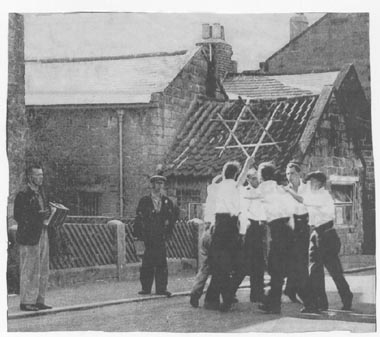
Usually regarded as a type of morris, although many of the performers themselves consider it as a traditional dance form in its own right, is the sword dance tradition, which includes both rapper sword and longsword traditions. In both styles the "swords" are not actual swords, but implements specifically made for the dance. The dancers are usually linked one to another via the swords, with one end of each held by one dancer and the other end by another. Rapper sides consist of five dancers, who are permanently linked-up during the dance. The rapper sword is a very flexible strip of spring-steel with a wooden handle at each end. The longsword is about 2'6" (0.8 metres) long, with a wooden handle at one end, a blunt tip, and no edge. Longsword sides consist usually of five to eight dancers. In both rapper and longsword there is often a supernumerary 'character', who dances around, outside, and inside the set.


Nowell Sing We Clear - A Pageant of Midwinter Carols
Live at the Folk Festival, NPR Radio Broadcast 1977

Never officially released. Extended introductions to each song provide the listener with a wealth of information about these old and mysterious songs.

Tracks:
01 Nowell Sing We Clear
02 intro
03 The Cherry Tree Carol
04 intro to While Shepherds Watch
05 While Shepherds Watch
06 intro to Coventry Carol
07 Coventry Carol
08 intro to Divers & Lazarus
09 Divers & Lazarus
10 intro to King Herod & the Cock & The Miraculous
11 King Herod and the Cock - The Miraculous
12 intro to Joys Seven
13 Joys Seven
14 intro to The Bitter Withy
15 The Bitter Withy
16 intro to The Boar's Head Carol
17 The Boar's Head Carol
18 intro to Lord of the Dance
19 Lord of the Dance
20 program break, credits
21 Green Grow the Rushes-O
22 Intro to The Cutty Wren
23 The Cutty Wren
24 Intro to Wassailing
25 Somerset Wassail
26 intro to Pace Egging Song
27 Pace Egging Song
28 Intro to Queen Mary's Men
29 Queen Mary's Men
30 Intro to Sword Dancing
31 Sword Dance Tunes from the Village of Sleights
32 Intro to Glousteshire Wassail
33 Glousteshire Wassail
34 Intro to Apple Tree Wassail & Darby Ram
35 Apple Tree Wassail & Darby Ram
36 Closing remarks
37 The Wren / The King / Joy, Health, Love and Peace
38 outro, credits

ripped from cassette, taped from radio

And if you're not celebrating, well, have a happy Saturday!