Donate to the Grapevine

Express your thanks by leaving the pirate a tip!
Showing posts with label Branches. Show all posts

January 11, 2011

Peter Ostroushko - Slüz Düz Music


I have already talked about Peter Ostroushko (here), so I'll keep it brief this time. This is, simply put, a totally fantastic album. One of the best I have heard in a long time. If you had to label it, you could call it 'Acoustic World Fusion' or 'Newgrass' or 'Exploratory String Band' music. Peter calls it Slüz Düz music. He plays some 'ukerish' (a combination of Irish rhythms and Ukranian melodies) tunes, some polkas, a waltz, a breakdown, a rag, and a last stand. His 'Sluz Duz orchestra' is a cast of some of the greatest pickers ever assembled: Norman & Nancy Blake, Mick Moloney, Daithi Sproule, Bruce Allard, Butch Thompson, and the entire band of Hot Rize, to name just a few.

Every note on this album sings. Every single melody line shines with the relaxed precision and care for details that comes from a lifetime of playing music. The theme is old-world meets new-world, but it isn't spelled out for you. It's just a natural fusion that occurs in Peter, being a man born of two worlds. In other words, there's nothing exotic here. Nothing sounds out-of-place. It all sounds as though it was meant to be this way. And with our cities becoming increasingly multicultural, with the emergence of the internet as a meeting ground and melting pot of divergent ideas, who's to say it's not meant to be this way?

Listen to this album, and have all doubts stricken from you. This is original music that claims its own place at the crossroads of many traditions. It is as fresh-sounding today as it was 25 years ago when it was recorded.


Peter Ostroushko - Slüz Düz Music
Original American Dance Tunes with an Old World Flavor

Year: 1985
Label: Flying Fish

Tracks:
1. The Last Stand - Ostroushko - 3:45
2. Friedrich Polka - Ostroushko - 3:23
3. Marjorie's Waltz - Ostroushko - 4:55
4. Fiddle Tune Medley: My Love,I Miss Her So/Farewell to Calgary - Ostroushko - 4:19
5. Burnt Biscuit Breakdown - Ostroushko - 4:55
6. Sleepy Jesus Rag - Ostroushko - 3:44
7. Slüz-Düz Polka - Ostroushko - 3:45
8. Katerina's Waltz - Ostroushko - 4:28
9. Christian Creek - Ostroushko - 4:00
10. Co. Kerry to Kiev Medley: Mcintyres Hornpipe/The Mist on the Lake/Mci - Ostroushko - 7:01

January 9, 2011

Debashish Bhattacharya - Live in Calcutta


More music from the best slide guitarist in the world! The last track on this album is seriously one of the best fusions of east and west that I've ever heard, with fearful symmetry to match any Fahey composition. That's all I can say!


The Jesuit maxim ‘Give me the child until he is seven and I will show you the man’ could just have easily have been coined in India, where the tradition of immersing children in music from birth is a natural result of them growing up within musical dynasties. In fact, Debashish Bhattacharya learnt to sing in the Gwailor classical vocal style his parents were steeped in even before he could talk. Oddly, the instrument he was first drawn to as a three-year-old was a Hawaiian lap steel guitar left lying around the house. As he recalls, “it was love at first touch.”

As a boy, Debashish learned western guitar as well as sitar, but his most rigorous training was a ten-year stint during his twenties studying with Pandit Brij Bhushan Kabra, the great pioneer of Indian raga slide guitar. It was during this time that he realised his vocation would be ‘to serve as a bridge between raga’s past and future’.

Now 43, and officially a Pandit (master musician) since turning 40, he is widely acknowledged as one of the world’s greatest slide guitarists, and has invented his own ‘Trinity of Guitars’. His Chaturangi has 22 strings, which enable it to suggest the timbres of violin, sitar, sarod and veena. The Ghandarvi is a 14-stinged guitar that can sound like a veena, sarangi, saz or flamenco guitar, and the tiny 4-stringed Anandi is basically a slide ukulele. He also has his own three-fingered style of playing which gives him an edge over others when it comes to speed and dexterity, and in 2003, he established a music school in his hometown of Kolkata.


Debashish Bhattacharya
World renowned Master of the Hindustani Slide Guitar

Debashish Bhattacharya is one of the world’s most amazing music personalities whose dynamism of artistry and creativity place him as a Genius. As a performer he is one of the worlds most powerful Slide Guitarists. He is creating a genre already in India and around the world.

As a composer he believes there is no east, and west in music, only Universal Human music which gives peace and joy to the believers.


As a creator he has become perhaps the only phenomenon in the History of World Music by creating TRINITY OF SLIDE GUITARS by name CHATURANGUI, GANDHARVI, and ANANDI.
As Debashish is perhaps the only Musician who has created such TRINITY in India too. As a recording artiste Debashish is a perfect Virtuoso matches in all the categories of Music starting from Indian Classical, Semi Classical, Folk to any Kind of World music.

Genetically Debashish carries music of his Devotee parent, who was singers by generations. His brother Subhasis is an extraordinary Tabla and other rhythm instruments. Sutapa his sister is a very popular singer who at her first abroad tour has been quiet popular in Japan And Canada.


As a disciple Debashish feels extremely fortunate to be associated with his Gurus, Pundit Ajoy Chakrabarty,the exponent vocalist and Pundit Brij Bhushan Kabra, the living legend and pioneer of Indian Classical Guitar.

As a performer Debashish began his debut at the age of four at All India Radio, Calcutta, late Ustad Karamatullah Khan of Farukhabad Gharana accompanied him on tabla was blessings from Ustadji

As he was twenty Debashish received President of India Award for wining National Music Competition of All India Radio. At his thirties Debashish has been awarded Top Grade, the ultimate honor by the Ministry of Information and Broadcasting of India, Prasar Bharati.

As a Classical Guitarist He is the best, as all the Gurus say today in India.


Debashish Bhattacharya visualised his customised guitar right back when he was sixteen years old. It took him the best part of two decades to solidify this fantasy into a range of axes with augmented strings, a collection that still look like guitars, but possessing trimmings that call to mind a sitar. He's added sympathetic resonating strings, raised high from the guitar body, and decorated his tuning knobs with bulbed carving. He plays with the axe laid flat, its strings caressed by a metal sliding bar. Could this be another version of the blues, to sit beside those manifestations from the Sahara and the Mississippi Delta?

Since signing to Riverboat Records, Debashish Bhattacharya's UK profile has been higher, particularly in the light of his duo disc Mahima, with serial collaborator Bob Brozman. The latter guitarist is obsessed with any string that slides, so his teaming with Debashish was almost inevitable. Now, Bhattacharya has just released his own album, Calcutta Chronicles, subtitled an Indian Slide Guitar Odyssey. It's refreshing to hear an artist verge on advising his audience not to buy the disc that's on sale at his gig. Well, not quite, but Debashish does issue a warning that it features capsule, or even compromised, versions of his crucial raga material, mentally edited for the purpose of audio home comfort.

In the onstage setting, Bhattacharya is more concerned with the expected lengthy unfolding of a traditional raga, though he's not going to take as much time to unwind as many of his peers. The average length of Debashish's journey is about thirty minutes per piece, instead of the oft-attained hour-long exploration. He drapes himself with the mantle of preservationist, viewing the old ways as being beleaguered in the face of modern technology (Bhattacharya has a curious obsession with citing GPS as the bane of the itinerant musician!). It's not that Debashish is particularly advanced in years, but he's set on preserving the ancient Indian classical system, and not just as a performer. His principle concern is that the audience needs to consciously battle, in order to find a quiet space for extended contemplation. He doesn't want you to play your disc whilst driving/eating/cleaning/procreating. He's right, of course. To solely listen requires a deliberate resolution...

Debashish is partnered by his tabla-playing brother, Subhasis, who observes silently as the opening alap is delicately formed by the sliding strings. He enters more prematurely than most, speaking with the deeply-rubbed tones of his bass skin. Debashish escalates quite quickly, plucking and picking, as he scatters single-note phrases against a backdrop of his own simultaneous jangle-cascade. It's highly intricate, and at its climax, incredibly speeding, with the pair displaying a uniquely bonded sense of improvising precision. Bhattacharya uses each of his three guitars in turn, the last being of ukulele size, and demonstrated on an even shorter piece. Close the eyes, and his sound is not so far removed from that of a sitar or veena, but Bhattacharya is nevertheless in possession of his own particular style, and has rapidly become one of the most impressive players on the Indian classical circuit.


RockOm's Tom Crenshaw had the privilege to interview Debashish in early 2008 and to witness a phenomenal concert in Savannah, Georgia, at the Savannah Music Festival, where Debashish debuted his "Song of Life" composition as performed by master guitarists Derek Trucks, Jerry Douglas, Bob Brozman, and Debashish himself. Tom remarks, "For close to ten minutes these giants of slide guitar held the audience in the palm of their hands trading licks back and forth, and singing dynamically through strings and fingers something entirely unheard-of up until that moment. I've never before witnessed or heard anything like these four masters speaking through their music in such a passionate and moving manner. There was a time when all four guitarists and the tabla percussionist were playing simultaneously and every single note, every beat made perfect sense! When the composition was over the audience erupted in a resounding, almost deafening applause. It was quite a moment- one I'll never forget!"

RockOm: I sometimes say that music is spiritual in nature- in that what flows through us musically seems to come from a higher realm. Do you agree?

Debashish Bhattacharya: No, not at all. Music is man's hard work with extreme passion. When it pleases us, it transports us to a level of the mind where we feel disconnected with all material things momentarily. If you call this spirituality, so be it. Spirituality lies in the philosophy shaping up any music and or true practice of humanity; it is not a package or brand to sell a product.

RockOm: Do you feel that your spirituality is communicated through your music and if so, how?

Debashish Bhattacharya: As I said, spirituality lies in the philosophy shaping up any music. Spirituality is also related to non-fake humanity. Of course, my music is deep-rooted in philosophy, which is why Indian classical or raga music has survived thousands of years. That so many people are learning, practicing, and listening to it all over the world is a percolation of its spirituality. My music is liked by millions around the world, so the aesthetics rooted in philosophy transcribes spiritual feelings in their minds; it is the music itself. In true presentation it shows what it is. This is a natural process of communication, but only possible in the hands of a dedicated and true artist.

RockOm: What do you think it is about music that breaks down barriers and divisions between people?

Debashish Bhattacharya: I call it emotional attachment. Subconscious self-identification with one and all. Only music evokes the realization that we are all human beings, "Brothers and Sisters," as the great Swami Vivekananda addressed audiences at the Chicago World's Religions meeting decades [ago.]

RockOm: Besides your own music, is there any one artist or album that you continually return to (more than others) for inspiration, depth, or spiritual revelation and why?

Debashish Bhattacharya: I always fall back upon Ustad Ali Akbar Khan, Pandit Ravi Shankar, and Ray Charles. Why? I think they shape my thinking, intellect, heart, hands, eyes, and all organs like vitamins.

RockOm: Is there a difference between hearing music and feeling music? How do you explain this?

Debashish Bhattacharya: I think that is a radical issue, which needs to be addressed rather seriously. Do you relate to your feelings phone ringtones, horns, jingles, lounge, titillating promos, and squeaks and squirms? All that comes without philosophy of life is "passing sound."

RockOm: Just as you've invented new musical instruments to express what you hear and feel inside, what do you think future master musicians will come up with?

Debashish Bhattacharya: I have invented sounds deep rooted in Indian tradition and use them to trans-create music that is eternal. I have been able to do something though I did not have any role model in front of me. I can't say for others.

RockOm: How are we limited here in the West with regard to writing and performing music of a spiritual nature?

Debashish Bhattacharya: Try to find an answer to why you think you are limited, if you believe so. I think only then you can get your answer of the question.

RockOm: How important is it for you to "get out of your own way," so to speak, when performing? Do you lose yourself while performing or must you remain fixated and aware of what you are doing at all times?

Debashish Bhattacharya: I do not believe in talking while performing. That's not done. I am deeply absorbed while performing, as I believe that I must deliver my best to my audience.

RockOm: Is playing music similar to praying or meditating?

Debashish Bhattacharya: Yes. If one concentrates while praying will he not do so while playing music?

RockOm: Does music have the power to heal and can you give any example of healing you have witnessed?

Debashish Bhattacharya: Healing varies from person to person. Yes, many of my fans listen to a certain piece of mine, at a certain time, to feel good. That's surely healing. But a general remedy is difficult to formulate in such abstract fine arts.

RockOm: Is everyone inherently musical to some degree?

Debashish Bhattacharya: Well, not really. I know of many who are least musical but make tons of money by selling music!

RockOm: What is the most important thing we should know about you and your music, Pandit?

Debashish Bhattacharya: The most important thing about me to know is my name Debashish Bhattacharya and my music - classical raga, music of India.

http://www.debashishbhattacharya.com/

Debashish Bhattacharya - Live in Calcutta

Year: 2010
Label: Rough Guide

This album is only issued as a bonus disc to the Rough Guide to India. You cannot purchase it by itself, and the rough guide isn't even half as good.

Tracks:
01. Raga Maru, Bihag Aalaap 13:41
02. Mahu Bihag, Jod-Jhala 9:29
03. Maru Bihag, Gat In Madhyala Rupak Tala 12:22
04. Maru Bihag, Gat And Jhala In Drut Tintala 13:20
05. Raga Khamaj, Aalaap 7:41
06. Anandam In Anandi (Raga: Mishra Shivaranjani) 7:07

if any of you have Debashish Bhattacharya - Calcutta to California, I'd love to hear it.

January 8, 2011

Béla Fleck - 2 Albums


Well it's past time that this blog paid a bit of tribute to the banjo's greatest contemporary icon.

In the taxonomy of the Grapevine, there are several divisions. Roots are the foundation of our music. Fruits are the perfection of it. Seeds begin something new and Branches connect two different strands. Well first Béla became a fruit, mastering the Scruggs/Keith/Trischka style banjo styles. Then he started branching, playing jazz and Celtic music on the 5-string banjo, and doing it better than anyone before. Then he became a seed, pioneering a new bluegrass meets funk meets world music with the Flecktones. And as I watch young players like Jayme Stone and Jake Schepps take the banjo to new places, I'm realizing that their foundation is in Béla's wonderful pioneering foundation. So in time he's becoming a new root. And yet he's going on to seed many new projects as well, making new kinds of music in Africa and India and who knows where next. So while I'm sure his name is well-known by now, I thought it still fitting to present some of his earlier, less-well-known works to give a picture of his primordial fully-formed coming out (he actually was in jazz bands and a couple of great bluegrass bands in the 70s, but this is his first statement that presents the full scope of his vision).


Biography
by Sandra Brennan
Premier banjo player Béla Fleck is considered one of the most innovative pickers in the world and has done much to demonstrate the versatility of his instrument, which he uses to play everything from traditional bluegrass to progressive jazz. He was named after composer Béla Bartok and was born in New York City. Around age 15, Fleck became fascinated with the banjo after hearing Flatt & Scruggs' "Ballad of Jed Clampett" and Eric Weissberg and Steve Mandell's "Dueling Banjos," and his grandfather soon gave him one. While attending the High School of Music and Art in New York, Fleck worked on adapting bebop music for the banjo.

Fleck always had diverse musical interests, and his own style was influenced by Tony Trischka, Earl Scruggs, Chick Corea, Charlie Parker, John Coltrane, the Allman Brothers, Aretha Franklin, the Byrds, and Little Feat. After graduation, he joined the Tasty Licks, a group from Boston. They recorded two albums and dissolved in 1979. Afterwards, Fleck joined the Kentucky band Spectrum. That year, only five years after he took up the instrument, he made his solo recording debut with Crossing the Tracks, which the Readers' Poll in Frets magazine named Best Overall Album. In 1982, he joined New Grass Revival and stayed with them until the end of the decade. During this time, his reputation continued to grow and in 1990, Frets magazine added his name to their Hall of Greats. In 1988, one of his compositions, "Drive" (from the album New Grass Revival), was nominated for a Grammy.

Fleck, mandolin player Sam Bush, fiddler Mark O'Connor, bassist Edgar Meyer, and Dobro player Jerry Douglas teamed up in 1989 to form Strength in Numbers and record The Telluride Sessions. Late that year, Fleck was asked by PBS television to play on the upcoming Lonesome Pine Special; in response he gathered together a veritable "dream team" of musicians to form the Flecktones. The original members included Howard Levy, who played piano, harmonica, and ocarina, among other instruments; bass guitarist Victor Lemonte Wooten, and his brother Roy "Future Man" Wooten on the drumitar, an electronic drum shaped like a guitar. Though the special wasn't aired until 1992, the Flecktones recorded their eponymous debut album in 1990 and followed it up with Flight of the Cosmic Hippo (1991).

In 1993, they released their third album, UFO Tofu, which featured music blending different genres ranging from bluegrass to R&B to worldbeat. In 1995, they released Tales from the Acoustic Planet; Left of Cool followed in 1998, and Tales from the Acoustic Planet 2: The Bluegrass Sessions was released a year later. Outbound followed in mid-2000. Busy and prolific, Fleck released an album of classical pieces, Perpetual Motion, in late 2001, followed by Live at the Quick in 2002, the ambitious double-disc Little Worlds (and its truncated single-disc version, Ten from Little Worlds) in 2003, and Music for Two (with bassist Edgar Meyer) in 2004. Hidden Land, another album with the Flecktones, appeared on Columbia Records in 2006. The band released its first holiday collection in 2008, appropriately titled Jingle All the Way. The Melody of Rhythm: Triple Concerto & Music for Trio appeared in 2009 from Koch Records, which teamed Fleck with cellist/bassist Edgar Meyer and the Indian percussionist Zakir Hussain along with the Detroit Symphony Orchestra directed by Leonard Slatkin.

Official Bio:

Béla Fleck (born July 10, 1958 in New York City, New York) is an American banjo virtuoso. He is best known for his work with the band Béla Fleck and the Flecktones, with bassist Victor Wooten, saxophonist Jeff Coffin, and percussionist Future Man.

Life and early career

Béla Anton Leoš Fleck, who is named after famous Hungarian composer Béla Bartók, Austrian composer Anton Webern, and Czech composer Leoš Janáček, was drawn to the banjo when he first heard Earl Scruggs play the theme song for the television show Beverly Hillbillies. He received his first banjo at age fifteen from his grandfather (1973). He was a member of the class of 1970 at P.S. 75 (the Emily Dickinson School) in Manhattan. Later, Fleck enrolled in New York City's High School of Music and Art where he studied the French horn. He was a banjo student under Tony Trischka.

Almost immediately after high school, Fleck traveled to Boston to play with Jack Tottle, Pat Enright, and Mark Schatz in Tasty Licks. During this period, Fleck released his first solo album (1979): Crossing the Tracks and made his first foray into progressive bluegrass composition.

Fleck played on the streets of Boston with bassist Mark Schatz; and the two, along with guitarist/vocalist Glen Lawson and mandolin great Jimmy Gaudreau, formed Spectrum: the Band in 1981. Fleck toured with Spectrum during 1981. That same year, Sam Bush asked Fleck to join New Grass Revival. Fleck performed with New Grass Revival for nine years. During this time, Fleck recorded another solo album, Drive. It was nominated for a Grammy Award in the then first-time category of "Best Bluegrass Album" (1988).

Béla Fleck and the Flecktones

Béla Fleck and Victor Wooten formed Béla Fleck and the Flecktones in 1988, along with keyboardist and harmonica player Howard Levy and Wooten's percussionist brother Roy "Future Man" Wooten, who played synthesizer-based percussion. Levy left the group in 1992, making the band a trio until Saxophonist Jeff Coffin joined the group onstage part-time in 1997, eventually becoming a permanent member. His first studio recording with the band was their 1998 album Left of Cool. In 1996, he appeared on the tribute album to Hank Marvin, one of his influences, and The Shadows "Twang" playing a Shadows UK hit from the 1960s, "The Stranger".

With the Flecktones, Fleck has been nominated for and won several Grammy awards. (Cf. Grammy sections below.)

Other music and recordings

Fleck has shared Grammy wins with Asleep at the Wheel, Alison Brown, and Edgar Meyer. He has been nominated in more categories than any other musician, namely country, pop, jazz, bluegrass, classical, folk, spoken word, composition, and arranging.

In 2001, Fleck collaborated with long-time friend and playing-partner Edgar Meyer to record Perpetual Motion, an album of classical material played on the banjo along with an assortment of accompanists, including John Williams, Evelyn Glennie, Joshua Bell and Gary Hoffman. The album includes selections such as Chopin's Etude Op. 10 No. 4 in C# minor, Debussy's Doctor Gradus ad Parnassum, and Paganini's Moto Perpetuo (from which is derived the name), as well as more lyrical pieces such as the first movement of Beethoven's Moonlight Sonata, two of Chopin's mazurkas, and two Scarlatti keyboard sonatas. Perpetual Motion won two Grammys at the Grammy Awards of 2002 for Best Classical Crossover Album and Best Arrangement for Fleck and Meyer's arrangement of Doctor Gradus ad Parnassum. Fleck and Meyer have also composed a double concerto for banjo and bass, and performed its debut with the Nashville Symphony Orchestra.

Fleck names Chick Corea, Charlie Parker, and the aforementioned Earl Scruggs as influences. He regards Scruggs as "certainly the best" banjo player of the three-finger style.

Solo and with the Flecktones, Fleck has appeared at Telluride Bluegrass Festival, Merlefest, Montreal International Jazz Festival, Toronto Jazz Festival, Newport Folk Festival, Austin City Limits Music Festival, Bonnaroo, and Jazzfest, among others.

He has also appeared as a sideman with artists ranging from Tony Rice to Ginger Baker and Phish.

In 2005, while the Flecktones were on hiatus, Fleck undertook several new projects: recording with African traditional musicians; cowriting a documentary film called Bring it Home about the Flecktones' first year off in 17 years and their reunion after that time; coproducing Song of the Traveling Daughter, the debut album by Abigail Washburn (a young banjo player who mixes bluegrass and Chinese music); forming the acoustic fusion supergroup Trio! with fellows Jean-Luc Ponty and Stanley Clarke, and recording an album as a member of the Sparrow Quartet (along with Abigail Washburn, Ben Sollee, and Casey Driessen).

In late 2006, Fleck teamed up with Chick Corea to record an album, The Enchantment, released in May 2007. Fleck and Corea toured together throughout 2007.

In July 2007 at the Winnipeg Folk Festival, he appeared and jammed with Toumani Diabaté, a kora player from Mali. He is also scheduled to play the 2009 Bonnaroo Music and Arts Festival with Toumani Diabaté.

In December 2007, he performed charity concerts in Germany to help promote AIDS awareness. His largest concert was held in Grosse Halle Bern on December 1, 2007.

On June 13, 2008, he performed as part of The Bluegrass Allstars, composed of bluegrass heavyweights Sam Bush, Luke Bulla, Edgar Meyer, Bryan Sutton, and Jerry Douglas at the Bonnaroo Music and Arts Festival in Manchester, Tennessee.

The next day Fleck performed with Abigail Washburn and the Sparrow Quartet also at the Bonnaroo Music and Arts Festival.

---------------

Béla Fleck is often considered the premier banjo player in the world. A New York City native, he picked up the banjo at age 15 after being awed by the bluegrass music of Flatt & Scruggs. While still in high school he began experimenting with playing bebop jazz on his banjo, mentored by fellow banjo renegade Tony Trischka. In 1980, he released his first solo album, Crossing the Tracks, with material that ranged from straight ahead bluegrass to Chick Corea’s “Spain.” In 1982, Fleck joined the progressive bluegrass band New Grass Revival, making a name for himself on countless solo and ensemble projects ever since as a virtuoso instrumentalist. In 1989 he formed the genre-busting Flecktones, with members equally talented and adventurous as himself.

Throw Down Your Heart, the third volume in Béla’s renowned Tales From the Acoustic Planet series, is his most ambitious project to date. In on-location collaborations with musicians from Uganda, Tanzania, Senegal, Mali, South Africa and Madagascar, Béla Fleck explores the African origins of the banjo, the prototype of which was brought to American shores by African slaves. Throw Down Your Heart is a companion to the award-winning film of the same name, which Béla and director Sascha Paladino are currently premiering at festivals nationwide. Transcending barriers of language and culture, Fleck finds common ground with musicians ranging from local villagers to international superstars such as the Malian diva Oumou Sangare to create some of the most meaningful music of his career.

The music on the album is as adventurous and varied as anything we’ve come to expect from Béla, ranging from the tradition-based opening track, performed with a group of Kenyan women singers, to the exquisite title track, performed with the Haruna Samake Trio and Bassekou Kouate from Mali. Basseko, who comes from a long line of Griot musicians, is an incredible improvising player who plays the n’goni, the Malian banjo. The music he and Béla make together is gentle and melodic. Equally modern is his duet with South African guitarist Vusi Mahlasela, who is simply known as ‘the voice’ (and what an awesome and expressive voice he has). His music connects South Africa’s Apartheid-scarred past with its promise for a better future.

Nothing can quite prepare the listener for the sound of the giant marimba played by the Muwewesu Xylophone Group in Uganda. Says Béla, “The marimba is reassembled every day, and it seems to be played by a set group of men. Each one plays a certain musical part in the group. I think there are other people who know each of the parts in case someone is unable, or unavailable to play. Also there seemed to be kids who were being taught parts. But a spot in the primary team seemed to be a very coveted spot, and the men who played in this group were very serious and very good. The village did join in – in large numbers, singing and playing flutes and fiddles and percussion instruments. They also danced.” It’s a sound of pure joy.

Another highlight is “Djorolen,” a duet with singer Oumou Sangare, who delivers a vocal that expresses heartbreaking beauty and sadness. “As she points out in this song,” says Béla, “it is often the orphans, those who have lost their parents when they are young, who have the greatest problems in life.”

“D’Gary Jam” is a fascinating amalgam that exemplifies the spirit of the album. Béla explains, “This track started its life in Nashville. We had a great jam one day, which went for 22 minutes straight, the whole take was really cool.

This was in July, about 7 months before we went to Africa. I decided to bring the track along, and add people to it as we went, and even after the trip, a kind of science project, if you will. After things got added, I took some liberties with people’s parts and did a little audio sculpting.” Along with the great acoustic guitarist D’Gary, the track features, among others, Oumou Sangare, the legendary kora player Toumani Diabate, and Bassekou Kouyate.

As to the origins of the banjo, Béla comments, “When I went to Africa I found instruments and players that gave me a better sense of where the thing started. In Gambia and Mali in particular, I found what I was looking for!” This is especially apparent on the traditional song medley “Ajula/Mbamba,” performed by Béla and The Jatta Family from the Gambia. “The akonting could very well be the original banjo. Everyone around Banjul certainly seems to think so! Huge numbers of slaves came west from this area. We were told that the musicians were allowed to play these instruments on the slave ships, and that many lives were saved due to it.”

While many of these recordings were made in the field, in Uganda, Tanzania, The Gambia and Mali, the album is beautifully recorded. The lasting impression is that Béla Fleck has revealed many subtle facets of African music, from the fully modern to the deeply traditional. It is some of the most exciting and beautiful music he’s ever made. “[Fleck’s] reverence for his fellow players allows for the honey of the African sounds to seem that much sweeter. And the music, well…You’ll just have to hear it for yourself…” -Popmatters.com

“The banjo sheds its image as the quintessential American instrument to reveal a symbol of deep African heritage and the collective wail of the European slave trade (the film’s title derives from this heartbreaking historical chapter).” - Austin American Statesman

Source: http://www.belafleck.com/bio.html


Béla Fleck - Daybreak

Year: 1988
Label: Rounder

Whenever I press a Bela Fleck disc into a friend's hand, I and ask them to listen to it,because Fleck is a virtuoso, a master of his instrument. Over the years, Bela Fleck continued to incorporate various styles into his recordings. 1988's `Daybreak' gives you a taste of how well-versed he is in playing other musical genres.

Bela stays faithful to his NewGrass style on `Texas Barbeque', `Twilight`, `Reading in the Dark', `Applebutter', `Dawg's Due' (a David Grisman tune); `Crossfire', and `Punchdrunk'.

There are jazz tunes: Spain'-- a few bars into it you'll recognize this Chic Corea favorite; and a honky-tonk version of Fats Waller's `How Can You Face Me Now' (with vocal).

This would not be a Bela Fleck disc few without a traditional bluegrass melody. This disc has several: `Bill Cheatham' featuring Bill Keith and Bela in a banjo duet; a joyful, bouncy version of `Silverbell` and a NewGrass-y version of `Fiddler's Dream'.

He also throws in a few Celtic songs---- 'Growling Old Man and the Grumbling Old Woman' and 'Christina's Jig/Plain Brown Jug'

For fans of his later `jazzgrass' sound with the Flecktones, `Daybreak', `Flexibility', `Old Hickory Waltz' and `The Natural Bridge Suite' (reminiscent of Stephane Grappelli/Django Rheinhart) won't disappoint.

Tracks
1. Texas Barbeque - Fleck - 3:57
2. Spain - Corea, Rodrigo - 7:10
3. Twilight - Fleck - 2:01
4. Reading in the Dark - Fleck - 2:36
5. Growling Old Man and the Grumbling Old Woman - Traditional - 1:38
6. How Can You Face Me? - Razaf, Waller - 4:52
7. Bill Cheatham - Traditional - 3:13
8. Christina's Jig/Plain Brown Jig - Fleck - 3:49
9. Silver Bell - Traditional - 2:54
10. Fiddler's Dream - Traditional - 2:46
11. Daybreak - Fleck - 2:58
12. Dawg's Due - Fleck - 2:57
13. Flexibility - Fleck - 4:10
14. Old Hickory Waltz - Fleck - 4:52
15. Crossfire - Fleck - 3:25
16. Applebutter - Fleck - 2:41
17. The Natural Bridge Suite - Fleck - 6:54
18. Punch Drunk - Fleck - 2:42


Béla Fleck - Crossing the Tracks

Year: 1979
Label: Rounder

Review
by Steve Leggett
Crossing the Tracks was Béla Fleck's first solo album, released on LP by Rounder Records in 1979 (for some reason Rounder never got around to releasing it on CD until 2005), and it featured an inspired and forward-thinking string band consisting of Bob Applebaum on mandolin, Russ Barenberg on acoustic guitar, Sam Bush on fiddle, Mark Schatz on acoustic bass, and Fleck, then a 20-year-old banjo player with brilliant chops and a bebop heart. Fleck gets the bluegrass monkey off his back with the opening track, a solid version of Lester Flatt and Earl Scruggs' "Dear Old Dixie," and then is free to roam through a gentle and sparkling set of traditional tunes ("Growling Old Man and Grumbling Old Woman"), boogie rags (Fats Waller's "How Can You Face Me Now"), airy and elegant originals ("Inman Square" and the wonderful, endlessly shifting "Twilight"), and genre-jumping jazz covers (Chick Corea's "Spain"), all done with a bright, joyful élan, before ending things with a beautiful old-timey version of the traditional "Ain't Gonna Work Tomorrow," which features vocals from Fleck's old Tasty Licks bandmate Pat Enright. In time this sort of thing would come to be known as "jazzgrass" or "newgrass," but there really wasn't a name for it in 1979, which certainly didn't stop Fleck from going there. Crossing the Tracks is full of subtle innovation, and if it doesn't seem as immediately startling as his later fusion flights, listen again. All the seeds are there.

Tracks:
1. Dear Old Dixie - Flatt, Scruggs - 2:39
2. Inman Square - Fleck - 4:00
3. Texas Barbeque - Fleck - 3:59
4. Growling Old Man and the Grumbling Old Woman - Fleck, Traditional - 1:41
5. Spain - Corea, Rodrigo - 7:12
6. Crossing the Tracks - Fleck - 3:38
7. Spring Thaw - Fleck - 2:27
8. How Can You Face Me Now - Razaf, Waller - 4:54
9. Twilight. 2:01
10. Frosty Morning. 2:58
11. Ain't Gonna Work Tomorrow. 2:26

July 20, 2010

Bertram Levy & Peter Ostroushko - First Generation


Back to some vinyl again!
We have here another incredible out of print Flying Fish LP. There is no information on this album pretty much anywhere, and little to none about Bertram Levy. Peter Ostroushko, however, is known as one of the finest mandolin and fiddle players in America. Aside from being able to play anything from bluegrass to klezmer to classical, Ostroushko is always characterized by a sparklingly clear and beautiful tone. Like Doc Watson, he can play dazzlingly fast runs, but never puts in a note that isn't needed. If in doubt, he takes the conservative approach rather than the showy one. Let the music breathe a little, you know? Let the silence speak.

This album is the only album made by a group of musicians calling themselves First Generation. They are all first generation immigrants to the US. And that is what gives this album its most distinctive and blogworthy quality. In fact, that is what gives the USA its most distinctive and noteworthy quality. The meeting ground. The melting pot. All American music is the product of immigrants coming together, interbreeding, intersocializing, and interspersing. But sometimes people forget that, and bluegrass fans boo black musicians, and white folks get accused of ripping of jazz & blues musicians, and everyone conveniently forgets that Native Americans exist. So these first generation immigrants remind us. Fruitful births happen when different people come together. Monocultured tradition breeds sterility and hemophilia. That's what a hick is. You'll find them still in royal families... Dynamism comes from the interplay of radically different bodies. Polyculture is permaculture. To blindly follow a tradition in a rapidly changing world is to render oneself an irrelevant artifact of the past before one has even entered the present. That's why World Fusion music works. The cultures of our world are fusing anyway, faster than we can even know. May as well have a music that's relevant. Lots of folks are realizing that now. First Generation realized it 25 years ago.

And actually, the ironic thing is that they manage to keep the traditions separate and distinct even as they meld themselves together in playing them. It's less like a melting pot than a meal with a bunch of different dishes, each from a different part of the world, but all cooked by the same team of crazy chefs.

Enjoy this, because I don't often post Celtic Ukranian Polka Hoedowns.

A little info on Bertram Levy thanks to Gadaya:
He played mandolin with The Hollow Rock String Band (with Alan Jabbour on fiddle) at the end of the 1960's , recorded a superb solo banjo lp ("That old gut feeling") at the beginnig of the 1980's and became a great concertina player as well. A few years ago he became interested in Tango music and learned the bandoneon. A complete and versatile musician that's for sure..


Peter Ostroushko

Biography by Craig Harris

The musical traditions of the Ukraine are fused with an aural reflection of America's Midwest by mandolin and fiddle player Peter Ostroushko. Best known for his regular appearances on National Public Radio show, A Prairie Home Companion, Ostroushko (pronounced: Oh-STREW-shko) has consistently achieved high standards with his solo recordings and duo albums with Minnesota-based acoustic guitarist Dean Magraw. Equally skillful on fiddle and mandolin, Ostroushko is, according to flatpicking guitar wiz Norman Blake, "the next Jethro Burns and Johnny Gimble rolled into one."

Ostroushko has been playing music most of his life. As the son of Ukrainian immigrants, Wasyl and Katerina Ostroushko, Ostroushko grew up listening to his father, a shoemaker, playing traditional songs of his homeland on guitar and mandolin.


Although he appeared on A Prairie Home Companion, in 1974, the first year that the show was broadcast on Minnesota Public Radio, Ostroushko didn't become a full-time cast member until the show went national in 1980. During the six years in between, Ostroushko worked as a session musician in Nashville. In addition to working on albums by Jethro Burns, Emmylou Harris, Willie Nelson, Chet Atkins, and Johnny Gimble, Ostroushko played mandolin, though uncredited, on the tune, "If You See Her, Say Hello," from Bob Dylan's album, Blood on the Tracks. Ostroushko also toured with Robin & Linda Williams and Norman & Nancy Blake.

Sluz Duz Music, Ostroushko's debut solo album, was released in 1982. The title referred to Ostroushko's description of his music, based on the Ukrainian words meaning "over the edge" or "off his rocker". Ostroushko's second effort, Down the Streets of My Neighborhood, released in 1986, included a medley of Ukrainian songs and an interpretation of Hank Williams' "Hey, Good Lookin'" sung in Ukrainian.


Ostroushko's albums have featured an illustrious list of supportive musicians. The Mando Boys, Ostroushko's third album, released in late 1986, featured a fez-wearing group that began when Ostroushko formed The Lake Woebegone Municipal Mandolin Orchestra for a tour with Garrison Keillor and the cast of A Prairie Home Companion. The same year, Ostroushko recorded First Generation with anglo concertina player Bertram Levy. Ostroushko's next album, Buddies of Swing, released in 1987, was a jazz-tinged collaboration with Jethro Burns (mandolin), Johnny Gimble (fiddle), Butch Thompson (piano), Dean Magraw (guitar), and Prudence Johnson (vocals). After recording a solo album, Blue Mesa, released in 1989, with guest appearances by Norman & Nancy Blake, Daithi Sproule, and Magraw, Ostroushko and Magraw collaborated on an album, Duo, released in 1991. Ostroushko's most successful recording, Heart of the Heartland, released in 1995, was an all-instrumental exploration of the Midwest. In addition to receiving a NAIRD award as "best independently released folk instrumental album," the album was featured on Ken Burns' PBS documentary, Lewis and Clark. The following year, Ostroushko released, Pilgrims on the Heart Road, which he described in the liner notes as "a collection of songs that are a companion piece to Heart of the Heartland." Sacred Heart followed in 2000.

Ostroushko has worked closely with the Children's Theater in Minnesota and the ACT Theater. One of his most ambitious projects was an appearance as lead ukulele player, with the Minnesota Symphony Orchestra.


2nd Bio:

When they write the book on Peter Ostroushko, they may mention that he loved his family and music and cooking and baseball. But there's no doubt they'll say he was one of the most accomplished instrumentalists and gifted composers of his generation.

The die was cast early on. Growing up in the Ukrainian community of northeast Minneapolis, Peter heard mandolin, balalaika and bandura tunes played by his father and family friends at get-togethers in their home and in church. It's the music that still echoes in Peter's memory and provides the basis for many of his compositions.


The musical road that led Peter to this point has had its share of twists and turns. He was still in high school when his career as a professional musician began. Asked to compose and play the music for a one-man staging of A Christmas Carol, Peter fell in love with theater. Soon he was honing his skills at the Children's Theatre School in Minneapolis.

He began to take up instrument after instrument, finally opting to concentrate on fiddle and mandolin. During the next three decades, he made his mark as a sideman, session player, headliner and composer. His first recording session was an uncredited mandolin set on Bob Dylan's Blood on the Tracks. He toured on a regular basis with Robin and Linda Williams, Norman Blake and the Rising Fawn Ensemble, and Chet Atkins. He also worked with the likes of Jethro Burns, Emmylou Harris, Willie Nelson, Johnny Gimble, Greg Brown, John Hartford and Taj Mahal, among a host of others.

As a solo performer, Peter has produced a number of recordings, including Down the Streets of My Old Neighborhood, Slüz Düz Music, and the three albums that make up his Heartland Trilogy: Heart of the Heartland, Pilgrims of the Heartroad and Sacred Heart. His latest is Meeting on Southern Soil, a collaboration with longtime friend Norman Blake.

Peter has spent more than 25 years as a frequent performer on A Prairie Home Companion, and for a few seasons, he did a stint as Music Director for the popular radio show. You may have caught Peter on TV, too. He's appeared on Austin City Limits, Late Night with David Letterman, even Mr. Rogers' Neighborhood.


Peter's talents extend beyond the realm of folk and jazz. Several years ago, the Minnesota Orchestra hired him to play Mahler's Seventh Symphony. The whole piece only has about 15 minutes of mandolin – and that's not until the fourth movement. Peter figures that Mahler must have had a brother-in-law who played mandolin and needed work. You can bet if Mahler had known Peter, he would have written the mando a bigger part.

When the Saint Paul Chamber Orchestra's season included a mandolin concerto by 18th-century composer Giovanni Paisiello, they called – who else – Peter Ostroushko. And they did the same when they presented Vivaldi's mandolin concerto and his concerto for viola d'amore and mandola. Finally, they decided to perform one of Peter's own compositions, the exquisite Prairie Suite.

Composer Peter Ostroushko has undeniably come into his own. His works have been performed by the Saint Paul Chamber Orchestra, the Minnesota Sinfonia, the Rochester (Minnesota) Symphony Orchestra, the Des Moines Symphony and the Kremlin Chamber Orchestra, among others. Twin Cities Public Television commissioned Peter to provide music for their nationally distributed programs, The Dakota Conflict and Grant Wood's America. Ken Burns used music from Heart of the Heartland for his PBS documentary Lewis & Clarke, and Peter's haunting arrangement of Sweet Betsy from Pike was underscore for Burns' Mark Twain.
And remember the Children's Theatre Company, where a teenage Peter Ostroushko first developed his interest in performance? Decades later, they commissioned their one-time student to write the music for a production of Little Women.

In 2001, Peter was the recipient of a Bush Artist Fellowship for Music Composition. And, along the way, he has picked up a N.A.I.R.D. Indie Award, and a couple of Minnesota Music Awards. His music has made its way around the world. Wherever it's heard, there's another bunch of fans eager for more.

Peter, with his wife and daughter, still makes his home in Minneapolis. He continues to compose and perform. He can still whomp up a first-rate batch of borscht. And he still roots for the Twins. Some things never change.


Bertram Levy & Peter Ostroushko - First Generation

Year: 1986
Label: Flying Fish


Tracks:
01 Paddy-rocker
02 Shifting Sands {Klezmer frailach}
03 Swallow's Tail and High Reels {Irish}
04 Hommage a Dorothee {Quebec waltz}
05 Jig Medley: Fiddle Hill/Fair Jenny/Always Able {New England}
06 Reb Dovidls Nign {Klezmer}
07 Ukranian Polka {Ukraine}
08 Medley: Doc Kammerer's {Utah}/Flowers of Edinburh {Revolutionary dance tune}
09 Les Amantes Infideles {Parisian cafe waltz}
10 Southern Sonata: Howdown - Old Molly Hare / Gospel - My Sorrows Encompass Me Round / Moonshine - Boatin' Up Sandy / Hospitality - Rock the Cradle Joe

vinyl, cleaned, mp3 >256kbps
* out-of-print

and in the spirit of Spirits & Spices, here are some Musical Recipes by Peter


June 6, 2010

Richard Greene - Duets


I've already introduced Richard Greene here. So I really don't need to say much. You should already be drooling...

This is his first solo album. Each track is just him and one other instrumentalist. Despite that, the sound is amazingly full because Richard's fiddle is able to occupy two octaves at the same time. His playing is so intense!!! Just look at those photos of him. He's lookin' at YOU and his music cuts through whatever ideas you may have had - it's got so much PRESENCE, like a Coltrane wail or a Fahey slide. He honors the beauty of the music, but he never plays it straight. He is a trickster, a maniacal fiddler who knows that the Devil's true gift to humanity is a raised eyebrow and a wicked grin. This is music that takes no prisoners, and leaves an imprint wherever it goes. The best tracks, surprisingly, are the two with Dave Frishberg on organ.

Richard Greene - Duets

Year: 1977
Label: Rounder

Duets, originally released in 1977, is innovative fiddler Richard Greene's first album as a leader, after lending his considerable talents to Bill Monroe's Blue Grass Boys, Jim Kweskin and the Jug Band, and the acoustic fusion ensemble Seatrain. On Duets Greene is backed by a who's who of '70s players including bluegrass virtuosos Tony Rice, David Grisman, Tony Trischka and J.D. Crowe and jazz pianist Dave Frishberg, and his playing ranges from beautifully sublime to jaw-droppingly complex, often on the same arrangement.

Tracks:
1 Alabama Jubilee 02:26
2 Methodist Preacher 02:47
3 Danny Boy 02:54
4 The Young Man Who Wouldn't Hoe Corn 02:21
5 Twinkle Little Star 02:26
6 Fish Scale 03:56
7 Little Rabbit 03:42
8 The Tennessee Waltz 03:14
9 Nick's Noodle 04:07
10 Colored Aristocracy 02:27
11 Anouman 04:19

June 5, 2010

Darol Anger & Mike Marshall

Yeah, you probably saw this post coming. It was only a matter of time before I posted these two alumns of the David Grisman Quintet.

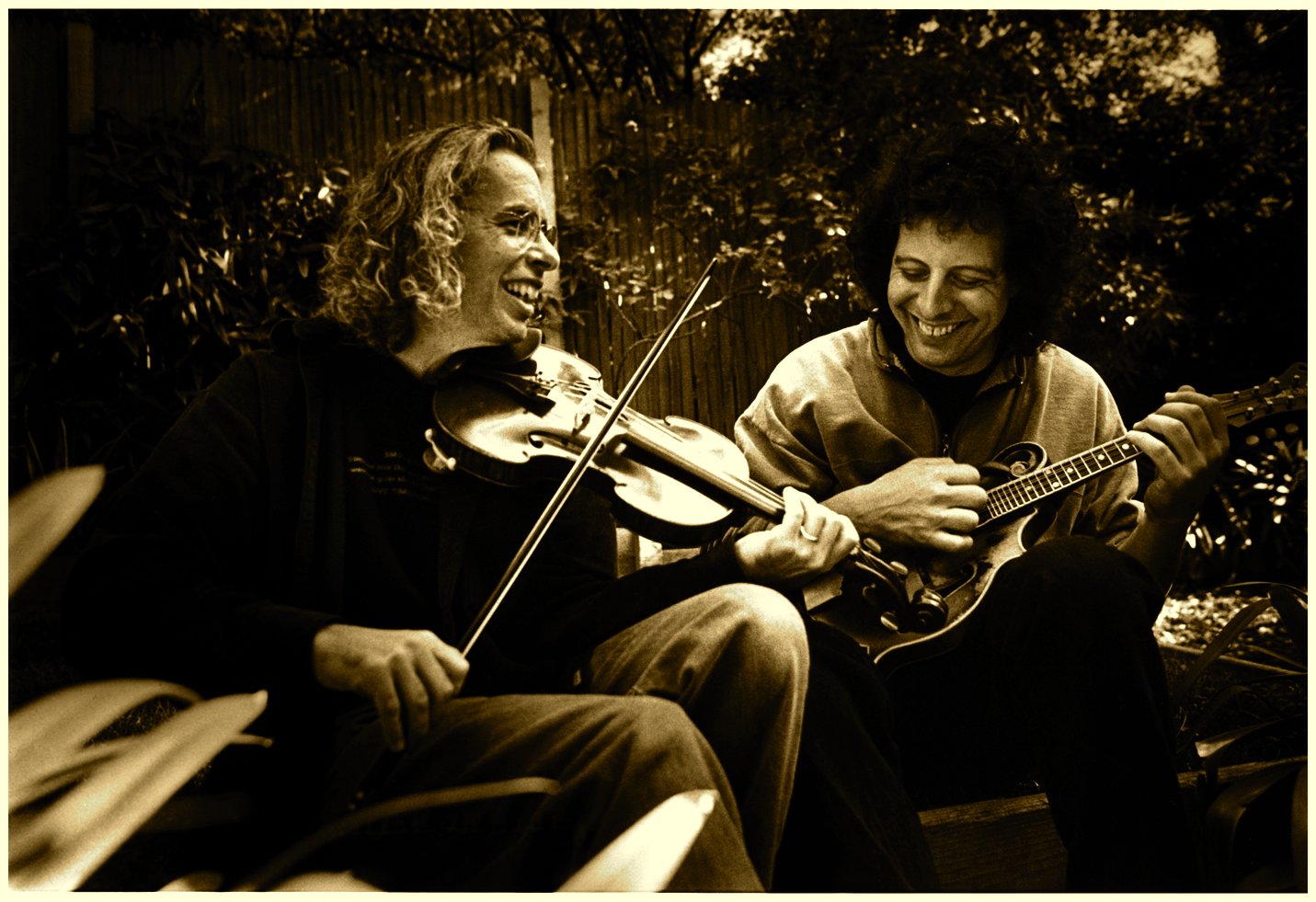
If there were ever two musicians destined to play together, it is Darol Anger and Mike Marshall. Having collaborated for over 30 years, they have something of a psychic connection when it comes to music. They share an aesthetic approach to music, drawing upon a myriad of styles from classical to jazz to rock to bluegrass to world music, and a similar sense of humor and dawged punstery. They anticipate each others' moves. In their hands, mandolin and fiddle become two voices engaged in a dialogue. Though not as deep as Statman, as spacious as Phillips or Wasserman, or as bouncy as Barenberg, they have a grace and comprehensive vision that unites the rests and notes of a hundred different musical whims, drawing them together into a playful and surprising presence. More than anyone besides perhaps David Grisman (and perhaps more than him), they have defined the sound of New Acoustic music. I saw the duo perform with Väsen last summer. Every single person in the audience was a musician. Need I say more?


Darol Anger - Biography by Steve Huey

Violinist Darol Anger has made his mark on new acoustic music with a number of different groups.

From 1975-84, Anger was a key member of new-acoustic pioneers the David Grisman Quintet, whose blend of folk, bluegrass, and jazz virtually defined the new acoustic genre, as well as advancing the harmonic and instrumental frontiers of traditional musics; as a member of the Turtle Island String Quartet in the late '80s and early '90s, Anger also helped bring virtuosic improvisation and boundless eclecticism to what had been an essentially classical, strictly composed musical format. Additionally, Anger co-founded the Montreux Band, a folk- and jazz-influenced group which recorded for Windham Hill in the mid- to late '80s and had an impact on the formation of so-called New Adult Contemporary radio, and with Grisman alumnus Mike Marshall founded the progressive bluegrass outfit Psychograss, which carried on the eclectic Grisman tradition in the 1990s. Again teaming up with Marshall in the late '90s, Anger co-founded the Anger/Marshall Band, which kept him busy into the 2000s alongside his work on the Heritage Folk Music project, his continued appearances with his previous groups, his founding of the American Fiddle Ensemble, and his work as a producer and arranger for other artists.


Mike Marshall - Biography by Craig Harris

Mike Marshall is one of the most innovative players of new instrumental music. Initially rooted in bluegrass, Marshall has consistently explored all the possibilities of his stringed instruments. During the five years (1985-1990) that he was a member of David Grisman's influential Quintet, Marshall toured with Stephane Grappelli, Mark O'Connor, Tony Rice, Bela Fleck, Jerry Douglas and fellow Grisman band member Darol Anger. Following his departure from Grisman's group, Marshall continued to work with fiddler Anger as a duo and, along with pianist Barbara Higbie and bassist Michael Manring, in a folk/chamber music group, Montreux. Marshall and Anger also collaborated, along with bassist Todd Phillips, banjo player Tony Trischka and guitarist David Grier, in a bluegrass/jazz/classical/folk group, Psychograss. Marshall currently leads the Modern Mandolin Quartet and plays Brazilian music with Choro Famoso. Marshall also periodically collaborates with Edgar Meyer, Jerry Douglas, Mark O'Connor and Sam Bush in a bluegrass superband, Strength By Numbers. Marshall has produced numerous albums including recordings by Laurie Lewis, Alison Brown, Jennifer Berezan and Tony Furtado.

A native of Pennsylvania, Marshall grew up in Lakeland, Florida. At the age of 18, he won the Florida state fiddle and mandolin championships. After performing with the Sunshine Bluegrass Boys, Marshall relocated to the West Coast. Soon after working with Grisman on the film score of The King of the Gypsies in 1985, Marshall was invited to join Grisman's Quintet.

Marshall has recorded two solo albums -- 1989's Gator Strut, which spotlighted his jazz-meets-bluegrass approach, and 1997's Brasil: Duets, which focused on the Brazilian influences on his music and featured duets with Edgar Meyer, Michael Manring and Bela Fleck. In 2003, Marshall teamed up with mandolinist Chris Thile to release Into the Cauldron, a fine record of duets between the two exploring everything from classical and traditional music to conteporary numbers written with each other.


Darol Anger - Fiddlistics

Year: 1979
Label: Kaleidoscope F8

Review by Wilson McCloy

Fiddlistics includes an all-star cast of new-grass musicians, and in many ways it is a continuation of the excellent David Grisman Quintet album. In fact, there is a slowed-down version of the composition "Blue Midnight" which first appeared on the innovative Grisman album, and the new-grass suite "Megatones" could easily have been from that session. However, the uniqueness of this album stems from its eclecticism. Anger and mandolin legend Tiny Moore joyfully swing through Charlie Parker's "Moose the Mooche," and Anger takes two duets: one quiet and meditative with pianist Barbara Higbie, and the other a traditional bluegrass romp, at first, which slowly becomes more progressive with George Stavis on banjo. Fans of the David Grisman Quintet, Mike Marshall, Tony Rice, or any of the other participating musicians will not be disappointed because this album is well-worth searching for.

Musicians:
Darol Anger
Tony Rice
David Grisman
Todd Phillips
Mike Marshall
Tiny Moore
Barbara Higbie

Tracks
1 Key Signator
2 Blue Midnight
3 Old Grey Coat
4 Moose the Mooche
5 Ride the Wild Turkey
6 Dysentery Stomp
7 Brann St. Sonata
8 Old Folkies
9 Megatones


Mike Marshall - Gator Strut
Year: 1984
Label: Rounder

Review by Ken Dryden

Mike Marshall is much like Mark O'Connor, a virtuoso on several string instruments, an innovative composer and arranger who refuses to be pigeonholed stylistically, and also an alum of David Grisman's band. Numerous Grisman alumni turn up on this 1984 release, including violinist Darol Anger, bassists Todd Phillips and Rob Wasserman, guitarist Tony Rice, and even Grisman himself, along with dobro player Jerry Douglas, Béla Fleck on banjo, violinist David Balikrishan (who would later co-found the Turtle Island String Quartet with Anger), and pianist Barbara Higbie. Marshall sticks primarily to mandolin on this mostly progressive bluegrass date, though he's also heard on mandola, mandocello, violin, and guitar. Highlights include the funky original "Gator Strut," "Ravel" (a solo effort featuring the leader overdubbed on several instruments while adapting a theme by the French Impressionist composer), a joint arrangement with Anger of John Coltrane's infrequently performed "Giant Hornpipe," and a brilliant interpretation of Thelonious Monk's "'Round Midnight."

Another Review:
In the mood for something a bit unique, random, diverse, spontaneous, and interesting? If so, then check out Mike Marshall’s Gator Strut with Darol Anger and featuring artists like David Grisman on mandolin, Bela Fleck on banjo, and Tony Rice on guitar.

The all-star group travels around music history ranging from classical composers like Ravel and Bach to Jazz masters like Coltrane and Thelonious Monk. They even stop in pop land on one of my all-time favorite Beatles numbers like Because. There are other songs here specifically written by Marshall, who plays mandolin, mandocello, guitar and sometimes violin, while in most cases Darol Anger is on violin or low violin. There are some other talented artists involved as well such as Rob Wasserman on bass, Mike Wollenberg on guitar, Barbara Higbie on synthesizer, Jerry Douglas on dobro, and Todd Philips on bass. With a stack of individuals like this, a vast accompaniment of instruments, and a unique selects of material, this particular recording is unlike any other out there.

Tracks
1 Dance of the Planktons - Marshall - 3:32
2 We Three - Marshall - 4:43
3 Gator Strut - Marshall - 6:07
4 Chief Sitting in the Rain - Traditional - 3:23
5 Assez Vif-Tres Rythme -1:50
6 Giant Hornpipe - Coltrane - 2:41
7 Because - Lennon, McCartney - 2:55
8 Scotch & Swing - Marshall - 3:42
9 Bach Partita No. 3 in E Major for Solo Violin - Public Domain - 4:08
10 Ybor City - Marshall - 3:52
11 'Round Midnight - Hanighen, Monk, Williams - 5:02
12 Gator's Dream - Marshall - 7:37
13 Wake Up - Marshall - 4:01
14 We Three (Reprise) - Marshall - 1:03


Darol Anger & Mike Marshall - The Duo

Year: 1983
Label: Rounder

Review by Linda Kohanov

Violinist Darol Anger and mandolinist Mike Marshall were pioneers of the New Acoustic Music movement, which brought folk, jazz, bluegrass and world music influences together in an instrumental acoustic setting. Here is their groundbreaking 1983 album The Duo, which highlights their virtuosity, creativity and humor in a wide-ranging selection of breathtaking duets. Darol Anger and Mike Marshall were snatched up by Windham Hill soon after this early Rounder release.

Tracks
1 Rotagilla - Anger, Marshall - 3:52
2 Lime Rock - Traditional - 2:20
3 Children's Song #6 - Corea - 2:53
4 Golden Slippers - Traditional - 3:35
5 N.K.F. - Marshall - 4:01
6 Wall of Mando Madness - Marshall - 3:47
7 Donna Lee - Parker - 2:24
8 Free D - Marshall - 4:08
9 Bach Partita #3 in E Major for Solo Violin - Bach - 4:07
10 It's Dark - Anger, Marshall - 5:25
11 Gator's Dream - Marshall - 7:37


May 24, 2010

Kenny Kosek and Matt Glaser - Hasty Lonesome


Boy, once I get started on a theme I can't stop! Especially when it involves newgrass players, because every time I look at one it leads me to another. These guys have been in the scene since the Country Cooking days, and show up on all the other guys' projects (Statman, Trischka, Barenberg, etc.) This next album is on some people's top-10 New Acoustic albums of all time. Very original, very sparkling, very out-of-print. All the names which should be familiar to you by now stop in to lend their wildly imaginative hands to the task of making original acoustic music.

The name Kenny Kosek may seem unfamiliar to you. His is a case of someone whose fiddling has been heard by nearly everyone but his name by only a precious few. But those who've heard his playing beyond his relatively anonymous work for advertising jingles and Broadway musicals know Kosek as one of the core members of a group of New York-based innovators in the area of progressive bluegrass music since the 1970s. Up until now, most of his more prominent recorded legacy has been with the trailblazing bands Breakfast Special and Country Cooking, as well as his out-of-print Rounder LP collaboration with swing fiddler Matt Glaser, Hasty Lonesome.

Kenny Kosek is one of the most recorded fiddlers in America today, having been the feature soloist on hundreds of albums, soundtracks, and jingles. He can be heard on recordings by James Taylor, Jerry Garcia, David Byrne, Chaka Kahn, Willie Nelson, and John Denver. He has been a frequent guest player with the Late Night Band on Late Night with David Letterman. Kenny's distinctive roots music-inspired compositions have been used in the documentaries The Way West, The Donner Party, Harlan County, U.S.A., The High Lonesome Sound, and the Broadway musicals Big River and Foxfire, NBC's Another World, CBS's Guiding Light, and Fox's Kirby Kids. His most recent CD, Angelwood on Rounder Records was called "a lovely piece of work with a strong hint of the spiritual" (David Hinkley, Daily News); "an album that will surprise and delight fans of fiddle music in all its many forms" (Bluegrass Unlimited); and "Kosek's signature sound—a swinging, smooth, and creamy hot rise that is as hard as it rocks, has exponentially enhanced every project he's lent it to" (Village Voice).


Matt Glaser is the only tenured professor of violin in the United States who specializes in jazz, folk and swing instead of classical music. Matt has appeared on over thirty recordings, is the head of the string department at Boston’s Berklee College of Music, and co-authored the book "Jazz Violin" with legendary jazz violinist Stephane Grappelli.

Violinist Matt Glaser tells a Groucho Marx joke one minute and quotes mystic Sufi poet Rumi the next. He’s a dedicated jazz educator and musician, who believes music is capable of expressing every shade of human experience. As the chairman of the string department of Berklee for the last 20 years, Glaser tries to break down musical barriers with the zeal of a missionary every chance he gets. His new album, Shifting Sands of Time (Rounder), with the Wayfaring Strangers, does just that, organically bringing together bluegrass, jazz and klezmer with a surprising combination of musicians and material.

As an educator, Glaser often lectures on seemingly disparate connections between jazz luminaries and visual and literary artists such as Lester Young/Paul Klee/Emily Dickinson or Sonny Rollins/Jackson Pollack/Walt Whitman, exploring similar bents across artistic styles. Glaser is interested in grand themes, something he shares with his friend, film director Ken Burns.

“Jazz by Ken Burns is horribly flawed and great and beautiful at the same time,” says Glaser, who is a featured talking head in the film. During the making of Jazz, Glaser suggested, to no avail, that Burns include 50 additional musicians such as Chick Corea, Cannonball Adderley, Stan Getz, Albert Ayler, Pat Metheny and Freddie Hubbard. “We discussed it, but Ken wanted a narrative thrust telling a few stories. It was not meant to be inclusive, but as an introduction for 37 million Americans to jazz. I’m proud it doubled jazz record sales,” Glaser says, in spite of residual frustration.

As a violinist, Glaser has performed at Carnegie Hall, the Boston Museum of Fine Arts and the White House, but he is most comfortable playing swing tunes with an existential viewpoint.

“Music for the ultimate situation is no longer so abstract. Music has to increase its power to heal; it’s needed now,” says Glaser. He’s drawn to the chanting of the Koran and the Vedas as well as Bach and the traditional “The Wayfaring Stranger.” At home in Cambridge, Mass., he’s listening to Marty Ehrlich’s Soujourn (Tzadik), George Jones’ Cold Hard Truth (Elektra/Asylum) and Joe Lovano’s Trio Fascination (Blue Note). This mix is par for the course for someone who grew up with an opera singer mother (who’s recently enjoying hip-hop) and listened to his father’s extensive jazz collection, and later studied ethnomusicology.

Glaser is a passionate educator. He’s written four books, including Jazz Violin (Oak) with Stephane Grappelli and Jazz Chord Studies for Violin (Berklee Press) with Joe Viola. But he’s more drawn to ideas rather than information. “I don’t have an anti-fact approach, but there are other ways of grasping things—metaphors, analogies and intuition. Ideas can be transformative and toxic.” Paraphrasing Theodore Roszak’s book Cult of Information (University of California Press), Glaser says we live in a world saturated with information, but not ideas. He’s fond of speaking about Louis Armstrong in the same breath as Albert Einstein and quick to find common ground and parallels between artists, eschewing divisiveness, especially in the jazz world. “In light of recent events [just after the terrorist attacks on America] all jazz musicians should feel connected to each other, rather than divided,“ he pleads.

Asked about future plans and dreams, there is no mention of new albums or gigs. Instead he speaks about practicing, learning and growing as a musician. His mission is to glorify musicians of all sorts.

“Music is not about facts; it’s about life, death, human transcendence and beauty.”


Kenny Kosek and Matt Glaser - Hasty Lonesome

Year: 1980
Label: Rounder Records [0127]

Recorded and mixed at Skyline Studios, NYC

Side A:
01 - Hasty Lonesome
02 - Le Chamoix Cornu
03 - K-Town Fling
Side B:
04 - Lonesome Fiddle Blues
05 - Deep Elum Blues
06 - B-Fiddle Medley (The Fiddler, Flies in The Whiskey, Bing Bong The Sailor)
07 - Marx Brothers Medley

Credits:
Bass - Roger Mason (A1,A3,B1, B3) Marty Confurius (A2,B4) Nick Forster (B2)
Guitar - Russ Barenberg (A1,A3,B1,B3) Richard Lieberson (A2,B4) Bill Bachman (A2,B4) Charles Sawtelle (B2)
Mandolin - Andy Statman (A1,A2,A3,B1,B3) Tim O'Brien (B2)
Banjo - Marty Cutler (A1,A2,A3,B1) Tony Trischka (A1,A3,B3) Peter Wernick (B2) Alan Feldman (B3)
Drums - richard Crooks (A2,B1,B4)
Clarinet - Andy Statman (A1)
Electric Guitar - Jon Scholle (B2)
Bodhran - Alice Olwell (B3)