Donate to the Grapevine

Express your thanks by leaving the pirate a tip!
Showing posts with label fruits. Show all posts

April 30, 2011

Akira Kurosawa's Dreams


So. I've been gone a while and you oughtn't expect much from me in the coming month, as I'll be in a cabin away from electricity for most of it. I wanted to start sharing some film on this blog, starting with the old crazy visionaries of the 1900s and working forwards, but this film is just so timely it has to be shared now. It's also, in my opinion, one of the greatest films ever made. 

I really don't have much time to write, but I can say this:
This film is a complete art. It is perfect. It is the essence of cinema.
This film is life. It is dreams. It is the shadow at the corners of your eyes, come to full focus in front of you.
This film destroys time. Or at least, radically disfigures it and rebuilds it from the ground up, in a more fluid, effervescent manner.

This film is a flower in a factory, a golden cow in a field of white teeth.

Let it look through your eyes to the dark grey matter that lurks behind. Let it plant puddles in your eyes.

As people in Japan begin to put their lives back together, people in the States are discovering high levels of radiation in their foods. We all see the causes. We accept them. And the machine grinds on, because we are not willing to leave it.

Enjoy the coming month, dancing in the spring showers, planting a garden, getting up early to embrace the day. Nourish your dreams. And if you have some time, give these ones a look as well. 


The Skinny:
Eight short films with overlapping themes and characters based on the actual dreams of director Akira Kurosawa.

"From just a cinematographic point of view, Kurosawa's mastery of colour is unrivaled, and a sound reason to watch this film, yet not the only one by far. The true value of "Yume", in my opinion, is the use of the parabolas presented disguised as dreams to teach us a way of life. The absurdity of war. The beauty of nature. The need to preserve our environment. In summary: a praise to life. And yet, Kurosawa being old himself when he filmed his "Dreams", looks at death and presents it as the last station of a wonderful journey. Carpe diem, yes, but not to the point of being scared. Life will follow its course as does the river at the end of the movie, with or without us being here to enjoy it. Just be thankful for the small things in life; they are the most important. Enjoy them while you can and you will leave this existence in peace with yourself."


Review by Magicvoice:
Akira Kurosawa's Dreams is comprised of eight short films, each featuring a character named "I," who we are to assume is Kurosawa himself. The film begins with two dreams from Kurosawa's childhood and eventually move into adulthood. One tale, "Crows," expresses Kurosawa's love for the artist Vincent Van Gogh, and is the most questionable of the eight tales. An art student enters the paintings of Van Gogh and meets Van Gogh, played here by American director Martin Scorcese. It's interesting that Kurosawa cast Scorsese to play Van Gogh—perhaps he felt that only another auteur could fully grasp the creative compulsion of Van Gogh. That point is not lost on the viewer, but it still would have been preferable to cast a real actor in the part. Scorsese's New York accent just doesn't fit the film.
     The best segment of Dreams is "The Tunnel," which is directed by an uncredited Ishiro Honda (Godzilla). It tells the tale of a military officer who is confronted by the spirits of his dead platoon. Heartbreakingly, the officer apologizes for his actions, which led to the death of his men. He takes responsiblity instead of simply blaming the stupidity of war—a universal theme that people today could perhaps learn from.
     "Mt. Fuji in Red" and "The Weeping Demon" both deal with nuclear disaster and a post-apocalyptic world. They pretty much hit the viewer over the head with Kurosawa's (and Honda's) views on the destruction of nature and the stupidity of mankind. Since we currently live in an era where world leaders propose to cut down trees in order to avoid forest fires, some people may still need that point to be drilled into them. The last segment shows what would happen if we did things Kurosawa's way. The people in "Village of the Watermills" live at one with nature and are rewarded with health, happiness and long lives that are celebrated upon conclusion. It's the most beautiful dream of all, and a perfect ending to a great film.
     Visually, Akira Kurosawa's Dreams is a masterpiece. The sets, composition and use of color are all breathtaking. The pace of some of the stories is a bit slow, but this is still a great and very underrated film. Dreams is Kurosawa's most personal work, and when it's over the viewer might feel like they've just met the man who delivered this work of art, much like "I" was somehow able to meet Van Gogh in one of his paintings. (Magicvoice 2003)


Dreams

The film consists of several dreams based on Kurosawa's own, throughout his life. The dreams are eight separate segments in the following order:


Sunshine Through The Rain
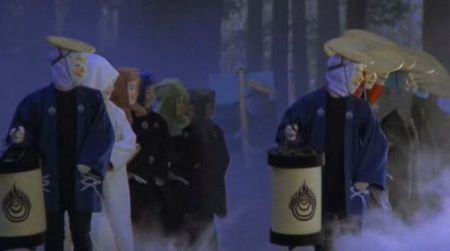
There is an old legend in Japan that states that when the sun is shining through the rain, the kitsune (foxes) have their weddings. In this first dream, a boy defies the wish of a woman, possibly his mother, to remain at home during a day with such weather. From behind a large tree in the nearby forest, he witnesses the slow wedding procession of the kitsune. Unfortunately, he is spotted by the foxes and runs. When he tries to return home, the same woman says that a fox had come by the house, leaving behind a tantō knife. The woman gives the knife to the boy, implying that he must commit suicide. The woman asks the boy to go and beg forgiveness from the foxes, although they are known to be unforgiving, refusing to let him in unless he does so. The boy sets off into the mountains, towards the place under the rainbow in search for the kitsune's home.


The Peach Orchard
Hina Matsuri, the Doll Festival, traditionally takes place in spring when the peach blossoms are in full bloom. The dolls that go on display at this time, they say, are representative of the peach trees and their pink blossoms. One boy's family, however, has chopped down their peach orchard, so the boy feels a sense of loss during this year's festival. After being scolded by his older sister the boy spots a small girl running out the front door. He follows her to the now-treeless orchard, where the dolls from his sister's collection have come to life and are standing before him on the slopes of the orchard. The living dolls, revealing themselves to be the spirits of the peach trees, berate the boy about chopping down the precious trees. But after realizing how much he loved the blossoms, they agree to give him one last glance at the peach trees by way of a slow and beautiful dance to Etenraku. After they disappear the boy finds the small girl walking among the treeless orchard before seeing a single peach tree sprouting in her place.


The Blizzard
A group of four mountaineers struggle up a mountain path during a horrendous blizzard. It has been snowing for three days and the men are dispirited and ready to give up. One by one they stop walking, giving into the snow and sure death. The leader endeavors to push on, but he too, stops in the snow. A strange woman (possibly the Yuki-onna of Japanese myth) appears out of nowhere and attempts to lure the last conscious man to his death - give into the snow and the storm, she urges him on, into reverie, into sleep, into certain death. But finding some heart, deep within, he shakes off his stupor and her entreaties, to discover that the storm has abated, and that their camp is only a few feet away.


The Tunnel
A Japanese army officer is traveling down a deserted road at dusk, on his way back home from fighting in the Second World War. He comes to a large concrete pedestrian tunnel that seems to go on forever into the darkness. Suddenly, an angry, almost demonic-looking anti-tank dog (strapped with explosives) runs out of the tunnel and snarls deeply at him. He proceeds with his walk, afraid, into the tunnel. He comes out the other side, but then witnesses something horrific — the yūrei of one of the soldiers (Private Noguchi) whom he had charge over in the war comes out of the tunnel behind him, his face a light blue, signifying that he is dead.

The soldier seems not to believe he's dead, but the officer convinces him and the soldier returns into the darkness of the tunnel. Just when he thinks he's seen the worst, the officer sees his entire third platoon marching out of the tunnel. They too are dead, with light blue faces. He tries to convince them that they're dead, and he expresses his deep-seated guilt about letting them all die in the war. They stand mute, in reply to his words. He then orders them to about face, and then march back into the tunnel. Lastly, we see a second appearance of the hellish dog, from the beginning of this dream.
This is one of three "nightmares" featured in the film.

Akira Kurosawa's long time friend Ishirō Honda may have helped to direct, or have directed this piece entirely. The two always spoke of filming a story of a dead soldier returning from war.


Crows
A brilliantly-colored vignette featuring director Martin Scorsese as Vincent Van Gogh. An art student (a character wearing Kurosawa's trademark hat who provides the POV for the rest of the film) finds himself inside the vibrant and sometimes chaotic world inside Van Gogh's artwork, where he meets the artist in a field and converses with him. The student loses track of the artist (who is missing an ear and nearing the end of his life) and travels through other works trying to find him. Van Gogh's painting Wheat Field with Crows is an important element in this dream. This Segment features Prelude No. 15 in D-flat major ("Raindrop") by Chopin. The visual effects for this particular segment were provided by George Lucas and his special effects group Industrial Light and Magic.[citation needed]


Mount Fuji in Red
The film's second nightmare sequence. A large nuclear power plant near Mount Fuji has begun to melt down, painting the sky a horrendous red and sending the millions of Japanese citizens desperately fleeing into the ocean. Three adults and two children are left behind on land, but they soon realize that the radiation will kill them anyway.


The Weeping Demon
A man (possibly Kurosawa himself) finds himself wandering around a misty, bleak mountainous terrain. He meets a strange oni-like man, who is actually a mutated human with one horn. The "demon" explains that there had been a nuclear holocaust which resulted in the loss of nature and animals, enormous dandelions and humans sprouting horns, which cause them so much agony that you can hear them howling during the night, but, according to the demon, they can't die, which makes their agony even worse. The last of the three "nightmare" sequences. This is actually a post-apocalyptic retelling of a classic Buddhist fable of the same name.


Village of the Watermills
A young man finds himself entering a peaceful, stream-laden village. The traveller meets an old, wise man who is fixing a broken watermill wheel. The elder explains that the people of his village decided long ago to forsake the polluting influence of modern technology and return to a happier, cleaner era of society. They have chosen spiritual health over convenience, and the traveller is surprised but intrigued by this notion.

At the end of the sequence (and the film), a funeral procession for an old woman takes place in the village, which instead of mourning, the people celebrate joyfully as the proper end to a good life. This segment was filmed at the Daio Wasabi farm in the Nagano Prefecture. The film ends with a haunting yet melancholic melody from the excerpts of "In the Village" , part of the Caucasian Sketches, Suite No. 1 by the Russian composer Mikhail Ippolitov-Ivanov.


Year: 1990
Director: Akira Kurosawa, Ishiro Honda
Time: 120min
Released by: Warner Bros.


March 25, 2011

Végh Quartet - Bartók: The Complete String Quartets


In honor of his 130th birthday, I thought we ought to pay some heed to the music of Béla Bartók. Now for those of you who like bluegrass and John Fahey and don't think you like modern classical music, consider this:
  1. John Fahey's compositional sense was guided by the desire to try to do with American folk music what Bartók did with Hungarian folk music. Bartók was as great an influence on Fahey as was Charley Patton.
  2. Béla Fleck was named after Béla Bartók.
  3. This is damn good music, whatever the genre.
Now, secondly, I want you to look at this photo of our man. Look at his eyes. Tell me, does he not burn with the fires of inspiration? Does he not look as crazy, intense, and twisted as Skip James?


Well?
I thought so.

Just remember. As the magic of the blues, Celtic music, and Indian Classical music relies on being in neither a major or minor scale, the music of Bartók derives its particular magic from being both harmonious and discordant, at the same time. If his music was a church (and in some ways it is), half the choir would be singing hallelujah together, while the other half shouted "I AM THE GOAT-HORNED DANCING BOY!"

Amen.


Autobiography written by Béla Bartók in 1921.

I was born on March 25, 1881, in a small place called Nagyszentmiklós, which now, together with the whole county of Torontal, belongs to Rumania. My mother gave me my first piano lessons when I was six years old. My father, who was the head of an agricultural school, was gifted musically and active in many directions. He played the piano, organized an amateur orchestra, learned the cello in order to play that instrument in his orchestra, and composed some dance music. I was eight years old when I lost him. After his death my mother had to work as a schoolmistress and struggle hard for our daily bread. We first went to live at Nagyszöllõs (at present Czechoslovak territory), then to Beszterce in Transylvania (at present Rumanian territory) and in 1893 to Pozsony (Bratislava, at present Czechoslovak territory). I began writing piano music when I was nine years old and made my first public appearance as a “composer” and pianist at Nagyszöllõs in 1891 ; it was therefore a matter of some importance for us to settle at last in a biggish town. Among Hungarian country towns at that time it was Pozsony that had the most vigorous musical life, and by moving there I was given the possibility of having lessons in piano and composition with László Erkel (Ferenc Erkel’s son) and also of hearing a few operas, more or less well performed, and orchestral concerts. I had the opportunity, too, of playing chamber-music, and before I was eighteen I had acquired a fairly thorough knowledge of music from Bach to Brahms (though in Wagner’s work I did not get further than Tannhäuser). All this time I was also busy composing and was under the strong influence of Brahms and Dohnányi (who was four years my senior). Especially Dohnányi’s youthful Opus I influenced me deeply.

When my education at the Gymnasium (high school) was concluded the question arose at which musical academy I should continue my studies. In Pozsony, at that time, the Vienna Conservatorium was considered the sole bastion of serious musical education, but I took Dohnányi’s advice and came to Budapest and became a pupil of István Thomán (in piano) and of Hans Koessler (in composition). I stayed here from 1899 till 1903. I started studying with great enthusiasm Wagner’s work, till then unknown to me – The Ring, Tristan, The Mastersingers – and Liszt’s orchestral compositions. I got rid of the Brahmsian style, but did not succeed via Wagner and Liszt, in finding the new way so ardently desired. (I did not at that time grasp Liszt’s true significance for the development of modern music and only saw the technical brilliance of his compositions.) I did no independent work for two years, and at the Academy of Music was considered only as a first-class pianist.

From this stagnation I was roused as by a lightning stroke by the first performance in Budapest of Thus Spake Zarathustra, in 1902. The work was received with real abhorrence in musical circles here, but it filled me with the greatest enthusiasm. At last there was a way of composing which seemed to hold the seeds of a new life. At once I threw myself into the study of all Strauss’s score and began again to write music myself. Other circumstances entered my life at the same time which proved a decisive influence on my development. It was the time of a new national movement in Hungary, which also took hold of art and music. In music, too, the aim was set to create something specifically Hungarian. When this movement reached me, it drew my attention to studying Hungarian folk music, or, to be more exact, what at that time was considered Hungarian folk music.

Under these diverse influences I composed in 1903 a symphonic poem entitled Kossuth, which was at once accepted for performance by János Richter, and was performed in Manchester in February 1904. Other compositions of the same period are a Violin Sonata and a piano Quintet. The former was performed by Rudolf Fitzner in Vienna, the latter by the Prill Quartet. These three works remain unpublished. In 1904 I composed my Rhapsody for piano and Orchestra (Opus I), which I entered for the Rubinstein competition in Paris but without success. In 1905 I wrote my first Suite for Large Orchestra.

Meanwhile the magic of Richard Strauss had evaporated. A really thorough study of Liszt’s --uvre, especially of some of his less well known works, like Années de Pélerinage, Harmonies Poétiques et religieuses, the Faust Symphony, Totentanz, and others had after being stripped of their mere external brilliance which I did not like, revealed to me the true essence of composing. I began to understand the significance of the composer’s work. For the future development of music his --uvre seemed to me of far greater importance than that of Strauss or even Wagner.

In my studies of folk music I discovered that what we had known as Hungarian folk songs till then were more or less trivial songs by popular composers and did not contain much that was valuable. I felt an urge to go deeper into this question and set out in 1905 to collect and study Hungarian peasant music unknown until then. It was my great good luck to find a helpmate for this work in Zoltán Kodály, who, owing to his deep insight and sound judgment in all spheres of music, could give me many a hint and much advice that proved of immense value. I started these investigations on entirely musical grounds and pursued them in areas which linguistically were purely Hungarian. Later on I became fascinated by the scientific implications of my musical material and extended my work over territories which were linguistically Slovakian and Rumanian.

The outcome of these studies was of decisive influence upon my work, because it freed me from the tyrannical rule of the major and minor keys. The greater part of the collected treasure, and the more valuable part, was in old ecclesiastical or old Greek modes, or based on more primitive (pentatonic) scales, and the melodies were full of most free and varied rhythmic phrases and changes of tempi, played both rubato and giusto. It became clear to me that the old modes, which had been forgotten in our music, had lost nothing of their vigour. Their new employment made new rhythmic combinations possible. This new way of using the diatonic scale brought freedom from the rigid use of the major and minor keys, and eventually led to a new conception of the chromatic scale, every tone of which came to be considered of equal value and could be used freely and independently.

When an appointment to the chair of piano teaching at the Academy of Music in Budapest was offered to me in 1907 I considered this a happy event because it enabled me to settle in Hungary and to continue my studies in musical folklore. In 1907, at the instigation of Kodály, I became acquainted with Debussy’s work, studied it through thoroughly and was greatly surprised to find in his work “pentatonic phrases” similar in character to those contained in our peasant music. I was sure these could be attributed to influences of folk music from Eastern Europe, very likely from Russia. Similar influences can be traced in Igor Stravinsky’s work. It seems therefore that, in our age, modern music has developed along similar lines in countries geographically far away from each other. It has become rejuvenated under the influence of kind of peasant music that has remained untouched by the musical creations of the last centuries. My works which, from Opus 4 onward, tried to convey something of the development just described were received in Budapest with animosity.

This lack of understanding had many reasons, one of which was the inadequacy of the performances in which our new orchestral works were heard. We could find neither a conductor who would understand our works nor an orchestra able to perform them. In 1911, when these controversies became very heated, a number of young musicians, Kodály and myself among them, tried hard to found a New Hungarian Musical Society. The chief aim of the new organization would have been to form an orchestra able to perform old, new and recent music in a proper way. But we strove in vain, we could not achieve our aim.

Other more personal disappointments were added to this broken plan and in 1912 I retired completely from public life. With more enthusiasm than ever I devoted myself to studies in musical folklore. More than one daring journey to faraway countries was planned in my head, out of which, as a modest beginning, one only was carried out. In 1913 I travelled to Biskra [Algeria] and the surrounding countryside, collecting Arabic folk music. Then came the outbreak of the war, which - apart from general human considerations - hit me very hard because it put an end to my work. Only a small part of Hungary remained open to my studies and I worked there under hampered conditions till 1918.
The years 1917 marked a turning point in Budapest’s audience attitude about my works. I had the chance to hear my ballet The Wooden Prince, brilliantly performed by the master Egisto Tango who, in 1918, conducted also the performance of my opera in one act, written in 1911 : The Bluebeard’s Castle

This auspicious turning point was unfortunately followed by the political and economical collapse of 1918 autumn. The period of unrest that followed and lasted about 18 months didn’t allows to work seriously.

Even the current situation doesn’t allow to think about the resumption of the works related to folk music. We can’t afford this luxury ; on the other hand, the scientific exploration of territory detached from Hungary is almost impossible for political reasons and because of mutual hostility. As for to visit faraway countries, it’s an unrealisable dream.

Besides, no real interest appears in the world for this branch of musicology. Who know ? Maybe it hasn’t the importance that these fanatics assign to it.


Béla Bartók - Biography
by Michael Rodman
Through his far-reaching endeavors as composer, performer, educator, and ethnomusicolgist, Béla Bartók emerged as one of the most forceful and influential musical personalities of the twentieth century. Born in Nagyszentmiklós, Hungary (now Romania), on March 25, 1881, Bartók began his musical training with piano studies at the age of five, foreshadowing his lifelong affinity for the instrument. Following his graduation from the Royal Academy of Music in 1901 and the composition of his first mature works -- most notably, the symphonic poem Kossuth (1903) -- Bartók embarked on one of the classic field studies in the history of ethnomusicology. With fellow countryman and composer Zoltán Kodály, he traveled throughout Hungary and neighboring countries, collecting thousands of authentic folk songs. Bartók's immersion in this music lasted for decades, and the intricacies he discovered therein, from plangent modality to fiercely aggressive rhythms, exerted a potent influence on his own musical language.

In addition to his compositional activities and folk music research, Bartók's career unfolded amid a bustling schedule of teaching and performing. The great success he enjoyed as a concert artist in the 1920s was offset somewhat by difficulties that arose from the tenuous political atmosphere in Hungary, a situation exacerbated by the composer's frank manner. As the specter of fascism in Europe in the 1930s grew ever more sinister, he refused to play in Germany and banned radio broadcasts of his music there and in Italy. A concert in Budapest on October 8, 1940, was the composer's farewell to the country which had provided him so much inspiration and yet caused him so much grief. Days later, Bartók and his wife set sail for America.

In his final years Bartók was beleaguered by poor health. Though his prospects seemed sunnier in the final year of his life, his last great hope -- to return to Hungary -- was dashed in the aftermath of World War II. He died of leukemia in New York on September 26, 1945. The composer's legacy included a number of ambitious but unrealized projects, including a Seventh String Quartet; two major works, the Viola Concerto and the Piano Concerto No. 3, were completed from Bartók's in-progress scores and sketches by his pupil, Tibor Serly.

From its roots in the music he performed as a pianist -- Mozart, Beethoven, Chopin, Brahms -- Bartók's own style evolved through several stages into one of the most distinctive and influential musical idioms of the first half of the twentieth century. The complete assimilation of elements from varied sources -- the Classical masters, contemporaries like Debussy, folk songs -- is one of the signal traits of Bartók's music. The polychromatic orchestral textures of Richard Strauss had an immediate and long-lasting effect upon Bartók's own instrumental sense, evidenced in masterpieces such as Music for Strings, Percussion, and Celesta (1936) and the Concerto for Orchestra (1945). Bartók demonstrated an especial concern with form in his exploitation and refinement of devices like palindromes, arches, and proportions based on the "golden section." Perhaps above all other elements, though, it is the ingenious application of rhythm that gives Bartók's music its keen edge. Inspired by the folk music he loved, Bartók infused his works with asymmetrical, sometimes driving, often savage, rhythms, which supply violent propulsion to works such as Allegro barbaro (1911) and the Sonata for Two Pianos and Percussion (1937). If a single example from Bartók's catalogue can be regarded as representative, it is certainly the piano collection Mikrokosmos (1926-1939), originally intended as a progressive keyboard primer for the composer's son, Peter. These six volumes, comprising 153 pieces, remain valuable not only as a pedagogical tool but as an exhaustive glossary of the techniques -- melodic, harmonic, rhythmic, formal -- that provided a vessel for Bartók's extraordinary musical personality.


Végh Quartet - Biography
by Robert Cummings
The Végh Quartet was not only one of the finest string quartets from mid-twentieth century Europe, but its style was never subjected to radical change over the years from personnel changes because the four original players remained members for 38 of the 40 years of the ensemble's existence. Its style evolved in subtle ways, of course, but its essential character endured until 1978: the quartet was Central European in its sound, with a bit more prominence given to the cello in order to build tonal qualities from the bottom upward. The Végh Quartet was best known for its cycles -- two each -- of the Beethoven and Bartók quartets. It also performed and recorded many of the Haydn quartets, as well as numerous other staples of the repertory by Mozart, Schumann, Brahms, and Debussy. For a group that disbanded in 1980, its recordings are still quite popular, with major efforts available in varied reissues from Music & Arts, Archipel, Naïve, and Orfeo.

The Végh Quartet was founded in 1940 by its eponymic first violinist Sándor Végh. The other original members were Sándor Zöldy (second violin), Georges Janzer (viola), and Paul Szabó (cello). The war years were hardly productive for the group, but in 1946 the Végh players settled in France and launched their international career. Soon they were making regular concert tours across the globe with great critical acclaim, and their first major recordings appeared in the early '50s: six quartets by Mozart (K. 387, 421, 458, 464, 575, and 590) in 1951-1952 on the André Charlin label and the complete Beethoven quartets in 1952 on the Les Discophiles Français label. The complete Bartók quartets came in 1954 on EMI and met with the same critical success.

The ensemble's reputation flourished in the 1960s and '70s, even though Sándor Végh had developed a parallel conducting career and had always been active as a music teacher, first in Switzerland, then in Germany and Austria. The group continued making international tours and issued numerous successful recordings during this period, including remakes of the Beethoven quartets (1972-1974, on Auvidis/Valois) and the Bartók six (1972, on Astrée). In 1978 Zöldy and Janzer left the group and were replaced by violinist Philipp Naegele and violist Bruno Giuranna. Végh himself took up a conducting post that same year in Salzburg with the Salzburg Camerata Academica. The group disbanded two years later.


Végh Quartet - Bartók: Complete String Quartets

Year: 1997 (released); 1972 (recorded)
Label: Valois

Tracks:
Disc: 1
1. String Quartet No. 1 in A minor, Sz. 40, BB 52 (Op. 7)
2. String Quartet No. 2 in A minor, Sz. 67, BB 75 (Op. 17): I. Moderato
3. String Quartet No. 2 in A minor, Sz. 67, BB 75 (Op. 17): II. Allegro molto capriccioso
4. String Quartet No. 2 in A minor, Sz. 67, BB 75 (Op. 17): III. Lento

Disc: 2
1. String Quartet No. 3 in C sharp major, Sz. 85, BB 93
2. String Quartet No. 4 in C major, Sz. 91, BB 95: I. Allegro
3. String Quartet No. 4 in C major, Sz. 91, BB 95: II. Prestissimo, con sordino
4. String Quartet No. 4 in C major, Sz. 91, BB 95: III. Non troppo lento
5. String Quartet No. 4 in C major, Sz. 91, BB 95: IV. Allegretto pizzicato
6. String Quartet No. 4 in C major, Sz. 91, BB 95: V. Allegro molto

Disc: 3
1. String Quartet No. 5 in B flat major, Sz. 102, BB 110: I. Allegro
2. String Quartet No. 5 in B flat major, Sz. 102, BB 110: II. Adagio molto
3. String Quartet No. 5 in B flat major, Sz. 102, BB 110: III. Scherzo
4. String Quartet No. 5 in B flat major, Sz. 102, BB 110: IV. Andante
5. String Quartet No. 5 in B flat major, Sz. 102, BB 110: V. Finale
6. String Quartet No. 6 in D major, Sz. 114, BB 119: I. Mesto - Piu mosso, pesante - Vivace
7. String Quartet No. 6 in D major, Sz. 114, BB 119: II. Mesto - Marcia
8. String Quartet No. 6 in D major, Sz. 114, BB 119: III. Mesto - Burletta
9. String Quartet No. 6 in D major, Sz. 114, BB 119: IV. Mesto

You can also get some free downloads from banjoist Jake Schepps' upcoming Bartók album here: jakeschepps.bandcamp.com.

March 21, 2011

Tomoko Sunazaki - Tegoto: Japanese Koto Music


Japan has been on our minds.
Since I've been on a theme of music from the far-east recently, I ought to continue it with a few albums of Japanese music. This is a really beautiful, quite accessible album, totally recommended if you have been interested by any of the Chinese & Vietnamese stuff that I've posted. Though of course it's different too. Sonically, it is like a cat prancing from roof to slanted roof in the middle of a rainstorm. Emotionally it runs the gamut from serenely delicate to luscious and wet to stark and cold. Apart from one flute duet, it's mostly solo Koto, which is just fantastic for cordophiles like myself. Listen to this music at night, and then go take a midnight walk and smell the plum and cheery trees coming into blossom. There is a full gleaming moon in this music, I promise you.


Tomoko Sunazaki - Tegoto: Japanese Koto Music

Year: 1996
Label: Fortuna

Product Description
This splendid collection of recordings covers a wide spectrum of Japanese koto music; the compositions span three centuries, from ancient traditional to modern Western influenced pieces. Undoubtedly, the most impressive element of the releases is the artist herself, the world renowned Tomoko Sunazaki. She is internationally recognized as a master of the Japanese koto. From the age of six, Sunazaki was trained in the direct lineage of the famous koto performer and composer, Michio Miyagi. At the age of 14, she had already earned her teacher's license in koto from the Ikuta School. Later she earned her Bachelor and Master degrees at the Tokyo University of Fine Art, and subsequently joined the faculty there. In 1981, Madame Sunazaki was awarded a teaching degree from the Miyagi Koto school, which is a rare honor.
Michio Miyagi's works are an integral part of each of the releases in this collection, performed with respect and devotion. Miyagi was one of the first to integrate Western inspiration into koto music, an aspect Madame Sunazaki found especially important. By recording traditional Japanese music, Western classics, and the delicate blend of both, she hoped to expand the perceived limitations of the koto.

Drawing from Sound of Silk Strings (1984), Spring Night (1984) and Moon at Dawn (1986) this compilation CD presents a delicious sampling of Sunuzaki's most elegant and most exciting performances.

Special note should be taken of the beautiful release Tegoto: Japanese Koto Music. From the stunning rice paper booklet to the choice of titles, this compilation is clearly an artistic masterpiece. This sampling of Madame Sunazaki's most elegant and exciting performances is the perfect choice for the audiophile interested in koto music.


Review by Backroads Music/Heartbeats
This 60-minute CD-only release is a compilation from Mme. Sunazaki's tapes, plus one cut from Moon at Dawn (her duet with M. Koga). Ms. Sunazaki is a master of the koto, and the music is graceful and serene.

Tracks
1 Sea of Spring - Miyagi - 6:56
2 London No Yoru No Ame [London in a Rainy Night] - Miyagi - 3:51
3 Shinsencho Bukyoku - Yuize - 9:37
4 Koto Tanshishu - Miki - 9:53
5 Tegoto - Miyagi - 12:26
6 Mittsu No Dansho - Nakanoshima, Nakonoshima - 9:08
7 Kamimu - Sunazaki, Yamamoto - 8:05
8 Midare - Kengyo, Sunazaki - 7:48

* out-of-print


February 20, 2011

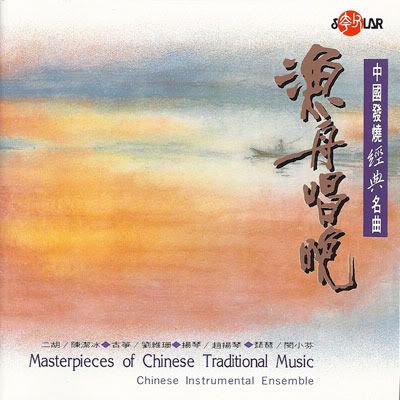
Chinese Instrumental Ensemble - Masterpieces Of Chinese Traditional Music


And while we're deep in the orient, here's a great instrumental album from China. While previously I've posted some solo records, here is a full-on ensemble piece that swells and booms and crashes and caresses like a chorus of waves. The music is a journey of splendor, repose, and yearning.

Though holding strong to the Chinese tradition, it draws upon a few western elements (like the Cello), and should prove much more accessible to western ears than, say, Chinese opera. The ehr-hu player, Jie-Bing Chen, released an album with Béla Fleck and V.M. Bhatt a few years back, called 'Tabula Rasa', which is fantastic. She's top class, and the rest of the musicians are too. Give it a try? 


Image

Chinese Instrumental Ensemble - Masterpieces Of Chinese Traditional Music

Year: 1994
Label: Wind

There are not enough words to describe the exquisite joy in the heartbreakingly beautiful music on Masterpieces of Chinese Traditional Music. Loving care was put into the recording and performances on every track. The blending of traditional Chinese instruments such as the erzu and the guzheng will transport you to a lush moss garden, even if you're stuck in a traffic jam. This is healing music, plain and simple. ~ Tim Sheridan

engineered by Kavichandran Alexander using the warm tones of vacuum tube and analog equipment and the unique acoustics of an old church in Santa Barabara, CA to preserve the richness of this ancient music 

Recording information: Christ the King Chapel, St. Anthony Seminary, Santa Bar.

Arrangers: Guo-Hui Ye; Xiao-Gu Zhu.

Personnel: Min Xiao-Fen (pipa); Jie-Bing Chen (erhu); Bei Chen (cello); Yang-Qin Zhao (yang-chin).

Tracks:
1. Dancing Song of the Yao Tribe - Traditional - 8:16
2. The Moon Over Wall Gate in Frontier - Traditional - 6:31
3. The Moon Is High in the Heavens - Traditional - 12:17
4. Parting at Yang Guan - Traditional - 5:28
5. Spring Rivers and Flowers Under the Moonlight - Traditional - 9:53
6. Melodies From the Night Fishermen - Traditional - 7:54
7. A Legendary Couple: Scholar Liang and Lady Chou - Traditional - 13:56

February 19, 2011

Vietnam - Instrumental Textures


Hm. How can I describe this music? It sounds so unlike anything ever conceived by western ears. And yet there are so many parallels in the realm of feeling and pure sound. The Đàn tranh (long zither) sounds like a slide guitar played by aliens. And the music is pentatonic, melancholy, and wistful like the blues. But it is also striding, triumphant, and exuberant like ragtime. It paints pictures and builds to climaxes like western classical music (both romantic and impressionistic), and bouncing like the best of folk music. 

But really, descriptions do nothing if they cannot bring you to a place of open-mindedness, to hear this music freshly, with innocent ears. Please, listen to these sublime sounds and allow yourself to be transported to another realm.  

Image

Vietnam - Instrumental Textures
performed by the “SONG OF THE NATIVE LAND” ENSEMBLE 

Year: 1996
Label: JVC

Tracks:
01 doc tau dan tranh “Tu Dai Oan”solo:17 string zither “Four Generations” 

02 doc tau dan bau “Ru Con”(dan ca Nam Bo)solo: monochord “Lullaby of the South” 

03 doc tau dan nhi “Se Chi Luon Kim”(dan ca quan ho Bac Ninh)solo:2 string fiddle“Love Song”(folksong from Bac Ninh Province) 

04 song tau dan tranh va dan bau “Doan Khue Lam Giang va Vong Co” duo: 17 string zither & monochord“River Lam and Reminiscence” 

05 doc tau dan nhi voi hoa tau “Phien Cho Mua Xuan” solo:2 string fiddle with ensemble“The Market in Spring” 

06 doc tau sao truc voi hoa tau “Le Hoi Non Song” solo:bamboo flute with ensemble 

07 hoa tau nhac thinh phong mien Trung “Luu Thuy,Kim Tien,Xuan Phong, Long Ho” ensemble in a Central Vietnamese style “Flowing Water, Golden Sapeke, Spring Wind, Dragon & Tiger” 

08 doc tau dan t'rung voi hoa tau“Mua Hai Qua”solo:vertical bamboo xylophone with ensemble“Season for Picking Fruit” 

09 song tau sao va dan t'rung “Buoi Sang Tien Nuong” duo:bamboo flute and xylophone “Morning on the Terraced Fields” 

10 hoa tau“Ly Ngua O” ensemble“Song of the Black-haired Horse” 

11 doc tau dan tranh “Sakura”(dan ca Nhat) solo:22 string zither “Sakura”(variations on a song from Japan)


* out-of-print

February 15, 2011

Rene Heredia - Alborada Flamenca


Scalding flamenco from one of Sabicas' students.

“The guitar playing of René Heredia is in the finest tradition of flamenco, creating a flaming intensity that cannot fail to arouse.”  —Denver Post

“If any musician on the local Denver scene deserves the moniker of legend, it would have to be René Heredia. Simply put, the man is a living history of the art of Gypsy flamenco guitar. He is both a link to its glorious past through his early association with legendary greats such as Carlos Montoya and Sabicas, and a bridge to its future through his love of teaching and performance…. René Heredia is an artist who is as passionate about the music as the music is itself…. René is a local artist of international stature … without a doubt, one of the greatest proponents of flamenco guitar music alive today….” —Classically Speaking, Music for All

“René Heredia is the most sensational young flamenco guitarist in the United States.” —Sabicas

“The audience wouldn’t let him quit.” —Los Angeles Times

“René Heredia is a brilliant guitarist.” —Walter Terry, New York Saturday Review

René with Sabicas
René and his Flamenco guitar have been together for so many years of his lifetime that there seems to be no separation of the two.  He formed a bond with the guitar as a child.  His life, his character, his loves and aspirations have all developed through the instrument.

He began his training with his father, a Gitano Puro (pure Gypsy).  As a boy, René was taught the rudiments of Flamenco Guitar and Spanish Gypsy Dance.  He brings a unique view of both sides of the art form to his audience. 

As a little boy, René remembers always having the house full of flamencos such as Carlos Montoya, Vicente Escudero, Mario Escudero, José Greco’s dance Company, Carmen Amaya, Sabicas, La Chunga and her Company.  They were\all close friends of José Heredia and his family.  Sabicas would help and teach René the secrets of Flamenco at his mother’s kitchen table.

At thirteen, he was performing with his sisters, Fátima, Sarita, Zoraida, Carmen, and brother Enrique.  “Los Heredia” were doing concerts, television shows and supper club performances.  His international recognition came when he was seventeen and the incomparable Flamenco dancer Carmen Amaya (Spain’s greatest dancer of this century) heard him play.  She immediately took him to be her lead guitarist.  He toured many years doing concerts in the major capitals of Europe and the United States with the famous Amaya Ballet.  While he was in Spain, René was invited to perform with the singing and motion picture star Antoñita Moreno, in “Los Reinos de España”.  He was then invited to perform in the Festival de Cante Grande with Fosforito, Jarrito, Juanito Varea, Chocolate, and Gordito de Triana; some of Spain’s most outstanding singers.  As his reputation grew, the famous Spanish dancer José Greco invited him to be his lead guitarist for several seasons.  René has played for such outstanding dancers as El Güito, Mario Maya, Los Pelaos, Manuela Vargas, Luisita Triana, María Rosa, Ciros, Rosa Montoya, Lutys de Luz, María Benitez, Los Heredia, and many more.

While living in Paris, René’s distinguished L.P. album, Alborada Flamenca, was awarded the Gran Prix de Disque of France.  In the United States, René was invited to perform the world premiere of his symphony composition and Flamenco suite for Guitar and Orchestra “Alborada Gitana”(a Farruca), which he performed with the Denver Symphony and Denver Chamber Orchestra at Red Rocks Amphitheater.

René has performed live concerts and T.V. shows with his Flamenco Fusion Group and his Flamenco Fantasy Dance Theatre.  He performed solo concerts at such prestigious venues as New York’s Carnegie Recital Hall four years in a row, where he received standing ovations; the Champs Elysee Theatre in Paris; Westminster Theatre in London; Teatro Barcelona; Teatro La Zarzuela and Teatro Maravilla in Madrid, Spain; and the Dorothy Chandler Pavilion and Greek Theatre in Los Angeles.


René has performed concerts with his Flamenco Fantasy Dance Theatre in Kansas City, where he was awarded the “Keys to the City”  (sister city of Seville, Spain).  He was recognized as one of Colorado’s best-known composers in a special tribute to Colorado artists at the Kennedy Center in Washington, D.C.

René was awarded the prestigious Governor’s Award of Colorado for excellence in performance and education, as well as the Mayor’s Award of Denver for excellence in the arts.  He has done command performances for such dignitaries as Prince Rainier and Princess Grace of Monaco, Armand Hammer, Prince Bandar of Saudi Arabia, Queen Noor of Jordan, and Presidents Gerald Ford and Jimmy Carter.

René was invited to be the lead guitarist and guest artist with Stewart Copeland, founder of “The Police” in his national tour of the U.S.A. in “The Rhythmatists”.  René was invited by Colorado Performing Arts Center to be the musical director for the play “Romeo and Juliet” (set to early colonial California).

René has appeared on numerous national radio and television shows, including The Ed Sullivan Show with Duke Ellington, The Steve Allen Show with Sabicas, and The Art Linkletter Show with Donald O’Connor and Abbie Laine, The George Goble and Eddie Fisher Show with Carmen Amaya, and The Ann Southern Show with César Romero.  René appeared in the Spanish Movie “Balcón de Luna” with Paquita Rico, Carmen Sevilla, and Lola Flores.  His N.E.T. concert specials and opening acts for such outstanding artists as Bill Cosby, Hal Linden, and Peter Nero have put René in the forefront as one of the leading Flamenco Guitarists in the United States today.   


Rene Heredia - Alborada Flamenca
Label: Gypsy Productions, Inc.


*out-of-print & impossible to find


February 14, 2011

Pete Sutherland - Poor Man's Dream


Not much to say about this one, it's just a fine bit o' music. Flying Fish had a way of recording these albums that make you feel like you're sitting on a back porch with friends, even when the music is coming from all over the world. Sweet fiddle music and good times...

Raised on a diet of Broadway show tunes,operatic arias and British invasion melodies, Pete Sutherland discovered both traditional music and songwriting in college and like Huck Finn "lit out for the territories". A warm-voiced singer and multi-instrumentalist known equally for his potent originals and intense recreations and ago old ballads and fiddle tunes, his performances "cover the map" and "…shine with a pure spirit, which infuses every bit of his music and cannot fail to move all who hear him". The American Festival of Fiddle Tunes
Bio:
The old timey dance music of the American southern mountains, New England and the Celtic isles are resurrected through the playing of multi-instrumentalist Pete Sutherland. A former member, along with hammer dulcimer player Malcolm Dalglish and guitarist Grey Larsen, of mid-1980s folk trio, Metamora, Sutherland has continued to expand string band traditions as a member of The Clayfoot Strutters and Mac Benford's Woodshed All Stars. Sutherland has also recorded as a soloist and with his wife, Karen. 

Sutherland's earliest musical memories reflect the opera and musical theater albums favored by his parents. Although he played with several teenage rock bands, he most enduring musical outlet has come through traditional folk music. Inspired by Vermont-based fiddler Louie Beaudoin and Appalachian fiddlers Tommy Jarrell and Ed Haley, Sutherland began performing with the Arm & Hammer String Band in 1973. Moving to Burlington, Indiana in the early-1980s, he helped to form Metamora. Together with the band, Sutherland recorded six albums including the score of the Disney film, "Tuck Everlasting." 

"Poor Man's Dream," Sutherland's debut solo album, was released in 1984 and combined traditional fiddle tunes with original material. Shortly after the disbanding of Metamora, in 1989, Sutherland returned to his home state where he currently lives. Craig Harris, Rovi


Pete Sutherland - Poor Man's Dream

Year: 1984
Label: Flying Fish

Originally issued as an LP on the long-gone Flying Fish label, this 1984 recording of original and traditional songs and tunes produced by Metamora bandmate Grey Larsen has been repeatedly called a "folk classic" - featuring "Aunt Sue" and "Shacks and Chalets".

Tracks:
01 Coal Black Morning
02 The Apple Picker's Waltz - The Beautiful Lights of Burlington
03 Leather Britches
04 Coleman's March - Shacks and Chalets
05 Inch Along
06 Aunt Sue - Motleigh - Stone's Throw
07 You Were the One Who Loved Me
08 Guide Me, O Thou Great Jehovah
09 Mad River - Poor Man' Dream


February 13, 2011

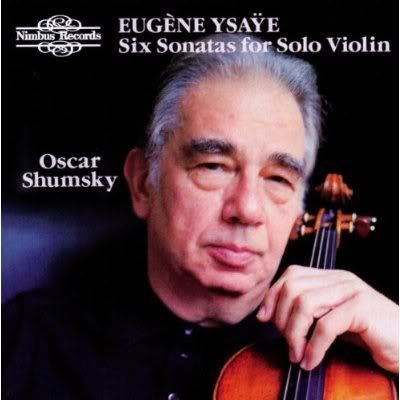
Oscar Shumsky - Eugène Ysaÿe: 6 Sonatas for Solo Violin


Another solo violin masterpiece! Just as good as Andrew Manze playing Tartini, but in a totally different way. It gets back into a corner and stares you in the eye like it will kill you, and then it takes off on unexpectedly gracious flights of fancy through the starbound firmament, only to return, perching on your rooftop, peering back at you expectantly. This music is ruthless in its beauty. It takes no prisoners, and will settle for nothing less than its ultimate prize: structured emptiness. Because that is what you are left with after listening to the 6 sonatas here - you are left with a very neat and tidy chest of lost memories and hungry ghosts. And with the sense that the violin is a white monster on the prowl, keeping just outside the confines of your ears' horizon.


Eugène Ysaÿe - Biography
by Edward Moore
Eugène Ysaÿe was one of the greatest violinists who ever lived. He coupled beauty of tone and remarkable technical ability with a depth of musical expression that few violinists before or since can be said to have equalled, or even approached. Ysaÿe succeeded in breathing new life into an art that had become polarized by two divergent styles and personalities: the austere temperament of Joseph Joachim (1831-1907), and the flashy virtuosity of Pablo de Sarasate (1844-1908). Ysaÿe achieved a grand synthesis of these two approaches by imbuing the "serious" music of Mozart, Brahms, and Beethoven, so dear to Joachim, with the flashy yet never superficial brilliance that Sarasate had been wont to apply to "lesser" works in the repertoire. Ysaÿe became the leading violinist of his time, spawning many illustrious pupils and proteges, among them Josef Gingold and Fritz Kreisler. Ysaÿe was also an accomplished composer, whose Six Sonatas for Solo Violin, Opus 27 (1924) are recognized masterpieces of the genre.

Eugène Ysaÿe was born on July 16, 1858 in Liege, Belgium. He received his first violin lessons from his father when he was five years old. After this he studied with Rodolphe Massart, making his first public appearance at age seven. Ysaÿe was not, however, a prodigy; he was later kicked out of the Liege Conservatory due to poor performance! But he persisted, and went on to study with the famous violinist and composer Henryk Wieniawski (1835-80) with whom he made considerable progress; he was soon accepted as a student by the legendary Belgian violinist-composer Henri Vieuxtemps (1820-81).

In 1879, Ysaÿe made the acquaintance of Joseph Joachim, and performed with Clara Schumann. He soon began touring, visiting Norway in 1881, and playing at the Paris Conservatory in 1883. In Paris, he befriended the composer Cesar Franck, who wrote his beautiful Sonata for Piano and Violin in A Major (1886) as a wedding present for Ysaÿe. This work soon became a signature piece for the violinist, who stamped it with his own inimitable style.

During this period, Ysaÿe founded the Concerts in Brussels that bore his name, as well as his own string quartet, which included his pupil Mathieu Crickboom, to whom Ysaÿe later dedicated the fifth of his Six Sonatas for Solo Violin. This ensemble premiered Claude Debussy's String Quartet No. 1 in G Minor, Opus 10 in 1893. A year later Ysaÿe made his first appearance in America, where he met with tremendous sucess, finally returning in 1918 to take over the post of conductor for the Cincinnati Symphony Orchestra which he held until 1922.

After his retirement from conducting, Ysaÿe devoted himself fully to composing, and the teaching of a select group of pupils, including Josef Gingold, who later went on to achieve international fame. By this time, Ysaÿe's performance technique had declined, due to a rapid deterioration of his right-arm stability -- a condition known to violinists as "bow tremor." This was probably the result of diabetes, with which he had been struggling for some time. Despite the fact that his performance career lasted for only 25 years, Ysaÿe exercised a tremendous influence on violinsts -- an influence still being felt today. His personal aura and grand musical sensibility were only two aspects of a complex personality that not only "played" but also lived the music he held dear. He was an authentic performer, an artist of immense stature and unmatched musical ability. Eugène Ysaÿe died on May 12, 1931, at the age of 72.


6 Sonatas for Solo Violin: Compostition Description
by Joseph Stevenson
Despite the fact that Ysaÿe had no formal training as a composer, his works are not only masterfully crafted, demonstrating various dimensions of violinistic expressiveness and sonority, but also provide the listener with a remarkable aesthetic experience. As a peerless virtuoso, Ysaÿe writes with a profound understanding of the violin's soul; as a performer deeply immersed in the music of his time, he evinces a familiarity with many styles; yet Ysaÿe's music, despite many recognizable echoes of other composers, clearly exhibits an unmistakable artistic individuality.

Inspired by a Bach recital by Joseph Szigeti, Ysaÿe's outlined these six sonatas in a day. The six works are dedicated to, respectively, Szigeti, Jacques Thibaud, George Enescu, Fritz Kreisler, Mathieu Crickboom (a member of the Ysaÿe Quartet), and Manuel Quiroga. Because each sonata is dedicated to a violinist, or, in some cases, a violinist-composer, every work has a distinct individuality. For example, Sonata No. 6 has a subtle, but unmistakable, Iberian flavor. Predictably, the sonata dedicated to George Enescu conjures up a truly Central European atmosphere. Like Fritz Kreisler, Ysaÿe in Sonata No. 4 re-creates the Baroque style with remarkable charm; this is a Baroque, or quasi-Baroque, sound which seduces the listener by its unpretentious spontaneity and freshness. Significantly, while exploring a variety of musical styles, Ysaÿe never lapses into sterile eclecticism; after all, these works are marked by his powerful individuality. Underlying his tasteful stylistic explorations is Ysaÿe's boundless interest in, and fascination by, his instrument. Containing an array of extreme, even breathtaking, technical challenges, these sonatas also explore the rich sonorities of the violin, with particular emphasis on original, and perhaps surprising, harmonic effects.


Oscar Shumsky - Biography
by Blair Johnston
There must have been something special in American water during the 1910s, something that allowed an unusual number of the children born during the decade to develop into violin prodigies of extraordinary gifts: Yehudi Menuhin and Ruggiero Ricci come straight to mind, and of course Isaac Stern (who was not really a prodigy as such, but why quibble?), and then, a minute later, the lesser-known but equally-brilliant Oscar Shumsky, born in 1917 and active as a performer all the way up into the 1990s. With this group of young American violinists, the North America made its first true bid for musical equality with the First World. When Shumsky passed on in July 2000, one of the last remaining links (they are growing ever more precious) to a beautiful bygone era was lost -- but not, thanks to modern recording technology and a class of distinguished pupils, forgotten.

Shumsky was born in Philadelphia, PA, to a Russian immigrant family on March 23, 1917. Early lessons on the violin were fully absorbed, and, at Leopold Stokowski's invitation, Shumsky appeared as soloist with the Philadelphia Orchestra in Josef Suk's Fantasy for violin and orchestra (or, according to alternate accounts, in Mozart's Violin Concerto No.5!) at the tender age of 8. During the late 1920s and throughout the 1930s, Shumsky studied with a pair of the finest teachers in the world: Leopold Auer (teacher of, among other distinguished pupils, the great Jascha Heifetz) and Efrem Zimbalist (a great violinist, who is nevertheless better known today as the father of the Hollywood personage by the same name). Shumsky joined Toscanini's NBC Orchestra just before the outbreak of World War II and stayed with it for about three years, all the while working to build a solo career and also playing with the Primrose String Quartet. He taught at one time or another at many schools, including the Peabody Conservatory, the Juilliard School, and the Curtis Institute. In the 1950s he began adding appearances as a conductor to his résumé. His solo career was not a particularly steady one -- he all but ceased giving concerts in the 1950s and only took up an active schedule again when he was in his sixties!

Shumsky's playing was distinguished by a velvety sonority (partly the product of the fine 1715 Stradivarius violin, the "ex-Rode," that he usually played) that nevertheless was wholly capable of steel-rimmed force when need be, and also by a refinement of manner that, while doing little to make his name one widely known to the general public, endeared him to serious music lovers around the world. Of his many recordings, the complete set of Mozart violin sonatas that he made with Artur Balsam is of special value.


Image

Oscar Shumsky - Eugène Ysaÿe: 6 Sonatas for Solo Violin, Op. 27
Year: 1992
Label: Nimbus

Oscar Schumsky was a master of this legendary instrument. The musical world was well aware his virtues as interpreter and pedagogue. But for better or worst, just a few soloists have kept into account the transcendental importance of these sonatas into the literature for violin solo. As far I remember, Ruggiero Ricci was captured and seduced by these pages (as matter of fact the CD has not been released yet, uniquely available on LP format on the label Candide). 

But when Schumsky decided to be part of this excel minority of notable violinists, probably he was not aware he was writing with golden letters, a glorious incursion to the immortality with these magisterial performances. 

Until this date no other soloist has been able to approach respect this sublime performance. 

A desert island issue, inch by inch.

Tracks:
1. Sonata for violin solo No. 1 in G minor, Op. 27/1: Grave
2. Sonata for violin solo No. 1 in G minor, Op. 27/1: Fugato
3. Sonata for violin solo No. 1 in G minor, Op. 27/1: Allegretto poco scherzoso
4. Sonata for violin solo No. 1 in G minor, Op. 27/1: Finale con brio
5. Sonata for violin solo No. 2 in A minor ('Obsession'), Op. 27/2: Obesession: Prelude
6. Sonata for violin solo No. 2 in A minor ('Obsession'), Op. 27/2: Malinconia
7. Sonata for violin solo No. 2 in A minor ('Obsession'), Op. 27/2: Danse des Ombres: Sarabande
8. Sonata for violin solo No. 2 in A minor ('Obsession'), Op. 27/2: Les Furies
9. Sonata for violin solo No. 3 in D minor ('Ballade'), Op. 27/3
10. Sonata for solo violin No. 4 in E minor (dedicated to F. Kreisler), Op. 27/4: Allemanda
11. Sonata for solo violin No. 4 in E minor (dedicated to F. Kreisler), Op. 27/4: Sarabanda
12. Sonata for solo violin No. 4 in E minor (dedicated to F. Kreisler), Op. 27/4: Finale
13. Sonata for violin solo No. 5 in G major ('Pastorale'), Op. 27/5: L'Aurore
14. Sonata for violin solo No. 5 in G major ('Pastorale'), Op. 27/5: Danse Rustique
15. Sonata for violin solo No. 6, Op. 27/6