Donate to the Grapevine

Express your thanks by leaving the pirate a tip!

May 1, 2010

Chris Wood & Andy Cutting - Following the Old Oss

Thought I'd share this absolutely beautiful tune, which is very appropriate for it being the May Day today. And then there's some background information on what it's all about, in case you're curious about just how odd some people's customs are...


Chris Wood & Andy Cutting - Following the Old Oss


Lyrics by Tony Deane

Here's adieu to winter's wailing.
From now on it's plain sailing:
For the summer is a coming today
As we welcome the first of May.

Chorus (after each verse):
And we're following the old 'oss through the town
And we're following the old 'oss Padstow round,
All on a bright May morning,
All on the first of May.

And we'll rise in the morning early
And remember Merv and Charlie,
By the Golden Lion we'll stand and greet
The old 'oss onto the street.

And there'll be no cries or cribbin'
We'll not wear the blue ribbon.
It's the Old Red Horse and a crate of beer
That brings us our good cheer.

And we'll sing from noon till nighttime
And for one song it's the right time.
Only in Padstow will you hear
The day song loud and clear.

So good men, don't ignore us,
Join in a May day chorus;
Dance with the old 'oss, it's no sin
To watch the summer come in.


'Obby 'Oss festival

From Wikipedia, the free encyclopedia

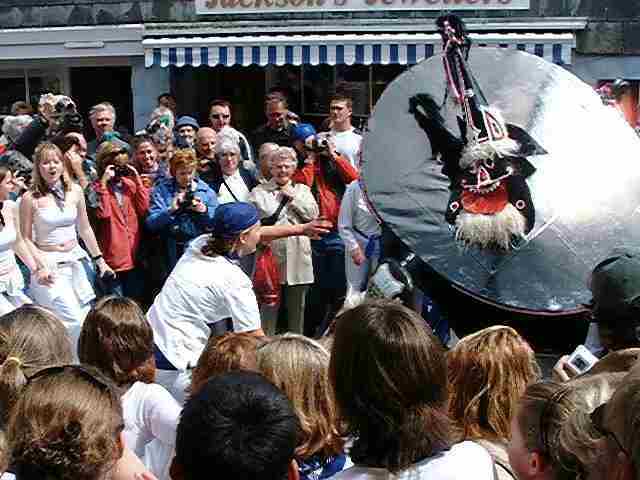
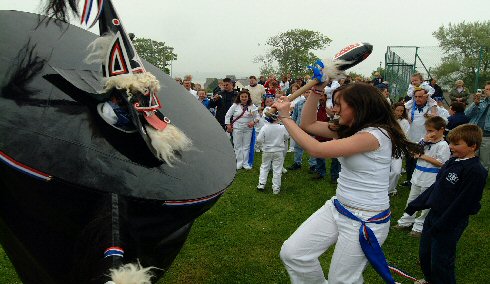
The Old 'Oss party attending the 'Obby 'Oss with dozens of accordions and drums.
The Old 'Oss capturing a passing maiden during the Mayday festival.

Padstow, in Cornwall, UK is internationally famous for its traditional 'Obby 'Oss day (dialect for Hobby Horse). Held annually on May Day (1 May), which in Cornwall, largely dates back to the Celtic Beltane, the day celebrates the coming of Summer.

The celebrations were the basis of the song "Padstow" by Steeleye Span.


The origins of the celebrations in Padstow are unknown. There is extensive documentary evidence of British community May Day celebrations in the 16th century and earlier, although the earliest mention of the Obby 'Oss at Padstow dates from 1803. An earlier hobby horse is mentioned in the Cornish language drama Beunans Meriasek, a life of the Camborne saint, where it is associated with a troupe, or "companions."


Origins

It has been speculated that such festivals have pre-Christian origins, such as in the Celtic festival of Beltane in the Celtic nations, and theGermanic celebrations during the Þrimilci-mōnaþ (literally Three-Milking Month or Month of Three Milkings) in England. It has also been proposed that the worship of horse deities such as Epona was found in ancient Celtic societies such as the possibly related Mari Lwyd ('Grey Mare') traditions of South Wales.


Festival practice

The festival itself starts at midnight on May 1 with unaccompanied singing around the town starting at the Golden Lion Inn. By the morning, the town is dressed with greenery, flowers and flags, with the focus being the maypole. The climax arrives when two groups of dancers progress through the town, one of each team wearing a stylised recreation of a 'horse.' The two 'osses are known as the "Old" and the "Blue Ribbon" 'osses. During the day a number of "Junior" 'osses appear, operated by children. Accompanied by drums and accordions and led by acolytes known as "Teasers", each 'oss is adorned by a gruesome mask and black frame-hung cape under which they try to catch young maidens as they pass through the town. The Blue ribbon oss is apparently of more recent origin. In the late 19th century it was supported by members of the Temperance movement who were trying to discourage the consumption of alcohol associated with the "old" 'oss followers. After the first world war the imperative of temperance was lost, and the 'oss became known as the Peace 'Oss. Each 'oss has a "stable" (in the case of the Old 'Oss, the Golden Lion Inn and the Blue Ribbon 'Oss, the Institute, from which they emerge at the start of the day's proceedings and retire at the end. Some time in the late afternoon the 'osses may meet at the maypole and dance together.


Night song

Unite and unite and let us all unite,
For summer is acome unto day,
And whither we are going we will all unite,
In the merry morning of May.
I warn you young men everyone,
For summer is acome unto day,
To go to the green-wood and fetch your May home,
In the merry morning of May.
Arise up Mr. ..... and joy you betide,
For summer is acome unto day,
And bright is your bride that lies by your side,
In the merry morning of May.
Arise up Mrs. ..... and gold be your ring,
For summer is acome unto day,
And give to us a cup of ale the merrier we shall sing,
In the merry morning of May.
Arise up Miss ..... all in your gown of green,
For summer is acome unto day,
You are as fine a lady as wait upon the Queen,
In the merry morning of May.
Now fare you well, and we bid you all good cheer,
For summer is acome unto day,
We call once more unto your house before another year,
In the merry morning of May.


Day Song

Unite and unite and let us all unite,
For summer is acome unto day,
And whither we are going we will all unite,
In the merry morning of May.
Arise up Mr. ..... I know you well afine,
For summer is acome unto day,
You have a shilling in your purse and I wish it were in mine,
In the merry morning of May.
All out of your beds,
For summer is acome unto day,
Your chamber shall be strewed with the white rose and the red
In the merry morning of May.
Where are the young men that here now should dance,
For summer is acome unto day,
Some they are in England some they are in France,
In the merry morning of May.
Where are the maidens that here now should sing,
For summer is acome unto day,
They are in the meadows the flowers gathering,
In the merry morning of May.
Arise up Mr. ..... with your sword by your side,
For summer is acome unto day,
Your steed is in the stable awaiting for to ride,
In the merry morning of May.
Arise up Miss ..... and strew all your flowers,
For summer is acome unto day,
It is but a while ago since we hove strewed ours,
In the merry morning of May.
O! where is St. George,
O!, where is he O,
He is out in his long boat on the salt sea O.
Up flies the kite and down tails the lark O.
Aunt Ursula Birdhood she had an old ewe
And she died in her own Park O.
With the merry ring, adieu the merry spring,
For summer is acome unto day,
How happy is the little bird that merrily doth sing,
In the merry morning of May.
The young men of Padstow they might if they would,
Far summer is acome unto day,
They might have built a ship and gilded her with gold,
In the merry morning of May.
The young women of Padstow might if they would,
For summer is acome unto day,
They might have made a garland with the white rose and the red,
In the merry morning of May.
Arise up Mr. ..... and reach me your hand,
For summer is acome unto day,
And you shall have a lively lass with a thousand pounds in hand.
In the merry morning of May.
Arise up Miss ..... all in your cloak of silk,
For summer is acome unto day,
And all your body under as white as any milk,
In the merry morning of May.
O! where is St. George,
O!, where is he O,
He is out in his long boat on the salt sea O.
Up flies the kite and down tails the lark O.
Aunt Ursula Birdhood she had an old ewe
And she died in her own Park O.
Now fare you well and bid you all good cheer,
For summer is acome unto day,
We call no more unto your house before another year,
In the merry morning of May.


Similar Hobby-Horses

'Obby 'Oss traditions also exist in nearby Barnstaple and Combe Martin. There is documentary evidence of an 'Oss' at Penzance in the late 19th century, made with a caped stick and skull which has formed the basis of the Penglaz Obby Oss which appears during the Golowan festival and the Montol Festival the oss is strikingly similar to the Mari Lwyd in Wales. There are some similarities between this festival and the Lajkonik hobby-horse festival in Kraków, Poland. In particular the idea that young women may be captured or struck with a stick in order to bring them "luck" or fertility suggests a pagan, or at least medieval origin. Lajkonik is 700 years old. Rather more recent is the Banbury Hobby-Horse festival, which started in 2000.


Note: this section didn't quite come out right. You might want to see the original page...

The Mystery of Mayday

CEREMONY AND CELEBRATION : TWO ‘OSSES - ONE TRADITION.

Throughout the world communities carry out celebrations that are special to the people in those places. They have often taken place for so long that the origins have become obscured. This is true of the Padstow May Day celebrations, which are not entirely unique, but have retained a special character that sets them apart. The man beneath the gown wearing the fearsome mask assumes a certain menace. Another personality. A sense of magic and of time standing still electrifies the atmosphere on this day. How old is it? Pre- Christian ritual or rustic Elizabethan fundraiser? Who knows? More likely fragments of both, surviving because a community refused to let it die, emerging in the 21stcentury as a symbol of community spirit in an ever-changing world. Listen to the words of the song "Unite and unite and let us all unite for summer is acome unto day".

WHAT PEOPLE WEAR.

White tops and trousers once only worn by a few ex sailors have become the standard dress for both parties. The piratical look favoured by the Old ‘Oss party was introduced in the 1950’s. The wearing of spring flowers, the flags the greenery and the May Pole are all part of the May Day experience.

Cowslips have special significance and are much in demand in the run up to the day. Once gardens were raided for tulips etc. but thankfully such anti-social behaviour is a thing of the past. (well almost!)

"With the merry ring adieu the joyful spring" the song goes and at times the ’Oss dies a symbolic death only to leap up with renewed vigour. Ancient Fertility Rite some say, and don’t forget it is said that if a maid is seen caught under the gown she will become pregnant before the year is out. Who can argue with such a potent image?

The "GREAT WAR" 1914-1919

This was a time of change for people everywhere. In many places the old customs died with the men on the battlefield. Here in Padstow the mood of survival gave encouragement for a new ‘Oss party to emerge, based on a previous Blue Ribbon ‘Oss with a patriotic red, white and blue ribbon round the rim of the gown and on the hat. It was also called the Armistice or Peace ‘Oss. The mask of this ‘Oss was slightly different too, a beard distinguished it from the original Old ‘Oss.

THE PRESENT AND THE FUTURE.

Today the friendly rivalry between the two enthusiastic groups helps to ensure the future of this special custom. Tourists flock to witness the spectacle, but it is not for them that it continues. This is Padstow’s day and it is a tribute to both ‘Oss parties that it has essentially remained as such, in spite of this invasion.

THE MYSTERIOUS MASK

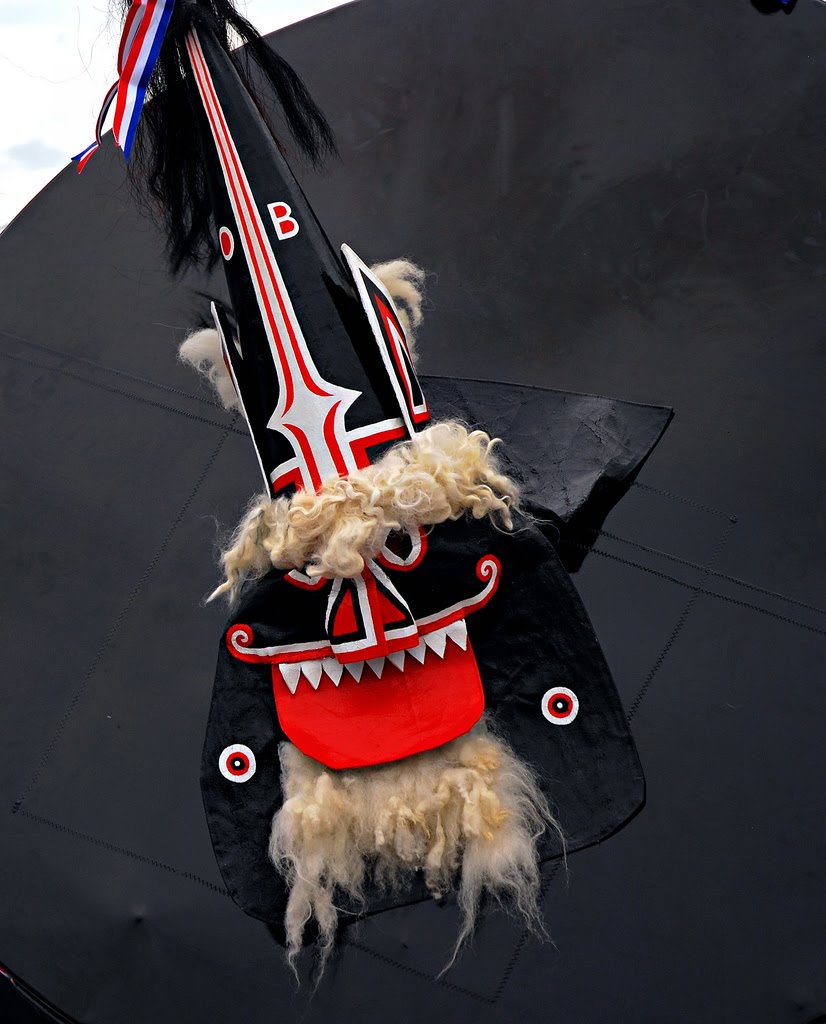
It is not known where the design for the Mask came from. The details are carefully copied year after year, including the letters O B that have long since lost their significance


The men who built the wooden ships and the men who sailed in them have left us their legacy. Is it mere fancy to suggest that the design may have been brought back from some other part of the world, where masked figures bearing an uncanny resemblance to our ‘Oss have been recorded?
Note the dramatic use of horse hair and sheep’s wool in the design along with the snappers at the front. These were once worked from inside the ‘oss by means of a string. The message is clear "Hand over your coin or the beast may bite". Once, these funds were vital. Nowadays the money goes to charitable causes.

NIGHT SINGING

The night singing remains unaccompanied, a simple and almost reverential start to the proceedings after the Church clock has struck midnight. The route, mainly in the old part of town, visiting well-known residents and singing appropriate verses. This part of the proceedings is led by the Old ‘Oss Party and begins outside the Golden Lion Inn, finishing somewhere "uptown" in the early hours.

"Rise up Alec Rickard and Gold be your ring, for Summer is acome unto day’

and bright is your bride as she lays down by your side, in the merry morning of May"

"I warn you Young Men everyone, for Summer is acome unto day,

to go into the greenwood and fetch your May home, in the merry morning of May.

"Now we fare you well and bid you all good cheer, for summer is acome unto day,

we’ll call once more unto your house before another year, in the merry morning of May".

THE GOWN OR SKIRT

The use of sailcloth to make the gown or skirt has been discarded for more modern material that is both lighter and easier to manage. Tar is no longer used as blacking (for the gown) and the paint now used no longer comes off on the hand when touched, considered a potent good luck symbol in its day! Today a touch is sufficient and the "Osses" will seek out elderly and infirm Padstonians in order that they may do this.

In the 1840’s the practice of smearing bystanders with soot or lampblack formed part of the ritual along with the firing of pistols to start the proceedings.

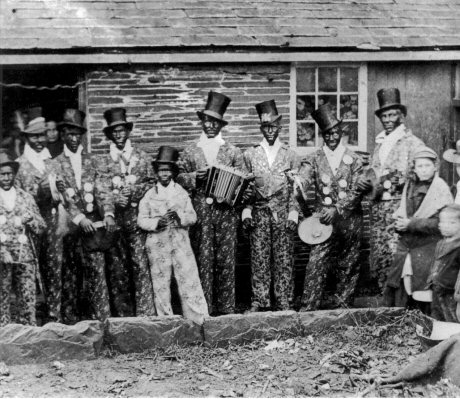
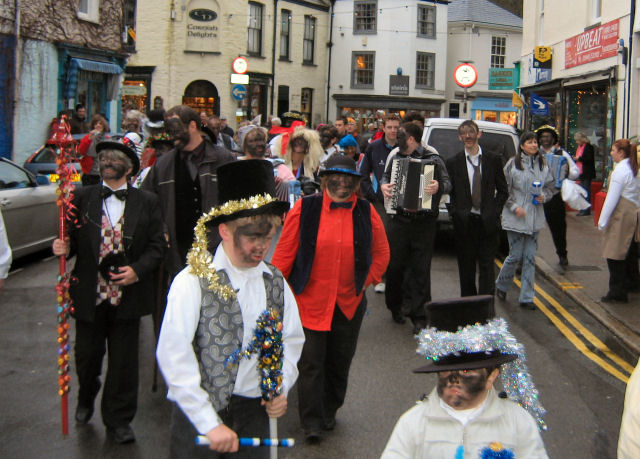
This face blacking forms an interesting link with the "Blackface" mumming tradition, formerly known as "Darkie Day" that takes place on Boxing and New Years Day.

THE TEASER

Dances in front of the ‘Oss taunting the beast, but ever respectful. The man or woman, boy or girl sweeps the air with graceful movements stepping nimbly about the cavorting creature.


Teasing the Oss in the Market


At Prideaux Place

THE MUSICIANS

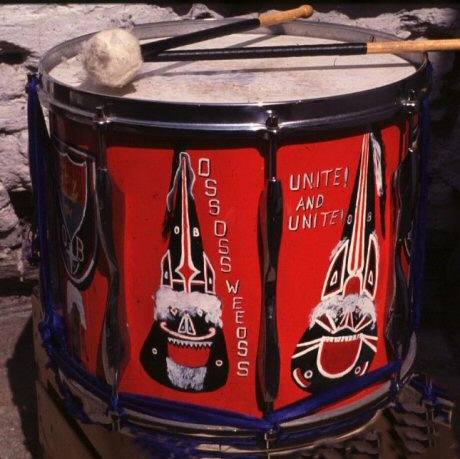
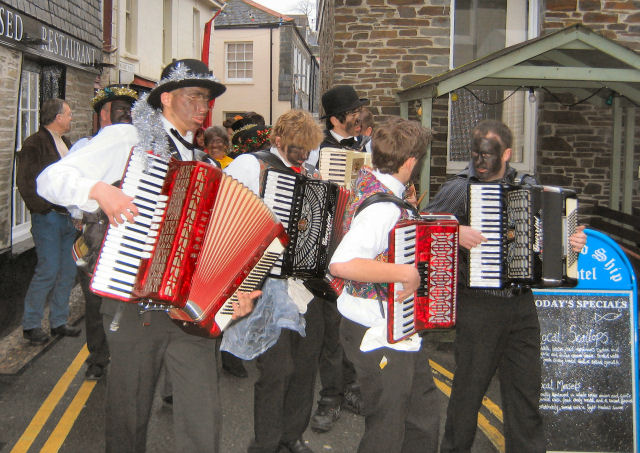
They are very prominent in today’s parade. Most of the homemade instruments seen in the old photos have disappeared. From the handful observed in the 1950’s we now get 20 or more accordionists and drummers in each party and numbers quite often have to be restricted.

ossdrum.JPG (51417 bytes)
Drum as used by Old Oss Party

THE MAYPOLE.

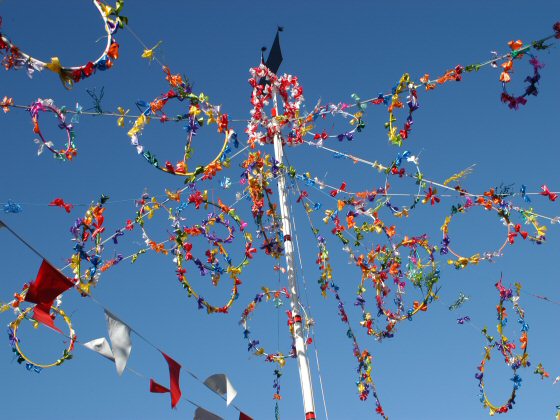
These were once common throughout Europe. In Padstow we know that one used to be erected in front of Cross House. The pebble cross was dug up each year and a decorated pole provided by the occupant, at that time the Tredwen shipbuilding family. The site itself could very well have had ritual significance but after complaints the pole was moved to its present position in Broad St where it is an impressive focal point.


Head of the Maypole

CHILDREN'S OSSES.

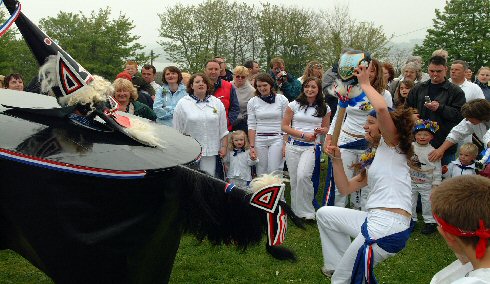
There seems never to have been a time when colts or junior Osses have not been a part of May Day. They start out much earlier than the main parties and usually finish before 10.30am. Their numbers and presentation may vary but the enthusiasm is undimmed.


Early Mayday Morning


Assembly of Young Osser's


Teasing a Junior Oss

THE PROGRAMME.
As the posters state the two Osses start the daytime proceedings at 10.00am and 11am respectively. They take different routes to each other. The Old ‘Oss visits Prideaux Place home of the Squire, in the morning moving up town in the afternoon with the Blue Ribbon Oss paying their visit in the afternoon. There are further perambulations in the evening, with occasional meetings of the two parties. A spectacle, which is much enjoyed, by the onlookers.

THE FAREWELL.
At the end of the day - sometime between 9.30 and 10 pm the Osses are stabled until the following May Day and both teams sing the very appropriate "Farewell" song - which was an Edwardian ballad about a soldier lamenting the parting from his loved one.

"I go where duty calls me,

I go what ere befalls me,

Farewell Farewell, my own true love."

MUMMERS and MINSTRELS

One could say that the May Day tradition has given Padstow an advantage over many communities in that a special awareness of this unique day makes other less high profile customs no less important to keep up. This is true of the Carols sung in December and the Boxing Day and New Years Day celebrations.

On these days the drums and accordions are present as on May 1st but the numbers are relatively small and the dress echoes the minstrel groups that were such a big part of the popular music culture for over a century. The music repertoire also reflects this era – fragments of once popular songs strung together performed with noisy enthusiasm. It is perhaps just as well that some of the words pass unnoticed. Where else but in Padstow would the fate of "poor old Ned" who’s "gone where the good niggers go" be mourned with such feeling. Stephen Foster wrote this song and any suggestion that slaves may have sung it on the quayside of Padstow is unfortunate conjecture.

It is worth noting that the concept of "black face" had been around in Europe long before white Americans started mimicking black entertainers. Mummers and Morris Dancers blackened their faces to avoid recognition and to assume an ‘other’ identity. On this basis we can readily assume that the arrival of the "minstrel" idea in Padstow replaced an earlier mumming tradition that is known to exist.

It is claimed that visits to Capetown S.A. by minstrel groups inspired the formation of the ‘Coon Carnival’ also known as the ‘Minstrel Carnival’ which still takes place, post Apartheid, on New Years Day among the Cape Coloured community of that city.

Old customs of the people, performed by the people, adapting to an every changing world

Recommended reading – Demons of Disorder – Dale Cockrell – Cambridge University Press.

The Mayday Photograph below right shows an interesting mix of costumes, some with black faces.


Minstrel Group circa 1900


Mayday circa 1920


Mummers 2006


Mummers 2006

--------------------------------------

EXTRACTS FROM VARIOUS PUBLICATIONS RELATING TO MAYDAY

May Day Mystery Update Feb 2005

In our various quotes from several 19c sources on Padstow and May Day we have previously omitted one of the earliest observations from C.S.Gilbert’s Historical Survey of the County of Cornwall published in 1820. It is significant in that it states "the inhabitants dress up a man in a horse’s skin". This description is not the same as the one detailed in the Bible Christian Magazine just a few decades later which relates fairly closely to the scene we witness today. (See Padstow Echo reprints) We are left wondering where Mr. Gilbert got his information from. However there is no mistaking the general feel for the occasion.

The Rev Charles Prideaux-Brune was at this time the Lord of the Manor. He was the first in the Prideaux family to inherit the name Brune. Not yet finished was the mansion of Thomas Rawlings at Saunders Hill. Gilbert writes –

"The streets of Padstow are in general narrow and uneven and many of the buildings have an ancient appearance, yet the town has been greatly improved within the last thirty years by the erection of several houses, which are in general very neat. These together with the numerous gardens which line the sides of the vale, in which the whole is situated, produce when viewed from the water, a very pleasing effect.

There is an annual jubilee kept up at Padstow, on May 1st, known by the name of the Hobby Horse, in illusion to which, the inhabitants dress up a man in a horses skin, and lead him through the different streets. This odd looking animal amuses, by many whimsical exploits, the crowd which follows at his heels, particularly by taking up dirty water, wherever it is to be found, and throwing it into the mouths of his gaping companions. These tricks naturally produce shouts of laughter, and the merriments are accompanied by songs made for the occasion. The origin of this festival appears to be unknown."

Taken from, "An Historical Survey of the County of Cornwall" by C.S. Gilbert – pub 1820.

************

As well as the animal skin comment the "splashing" actions are interesting. Quoting from "Folklore of Cornwall" by Deane and Shaw (Tempus new edition 2003). Writing about May dew customs they say:

"The importance of dew may have had some link with the May Day practice of sprinkling with water, ‘dipping’, to bring good luck. We have already noted that the Padstow Oss once visited Treator Pool for this purpose and all over Cornwall, dipping was a common custom. In Polperro and Pelynt anyone not wearing a lucky ‘may’ blossom was dipped, while in Looe, the boys went around carrying bullock horns filled with water. They walked through the town singing.

"The first of May is Dipping Day

The sixth of May is Looe Fair Day."Dipping as we are into the comments made on May Day in years gone by we end with those of Mr. George Rawlings who wrote to Robert Hunt the author of "Romances of the West of England" on Sept 1st 1865.

"Formerly all the respectable people kept the anniversary decorated with the choicest flowers but some unlucky day a number of rough characters from a distance joined it, and committed some sad assaults on old and young – spoiling all their nice summer clothes, and covering their faces and persons with smut. From that time – fifty years since – the procession is formed of the lowest. The maypole was once decorated with the best flowers – now with only some elm branches and furze in blossom. The horse is formed as follows :- The dress is made of sailcloth painted black – a fierce mask – eyes red – horse’s head – horse hair mane and tail distended by a hoop. Some would call it very frightful. Carried by a powerful man – they could inflict much mischief with the snappers. No doubt it is a remnant of the ancient plays, and it represents the devil, or the power of darkness. They commence singing at sunrise".

MAY DAY IS NOT LIKE IT WAS YEARS AGO Padstow Echo No 110 May 1999.

Nothing new or startling with this statement, as we come round once again to this day of days for all Padstow people. Much has been written on the whys and wherefores of this ancient custom of ours and the story of when Thomas Tregaskis the Bible Christian miller tried to stop May Day has been quoted many times. His objections were not against revelry as such; otherwise why offer an Ox to be roasted for at least a seven-year period at considerable personal expense, but to that aspect that he saw promoted drunkenness. He had his supporters then and I suspect there are those today who would support his sentiments. He died in 1873, twenty-eight years after the Ox incident and we have from a memoir printed in the Bible Christian Magazine at that time a description of the day. The writer I feel was not totally disapproving of the event that he describes in such detail.

"The people have long been in the habit of singularly dressing up some strong man on the first of May, and following him with noisy mirth"

"There is the "gown" to begin with, made of canvas or some coarse material of the kind, painted black, caused to swell out to its proper dimensions by an enormous hoop at the waist, from which it tapers up to the neck; then the conical headpiece, answering the two-fold purpose of hat and mask, having a mixture of red and black, with a tuft of horse hair at the top. Attached to the hoop behind is a great sweeping tail and in front the "snappers" with iron teeth, and hair hanging down from it goat fashion; it is made to "snap" at the pleasure of the man inside, who holds a string in his hand, slackening which the under jaw drops with its own weight and a twick brings it up with a sharp sound to the upper-jaw. A great part of the fun consists in the man who carries the dress running after people making as if he would snap at them, or lift the gown over their heads."

"The opinion which prevails among the more intelligent is that it is a relic of druidism, and verily it is worthy to have descended from the days of barbarism"

"On the evening of April 30th, it might be seen that the town was all astir; for strong young men from the different yards were bringing up the "maypole"; adorning it with furze erecting it and making it sure with ropes, for the great events of the night. May morning comes, and at a given hour in the forenoon hundreds of young and old are at the windows, watching for a glimpse of the Hobby Horse. The eye of expectation was turned towards the Public House at the bottom of the central street. Here he comes! Crowds outside saluting him with loud cheering and firing of pistols over his head, loaded of course with powder only. There is dancing too and singing of "May Songs" Out into the country first thing, the air rending with frantic noises. Perambulating the town in the afternoon, getting up money, eating and drinking during the day, as they may. Now may be seen the special appendage of "smutting" - powder made into paste spread on the palm of the hand, then rubbed into anybody’s face, the clearer and fairer the face the greater the fun. Sometimes in place of Powder paste Lamp Black is used. The day finishes up with dancing, drunkenness, fighting &c. It is as if the Hobby Horse were Bacchus with his many worshippers."

The writer obviously knew his May Day; I leave it to the reader to seek out the differences with the present day. The full text can be read in the Courtney Library at Truro Museum in the Bible Christian Magazine for 1873 (pages 309/10) or ask me for a copy.

MAY DAY 1896 APRIL 30th

May Day is close upon us but very little heard as yet of the May Song. How different this from twenty years ago. In those days the strains of the old song were heard nightly from March to September. The custom of keeping up the "hobby hoss" is gradually dying out and in a few years will be little else than a recollection with old people.
The reporter’s pessimism continues in his later report, but he does end on a more positive note, I quote.

MAY 7th 1896

The "Hobby Hoss" demonstration invariably held on May Day passed off very quietly. The weather was very fair but the followers of the "Hoss" were less numerous than usual, although if reports be true the "collection" which they always devote strict attention produced a good round sum. There was very little damage to the flower gardens thanks partly to the alertness of Sgt Hugo and those under him. It is however evident that the "Hobby Hoss" demonstration is gradually dying out and will soon cease altogether. To strangers to the town the whole affair seems absurd, and one gentleman at a public meeting expressed his disapproval of it in vigorous terms; but there was not much in the conduct of those responsible for the demonstration that any person could reasonably complain of. Eighteen years earlier this enthusiasm among the local people for May Day caused the Headmaster of the Board School to record in his Log Book.

"The influence of Bank Holidays has hardly reached this remote place… On the other hand May Day in Padstow when almost every other City, Town and Village is in its usual working order is a season of rejoicing amongst the lower classes of a kind beyond ridiculous."

These words from over a hundred years ago send their own message to the present day custodians of the "Obby Oss" tradition. I’m sure our sympathetic reporter of the past along with "Boss" Harding the Headmaster for the "new" (1876) school’s first seventeen years, would be truly amazed at the way things are today.

News reports taken from copies held in the Courtney Library Truro Museum, Headmasters Log Book, Padstow School, available for inspection by appointment at County Record Office, Truro.

Extracts from the PADSTOW ECHO Issue 113 May 2000

Another May Day has arrived. Shaped by countless generations of Padstonians from time "immemorial". Where did it all come from? What is it all about? You could say "just enjoy it me ansum" and be right. Does it really matter? The important thing is to "keep er gain". Part of the magic of this day lies in the fact that after centuries of adaptation it’s origins have become obscure. This has fuelled the curiosity of locals and visitors for many years you can read about it in Donald Rawe’s excellent book "PADSTOW’S OBBY OSS" or in Ronald Hutton’s "THE STATIONS OF THE SUN" a wider drawn account of the many Calendar Customs in Britain.

From the early times of the Victorian "Folklore" collector comparisons have been made with similar customs involving ritual and masked figures in other countries and here are three examples.

The first was noted in 1912 by Thurstan Peter an eminent Cornish Historian who was struck by the similarities in appearance with the "Duk Duk" in New Guinea. My recent enquiries have unearthed details of village theatre in the Eastern Highlands (National Geographic) that is very much alive and I have hopes to track down the "Duk Duk" sometime. Also from this source came details of a custom in LIBERIA where "An animated Hay Stack with ebony head dances to the throb of drums. It drives away evil spirits" the reporter was warned not to go too close.

Thanks to my friends in the Strand Book Shop I obtained an old copy of the "Cornishman" magazine containing an article by Mary Utton describing a Dance held in Mexico called "SHALAKO" (Yes there was a movie, Sean Connery, Bridgett Bardot!!) the author had seen our "Oss" and was struck by the similarities. As in New Guinea there were strong elements of initiation and fertility in the ceremony. "The central figure was decorated with a feathered head-dress, while a tent like garment covers the dancer. The mask also has a wooden "beak" which the dancer snaps open and shut at certain points in the dance.

Accompanying the "Shalako" was a side dancer. Together the two dancers stamped out the measured steps of the dance. The songs changed but the dance was always the same, and was to continue for six hours without respite. As a religious ceremony it was impressive; and as a physical feat of endurance it was no less so.

Great reverence and awe was noticeable, especially on the part of the older Indians, while the children were frankly terrified and often hid beneath their mothers skirts."

What do these glimpses tell us? Perhaps nothing more than the fact that, in so many ways, people from other races and cultures, are not so different from us. This yearning to understand and identify our "place" in life unites us all. If you feel that special feeling on the day, you will know what I mean.

A hooden "horse" called "Hob nob" once accompanied a giant figure in parades at Salisbury Wilts. He can be seen in the City Museum there.

Ritual Animal Disguise Padstow Echo May 2001

We should not be surprised at the amount of stuff written about May Day over the years. One book written 23 years ago by E.C. Cawte recently came to my notice called RITUAL ANIMAL DISGUISE it puts Hobby Horses into the context of other similar customs, sensibly urging readers to go to the original sources so that they make their own judgements urging that they read this book with care so that they do not misinterpret it. Sound advice indeed.

At the end of Chapter X the author makes some interesting comments on SEASONS OF PERFORMANCE.

"The structure of the Padstow ceremony suggests that a May ceremony of a typical kind has had a horse attached to it, so that the Padstow Horse may, at one time, have had a different time of performance which could have been Christmas, like the Penzance horse, the only other one known in Cornwall. (Edmonds 1858 concerning guise dancers). Similarly the structure of the Coombe Martin ceremony suggests that the horse and fool represent a separate performance. There is nothing in the Minehead performance to suggest that it has ever taken place at a season other than May. However, the vast majority of horses appear at about Christmas, the Penzance horse certainly did, and it seems possible, no more, that these horses may all at one time have appeared at Christmas. Certainly the designs and ceremonies of these horses are unusual, and they must surely represent local adaptations of customs acquired from elsewhere."

A fascinating study. Get it out from the Library it’s no longer in print. JB.

April 28, 2010

The Truth will Set You Free...


The music business is a cruel and shallow money trench - a long plastic hallway where thieves and pimps run free, and good men die like dogs. There's also a negative side."
- Hunter S. Thompson

April 24, 2010

'Spider' John Koerner - Spider Blues


Well it's been forever since I've posted anything blues- or jug-band-related, so I thought I'd reward the patience of my blues-loving readers and post this rarity. The most striking thing about this record, to me, is how it just feels subtly 'off'. As in, this is a white kid trying his very best to sound like a big black guy, and getting really close - I mean blindfold test close! He even took the 'handle' of Spider to add to his name. A la Blind Joe Death, you know? Same impulse, different direction. Like John Hammond too. But it's still, not quite right: not quite natural. But it's a subtle point, and aside from that, the record's really fun, the sound sparse bouncy, the playing finely honed but still raw. Really it's worth the price just for the last track, Rent Party Rag, in which Spider John sounds like a one-man-jug-band. And, apparently, he was the primary influence on Peter Lang in his early development.

"Alone among the young blues revivalists, Koerner had a sound that was completely idiosyncratic and personal. From the first guitar riff, there was never any doubt about who was playing. Today the material has changed but the sound is intact...spare and funky, with lots of open spaces between oddly placed notes, all of it held together with his impeccable timing."--Blueswire

Anyone who maintains that a white man can’t sing the blues has likely never come across “Spider” John Koerner. A Rochester native who was integral to the Minneapolis, Minnesota folk scene of the ’60s, Koerner has spent much of his career creating albums that inspired generations of white folk artists to explore their roots.

Bob Dylan, who encountered him in the Dinkytown neighborhood near the University of Minnesota, sang his praises in Chronicles; so have artists as diverse as Bonnie Raitt and David Bowie. Unlike the popular pop adaptations of stolen and reinterpreted songs in the folk style that were passed off as real folk music (from the Kingston Trio, the Weavers and Peter, Paul and Mary), Koerner and his associates Dave “Snaker” Ray and Tony “Little Sun” Glover made music that felt authentic. Though Ray passed away some years back, Koerner has performed consistently both with Glover and also solo, which is a boon to those who remember the ’60s as well as those who experienced it on TV.

As any self-respecting listener is well aware, the history of American popular music is a rather messy affair, characterized by a rape and tiptoe two-step that’s anything but pretty. What’s more difficult to admit is that sometimes both tendencies appear in the foreground at once; when a British “blues” band co-opts a Robert Johnson tune in full, it’s not entirely clear whether they’re playing tribute or trampling or both. It may be better to trust your gut, and it’s hard to trust the saccharine cleanliness of blues better heard in the parlor than in the barroom. And the brilliant thing about Koerner, Ray and Glover is that there appears to be less of a gulf between them and Huddie Ledbetter than with many of their Minnesota contemporaries. Blues is a dirty affair, after all, and Koerner’s music is anything but pristine.

Woe to the musician whose second album was praised in the liner notes for its “real understanding of Negro musical styles” and how it is “unbelievable that any white musician could come so close to the sound of Negro performance.” But it’s a challenge to listen to “Hangman” and “Ramblin’ Blues” from Blues, Rags & Hollers and distinguish the Ledbetter from the Koerner.

Speaking to him from his home on New Year’s Eve, Koerner admitted that the whole thing was, in a sense, pretty “weird.” “It’s kind of strange that at that age, I wanted to act like a black guy. And be like black guys — some of whom didn’t know how to read. Here we were, college kids, who got it in our mind to do like it was in the songs — drinking and partying, and chasing women.” Whatever the intentions, though, Koerner, Ray and Glover created music that went beyond mirroring the idiom of blues to create something wholly original within a tradition. It is nothing less than inspiring that Koerner is keeping the flame burning.

[Text by Luke Z. Fenchel; From the Ithaca Times]

Biography by William Ruhlmann
"Spider" John Koerner has been an influential practitioner of traditional folk music and country blues since the days of the late-'50s/early-'60s folk revival. Both in his group, Koerner, Ray & Glover, and on his own, he has helped popularize early folk and blues music through his performances and recordings, directly affecting the careers of Bob Dylan and Bonnie Raitt, and influencing many others.

Koerner grew up in Rochester, NY, where he was initially interested in flying, not music. He obtained a student glider-pilot license at 15, and when he graduated from high school in 1956, he enrolled at the University of Minnesota in Minneapolis to study aeronautic engineering. But in 1958, he was introduced to folk music by a campus acquaintance and took to it heavily, learning to play the guitar and dropping out of college to travel the country as a folksinger. He briefly joined the Marine Corps, then returned to Minneapolis in the fall of 1959, where he became a fixture in the coffeehouses of Dinky Town, the bohemian area around the University of Minnesota. There he encountered and played with a new undergraduate, Bob Zimmerman, who soon took the stage name Bob Dylan. He also met guitarist Dave Ray, who introduced him to harmonica player Tony Glover in the spring of 1962 while they were in New York City. The three began to play together there and back in Minneapolis formed the group Koerner, Ray & Glover. They adopted nicknames in the manner of old blues players: Ray became "Snaker," Glover "Little Sun," and Koerner, in reference to his long, skinny arms and legs, "Spider."

Koerner, Ray & Glover recorded an album, Blues, Rags & Hollers, that was released on the tiny Milwaukee-based independent Audiophile Records label in June 1963. Folk label Elektra Records then signed the group and bought the album from Audiophile, reissuing it in an abridged form in November. Lots More Blues, Rags & Hollers followed in June 1964. The trio appeared at the Newport Folk Festival in July, and their performance was recorded for the Vanguard Records album Newport Folk Festival 1964: Evening Concerts III (released in May 1965) and filmed for the motion-picture documentary Festival (which opened in October 1967). The group was always a loose aggregation, frequently breaking down in performance into duos and solos, and it was natural for the three to play separately. In 1965, Koerner and Ray each made solo albums for Elektra (actually assembled by the label from solo performances done at Koerner, Ray & Glover recording sessions). Koerner's was Spider Blues, released in May. He then appeared at the 1965 Newport Folk Festival, his performance captured on the Vanguard LP Festival -- Newport Folk Festival 1965, released in 1966. Koerner, Ray & Glover made one more album for Elektra, The Return of Koerner, Ray & Glover, released in October 1965, and an archival album of 1963-64 live recordings, Good Old Koerner, Ray and Glover (aka Live at St. Olaf Festival), was released by Mill City Records in January 1972. But the trio ceased to be a full-time act by 1966.

Koerner continued to play the folk circuit as a solo performer, appearing at such prestigious clubs as the Ash Grove in Los Angeles and Club 47 in Cambridge, MA. He made a trip to England in 1968 and again appeared at the Newport Folk Festival in 1969. That year, Elektra released his second album, Running, Jumping, Standing Still, which featured piano player Willie Murphy and included many original compositions, among them "I Ain't Blue," which Bonnie Raitt later covered on her self-titled debut album. By the early '70s a lack of success prompted Koerner to retire to Copenhagen, Denmark, after recording the album Music Is Just a Bunch of Notes for Dave Ray's Sweet Jane Records label. (The LP was released in May 1972.) His European retirement lasted for a year or so, its ending formally marked by another Sweet Jane release, Some American Folk Songs Like They Used To, in October 1974. The album showed that he had moved more toward traditional folk music rather than the folk-blues with which he had been associated.

Koerner moved back to Minnesota in 1977 and maintained his career on a part-time basis while also working outside music. He returned to greater national visibility due to his association with Red House Records, which released his first album in more than 11 years, Nobody Knows the Trouble I've Been, in 1986 (it had been recorded in 1980), followed by Raised by Humans in March 1992 and StarGeezer in May 1996. Red House also reissued the Koerner, Ray & Glover albums Blues, Rags & Hollers, Lots More Blues, Rags & Hollers, and The Return of Koerner, Ray & Glover, as well as Koerner's Running, Jumping, Standing Still, on CD. In 1997, a new Koerner, Ray & Glover live album, One Foot in the Groove, was released on Tim/Kerr Records. Koerner underwent emergency triple bypass surgery in January 1998, but recovered and returned to performing. Lacking health insurance, he suffered astronomical medical bills, but a series of benefit concerts paid them off. In the early years of the new millennium, he continued to perform, both solo and as a member of Koerner, Ray & Glover.


John Koerner - Spider Blues

Year: 1965
Label: Elektra

Side A
- Good Luck Child *
- I Want To Be Your Partner
- Nice Legs
- Spider Blues *
- Corrina
- Shortnin' Bread
- Ramblin' And Tumblin'
- Delia Holmes

Side B
- Need A Woman
- I Want To Do Something
- Baby, Don't Come Back
- Hal C. Blake
- Things Ain't Right *
- Rent Party Rag

* with Tony Glover on mouth harp

note, a couple of tracks have some ripping errors, due to my computer's low-memory. I might try to do a re-rip at some point but just enjoy the bizarre time-changes for now...

vinyl, cleaned | mp3 >256kbps vbr | w/o cover

This album so far as I know has never been reissued, either in physical or digital form.

But you can find others On Muddy Sava Riverbank, and be sure to check out the man's website - he's still gigging!

April 21, 2010

George Pegram


Here's one for anybody that liked the Obray Ramsey, or banjo/old-time music in general. Like Ramsey, he played banjo in the 3-finger style, but not quite bluegrass. He was as unique as a blue chicken, and twice as friendly. Whether you view him as "A grizzled, bowlegged, illiterate manual laborer with only one good eye" or "a broadaxe-finished mountaineer under a ten-gallon hat," he was the real thing allright - raw as a chewing-switch. Why do I love these guys? Because they're crazy and fun and just plain confound the mind to do anything but step aside and let the folksoul take over with tapping stomping feet and crowing hoarse throat and somehow a tenderness emerges like a soft pale foot from a dinged-up leather boot. So shoot!

Biography by Jason MacNeil
George Franklin Pegram was born and raised in Guilford County, a farming community that was rich in traditional music. Growing up as a teenager, the musician purchased his first Silvertone banjo for $15. He also met Zack Whitaker, a local promoter who organized fiddlers' conventions and showcases while Pegram was growing up. Also influenced by his uncle Clyde Pegram, George Pegram began perfecting the "double-thumbing" style of banjo playing, a three-finger movement that used single notes. At the age of 26, Pegram married Dorothy Louise Dick in Guilford County, then moved to Statesville. Upon entering the navy during the Second World War, Pegram lost one eye during the attack on Pearl Harbor. After working a variety of odd jobs in sawmills and furniture factories, the musician met Bascom Lamar Lunsford, a promoter of folk and "mountain" dance festivals. Needing additional acts to fill various folk festivals in North Carolina, Lunsford signed Pegram and recorded some of his material. Throughout the 1950s, he performed with Clegg Garner, Okie Mountain Boys and Corbett Bennett and His Mountain Dudes. In 1955, Pegram played with Walter "Red" Parhorn and more touring and performing continued. In 1957, Kenneth Goldstein recorded the duo for Riverside Records. Known for his dynamic and exciting live show, Pegram won a series of annual awards at the Galax Fiddlers' Convention, including the Outstanding Individual Performer in both 1966 and 1969. In 1970, he released his self-titled debut album. The album was the first album ever released on the Boston-based Rounder Records. Pegram continued playing until 1974, with the Asheville Folk Festival that year being his last performance. In September 1974, Pegram died from bone cancer.


George Franklin Pegram - Banjoist

The first time I saw George Pegram he was holding forth in his own inimitable, gravity-defying manner. The usual crowd had gathered at his feet. He wore a smile of unadulterated bliss. Bobbing and weaving his head, he and a guitarist, accompanied by two female singers, were tearing along in high style on that great reliable, 'Old Time Religion.' " Anne Gilbert

Banjoist and folklorist Art Rosenbaum described Pegram's playing as a "raucous, hell-for-leather, driving style." Robert Black further mentions, to achieve this effect "George Pegram uses a technique much like the well known 'double-thumbing' style. It is a three-finger movement employing single notes; the melody is picked with the thumb and the drone Is alternated between the first and second strings, using the index and the middle fingers."


George Franklin Pegram, Jr. was born August 5, 1911 and raised near Oak Ridge in Guilford County, the son of George (12/20/1881 or 1883-11/5/1955) and Phebe D. Henley Pegram (_1892-?). This farming community in North Carolina's Piedmont region was rich in stringband music.

Zack Whitaker (2/9/1876-11/3/1950), who taught music at the Oak Ridge Institute, was active in organizing area events. Whitaker promoted fiddlers' conventions and dances throughout George Pegram's upbringing, and, probably, it's those conventions that George attended when growing up. One of Zack Whitaker's musical compatriots was George's uncle, fiddler Clyde Pegram. A lifelong bachelor, Clyde Pegram lived at home with his mother and worked the family farm. George claimed that Clyde helped start him in music and that the two played together once George became musically proficient. George Pegram tells several different stories of acquiring his earliest instrument. Either his first banjo, which he started playing around the age of nine, was one discarded by his grandfather, or a cigar box banjo, which George made. Pegram continues: "My grandma drew a pension from the Civil War. I stayed with her, and she gave me a patch for tobacco. I said the first thing I was going to do when I sold my crop of tobacco, I'm going to buy me a banjo. I went down to Winston-Salem to a music store and paid $15 for a banjo a Silvertone. "I got to watching other banjo pickers. I'd pick it up. I'd go to school commencements, where there would be playing, and to fiddling conventions. I'd pick it up listening to others. "The first money I ever made in my life was for pickin' a banjo all night. I was just a barefoot kid and they gave me 15 cents. I tied it up in the end of a handkerchief and took it and gave it to my Momma." George evidently had fond memories of Oak Ridge. He would return there each year to perform at the horse show/fiddlers' convention that began in 1946. At the age of twenty-six, George Pegram married Dorothy Louise Dick (b. 1920) of Guilford County and moved to Statesville. The couple eventually had four children. Pegram professed to having served in the Navy during World War II, and to losing an eye in the Japanese attack on Pearl Harbor. To support his family, George worked in the tobacco fields, sawmills and furniture factories of North Carolina and Virginia. " never paid enough to live on, and Pegram moved his family from job to job, from one small town to another, wherever he could find work and 'play a little music,' " reported the Winston-Salem Journal/Sentinel. The man who would change Pegram's life was musician, folk song collector and festival promoter Bascom Lamar Lunsford. Lunsford had founded the Mountain Dance and Folk Festival in June of 1928 as a part of Asheville's Rhododendron Festival. "In 1948," says Bascom Lunsford's biographer Loyal Jones, "Lunsford was invited by Dr. Ralph Steele Boggs of the English Department to start a folk festival at the University of North Carolina at Chapel Hill which was held in June. In the same year Lunsford also established a festival for the North Carolina State Fair in Raleigh, in the month of August. Both of these festivals became popular events and made it necessary for Lunsford to locate new performers from places in North Carolina other than his native mountains. He traveled the hot and dusty roads of the Piedmont and Coastal Plain of the Old North State, seeking talent for his new festivals." Pegram, possibly living in Denton at the time, recalled his first meeting with Lunsford: "The old man discovered me. Oh, it was 1949, I believe it was. He came down there and he had car trouble. He wanted to spend the night. I said yes I'd be glad for him to. He didn't know that I was a banjo picker a musician. He had one of these recording things to make records. We eat supper and all. I asked him what his business was. He said folk music. I told him that I played the banjo a little bit once in a while. He said, 'Go get your banjo then.' I got my banjo and played 'Cumberland Gap' and different ones. He said, 'Why, that sounds just fine. Just fine. Let me record that.' He did, and I was invited to the festival." This account seems likely, although some of its details aren't correct. Since Pegram appeared at the first Festival, Lunsford must have visited George in 1948. Hoyle Bruton, publicity director for the 1948 festival, described talent scouting trips with Lunsford in the spring, and thinks that Lunsford had heard about Pegram before he went to see him. Arthur Palmer Hudson, reviewing the 1948 Carolina Folk Festival in the Southern Folklore Quarterly, mentions Pegram, "a broadaxe-finished mountaineer under a ten-gallon hat" as vying "with Clegg Garner of Randolph for honors as banjo soloist. George's 'Good Ol' Mountain Dew' a 'special request' number on every program after the first. A natural clown, with an excellent repertory of banjo songs and solo dance numbers, and with an inexhaustible fund of showmanship, George was the individual star of the Festival." Pegram also played "John Henry." The Asheboro Courier-Tribune reported that "One member of Garner's band, tall and lanky George Pegram, brought down the house with his rip-roaring rendition of 'Good Ol' Mountain Dew,' a number written by Lunsford in the style of the authentic folk songs. The large crowd, stacked up in the north side of Kenan stadium to the back wall, city folk and all, got the swing of folk music as George sang and whole assembly was soon clapping and swaying in rhythm." This event seems to be, outside of local community events, one of Pegram's first appearances as a professional musician. Although George Pegram would continue to work at a variety of manual labor jobs, from this point on, he would attempt to make a part of his living at music. Subsequent newspaper photos and recollections of area residents show Pegram still playing with Clegg Garner's band for dances at Denton (Davidson County) and Farmer (Randolph County) in the 1950s. And, a recording of the Okie Mountain Boys made at the 1948 event sounds like Pegram was also a member of that aggregation. In the late 1940s, George Pegram additionally performed with Corbett Bennett and His Mountain Dudes, both in public appearances and over radio station WTNC-Thomasville. Throughout his musical career, no matter what Pegram's band affiliation, George was always straining to take the spotlight. Pegram was such a singular performer, with his own style, that it was hard to play and share the stage with him.

The Pegram family moved to Union Grove at Bascom Lunsford's instigation around 1951, to a small white house off NC 115 near the Wilkes County line. With some of Lunsford's relatives living close by, Bascom may have been trying to take care of George or to keep an eye on him. By that time, George Pegram had become a favorite performer of Bascom Lamar Lunsford, who used him on the many events he later organized in the 1950s. Pegram played at the State Fair, the Mountain Dance and Folk Festival and the Burlington Centennial Festival (in 1949). He was a regular at the Carolina Folk Festival until its demise in 1956. And Lunsford subsequently put Pegram together with harmonica player Red Parham. Walter "Red" Parham ran Bascom Lunsford's farm and played at Bascom Lunsford's many events, including the Mountain Dance and Folk Festival. Pegram and Parham had begun performing together by 1955, when they appeared at the Carolina Folk Festival. In 1957, Red and George were recorded by Kenneth Goldstein for Riverside Records at Lunsford's home in South Turkey Creek, Leicester, NC. George Pegram and Red Parham also appeared on several Riverside Records anthologies: Banjo Songs of the Southern Mountains and Southern Mountain Folk Songs and Ballads. The act ceased active performing when booking decreased, and financial necessity caused Parham and Pegram to appear on their own. No matter how much Lunsford valued George as a performer, the latter's lack of constraint caused friction between the two men. Loyal Jones relates that, "For a while, he would not have George Pegram on the festival. Pegram became so popular that the crowd would often break into chants of 'We want George,' and Pegram, somewhat heady over this popularity, might just come forward without Lunsford's nod. This was the sort of thing that Lunsford, creator and boss of the festival, would not tolerate. However, Pegram held an affection and respect for Lunsford." By the late 1950s, George became a fixture at both the Galax, Virginia and Union Grove, North Carolina Fiddlers' Conventions. At these events, he was often associated with Wayne Johnson's Brushy Mountain Boys of North Wilkesboro, featuring fiddler "Lost John" Ray (_1917-?). Pegram's first award at the Galax came in 1959, when he won first prize for the "Novelty" category. One of the pieces he played that year was "On Top of Old Smokey." He took second prize on banjo in 1960, and first in 1961, rendering "John Henry" for his first place win. The Brushy Mountain Boys took third prize in the band competition for 1960 and 1963, performing "Turkey in the Straw" and "Hitchhiker's Blues" during the later year's convention. In 1963, Pegram also played on the program, executing "John Henry," "Arkansas Traveler," and "Old Rattler." The Band possibly attended the 1966 event, when George won "Outstanding Individual Performer," which he won again in 1969. George's Galax performance of "John Henry" from either 1961 or 1963 was recorded for the Folkways Records' 1964 release, Galax, Virginia Old Fiddlers' Convention . The Brushy Mountain Boys appeared at the 1961 Union Grove Fiddlers' Convention as a seven-member band. The band was included on the 1962 Folkways album The 37th Old Time Fiddlers' Convention At Union Grove North Carolina, and were mentioned as "one of the wilder bands and the winner of this year's (1961) band contest" in the album's notes. It is unclear if Pegram was with the Brushy Mountain Boys at this convention. Photos of the band, which at least sometime included Wayne Johnson's sons, show a different banjoist. However, the banjoist on the Folkways recording of "Hitchhiker's Blues" closely resembles George. George Pegram also appeared with fiddler Lost John Ray at the 1967 Union Grove Convention. Wade Walker financed the record, featuring George and Lost John, for his "Wade" label. The issued tunes were "Mississippi Sawyer" on one side of the record, backed with "Cumberland Gap" and "Arkansas Traveler." Sometime in the mid-to-late 1950s, Wade Walker had became acquainted with Pegram at the Farmer Grange dance, where George was playing. Pegram and Walker became good friends, and George was a regular at Wade Walker's music sessions from then on until George Pegram's death. Beginning at this time, as Mark Walker, Wade's son reports, "Pegram worked for the Southern Railroad as an entertainer at their conferences and meetings, traveling all over the country and even to Hawaii. They bought him a banjo, one of the last ones that he had. But I think he pawned it off when he got hurting for money. It was one of the Earl Scruggs models. They'd buy him new clothes, you know, before they'd take him on those trips. He wouldn't even have decent clothes, you know, to take with him. And when he'd come home, he might come into work at the sawmill or somewhere with them good clothes on and they'd have to buy new ones again then." By the late 1960s, the Pegram family had migrated once again, living for several years near Galax, Virginia. The following article appeared in the Galax Gazette, July 24,1969, and aptly describes Pegram's public appearances. "A perennial favorite at the convention is George Pegram of nearby Fries, Virginia, located like Galax, near the line separating Carroll and Grayson Counties. "Pegram, grizzled and balding and with only one good eye, is a virtuoso of the bluegrass banjo style. He is a showman, too, likely to put aside his instrument and dance into a loose-joined shuffle. "As he attacks the chorus of 'Cumberland Gap,' his lean old body tilts backward from the knees until his beaten black hat stands parallel to the ground and he is face to face with the August moon. He hoists his banjo high, fingers plucking louder and louder around the melody and a guttural hum hurtles from his throat into a piercing howl guaranteed to boil the blood: "'MmmmmYeoww! Way down yonder in Cumberland Gap!'" David Holt, the well-known banjoist and host of radio and television shows (including Mountain Stage), also witnessed his first Pegram performance that summer. "I will never forget the first time I saw George Pegram play. It was 1969 at the Mountain Dance and Folk Festival in Asheville, North Carolina. He came out on stage grinning from ear to ear, eyes darting around the auditorium like he was getting ready to play a hugh practical joke. He was bowlegged and slightly stooped from the weight of his banjo hanging around his neck. You sensed right away this guy was the 'real thing.' "Harmonica player Red Parham blew a couple of high, piercing notes to start 'Cindy.' George grabbed at the strings of his banjo as though he were trying to catch up with Red. Then all of a sudden they hooked into each others timing and were in perfect sync. It felt like an electric current went through the audience. Spontaneously the entire crowd began hollering and hooting. The music was so raw, so real and so damn good, you couldn't help it. They played through the tune like they were trying to hold onto an out of control freight train. It was one of the most exciting musical experiences I've ever had. And to this day, every time I play 'Cindy' I think of how George Pegram made that song come alive." The recordings heard on this compact disc were made by Charles Faurot (called "Farout" in the original album notes), well known for his tapes for County Records of Carolina/Virginia stringband music. Originally offered to Ken Davidson's Kanawha label for release, this became the first record on the fledgling Rounder label in 1971. Ken Irwin and Bill Nowlin, two of the three current partners in Rounder, had become interested in traditional music during the early 1960s through the recordings of Pete Seeger and the Kingston Trio. As undergraduate roommates, they followed music in the Boston area, often attending shows at the Club 47 in Cambridge. In 1966, their senior year in college, they both began attending the southern fiddler's conventions at Union Grove and Galax. After one such Galax event, Irwin was picked up hitchhiking (those were the days!) by Ken Davidson. He spent a few days at Davidson's home in West Virginia, visiting area musicians. Davidson's Kanawha operation made a favorable impression, and, upon his return to Boston, Irwin commented to Nowlin that they, too, should start a record label. In 1969, in the company of the third Rounder, then Marian Leighton, Ken again visited Ken Davidson, now relocated to Florida. Davidson played the tape of George Pegram heard here, and mentioned that he wasn't going to put it out. Since Irwin and Leighton were familiar with Pegram from his earlier lp with Parham and his star status at Union Grove, they jumped at the chance to acquire the tapes for their new record label (for $125!). Fred Cockerham (11/3/1905-7/8/1980), at the time living in Low Gap, North Carolina, is the best known of the musicians accompanying George Pegram on this disc. A fiddler and banjoist famous through his association with Tommy Jarrell and Kyle Creed, Fred can be heard on many County releases. Jack Bryant, nineteen years old when these recordings were made, was an auto body repairman from Galax, Virginia. Clyde Isaacs, a musical compatriot of Fred Cockerham in the Virginia-Carolina Ramblers, and a retired painter from Galax, was sixty-seven years old on the occasion of these sessions. Around the fall of 1969, the Pegrams relocated to Cedar Grove Township outside of Asheboro, North Carolina. The move took George closer to his friend and patron Wade Walker, and to a job with the State Dept of Transportation, overseeing gravel spreading crews for Randolph County. About this time, George Pegram reunited with Red Parham, and the duo played the Mountain Dance and Folk Festival, Berea College and the Union Grove Fiddlers' Convention. One of George's last appearances was with Parham at the Asheville Folk Festival, in August of 1974. A late 1973/early 1974 show by Pegram at Gardner-Webb College is described by Mark Walker: "He played before the Mission Mountain Wood Band. But George just put on a real good show and I remember after the show there, he went down one side of the bleachers there and I believe he kissed or hugged every girl on that one side down there. And the crowd really did like him." "But just, you know, sitting in the living room playing, I mean, he was a different person, almost, the way he'd play. But he would put on the dog in front of a crowd, especially if they got to hollerin' some for him and all. That just egged him on then." George Pegram died September 12, 1974, of bone cancer. He is buried at the Back Creek Church in Randolph County. "Wade" relates his son Mark, "went to a lot of people that we would invite when was at our place a playin', and so many enjoyed hearing him play and went to all these people and asked them if they would give a little donation toward buying George's stone and some of Wade's family, they all give a donation and pretty soon, why, they had enough to buy it." "He was just, you know, one of the best entertainers, I guess. About anywhere he would go, he would just make a crowd go wild."

Source: Excerpts from liner notes by Bob Carlin, Lexington, NC, 9/15/94 With permission of the author and Rounder Records; From the CD notes to Rounder 001.

George Pegram - George Pegram

Year: 1970
Label: Rounder [001]

Review by Pemberton Roach
The first solo album by bluegrass/old-time banjo picker George Pegram is historically important not only in the context of Pegram's work and the art of banjo playing in general, but because it was the first album ever released by the now-legendary folk label, Rounder Records. In fact, the acquisition of the George Pegram tapes by Rounder founders Bill Nowlin and Ken Irwin played an important role in inspiring the two folk fans to establish the label. Musically, the album could not have been a better starting point for a company that would revolutionize the business of folk while maintaining a healthy respect for the music's traditions. George Pegram was as real and raw as they come. A grizzled, bowlegged, illiterate manual laborer with only one good eye, Pegram here plays with an intensity reminiscent of blues legends Robert Johnson and Howlin' Wolf. His voice on these recordings is horse and ragged, yet capable of a broad range of emotional inflection. Pegram was by all accounts a highly entertaining and comedic live performer as well, but little of little of his flair for goofy humor is readily apparent here. These recordings consist simply of excellent music played with purity and passion rarely heard in the modern age.

Review:
A favorite at festivals and music conventions, George was a driving banjo picker and a natural performer, and it's easy to hear why he was Rounder's first ever recording artist. "Rounder Records was started (in 1970) to release these recordings of a North Carolina banjoist/singer described in 1948 as 'a broadaxe-finished mountaineer under a ten-gallon hat.' Discovered by singer/folklorist Bascam Lamar Lunsford in the 1940s, Pegram cut a dashing figure at North Carolina folk music gatherings till his death in 1974. The recordings that comprise this release were acquired by Rounder's founders in 1969 for $125.00 and became the label's debut vinyl offering. Along with Pegram's forthright three-finger banjo style, he sang in an amiably hoarse bellow, accompanied on several tracks by legendary fiddler Fred Cockerham." --Mark Humphrey, Record Roundup

Tracks:
1. Mississippi Sawyer
2. Workin' On A Building
3. Little Old Log Cabin In The Lane
4. John Henry
5. Where Could I Go But To The Lord?
6. Wildwood Flower
7. Never Grow Old
8. Reuben
9. What A Friend We Have In Jesus
10. Over The Waves Waltz
11. Johnson's Old Grey Mule
12. In The Sweet Bye and Bye
13. Are You Washed In The Blood?
14. Just Because

vinyl rip, cleaned | mp3 >256kbps vbr | 70mb

apologies in advance for the noise at the beginning of track 8.
You can get his great album 'Pickin and Blowin' with harmonica-player Walter Parham at Hard Luck Child'd Juke Joint or Allen's Archive
and get the LP 'Banjo Songs of the Southern Mountains' featuring both Obray and George at Down Home Radio Show!

April 20, 2010

More Sean Ó Riada and That's All Folk!


Hi there Mr. Joyce,

First of all thanks for the excellent post, not only this one but many of them.

Well, I write a blog about traditional music too, in portuguese though (I am brazilian - no, we do not speak spanish lol) at http://revistamovinup.com/thatsallfolk/.

I also wrote about, and posted records from, Séan Ó Riada there. Introducting him to the brazilian listeners of irish traditional music (who knows a lot about the Chieftains, but nothing from the genius of Sean ó Riada).

A link to his 64's record Sa Gaiety maybe will be an adition here(?):
http://www.mediafire.com/download.php?yqg42nm10gd

About Sean the man, I was reading a Chieftains biography, John Glatt's book, and I found some funny histories:

First of all, his unusual way to deal with money. One day, tells a Ceaóltóirí Cualann percussionist, Sean ó Riada arrived to give him a ride, driving his brand new Jaguar, just to ask him: "Could lend me some money for the petrol?" lol

The books tells also that Ó Riada often used the holes in the wooden floor of his house as an ashtray lol!

All The Best,

Tiago


Thanks Tiago, a cursory glance shows that you have a fine fine blog indeed, and I'm using Google Translate to convert it to English. There's much more there than I can read at the moment, but I look forward to the day I can plunge in and really explore it. Recommended to my readers (especially those who enjoy the European folk & trad music)!

April 9, 2010

Seán Ó Riada - Pléaráca an Riadaigh


Ok, now if you've managed to get through that last album of Sean-Nós singing, here's a treat for you (and if you haven't yet, go listen! You've gotta have your vegetables before your dessert!). You've heard the roots, now you get to hear the seeds, moving from ancient music to 20th-century music (but without losing sight of the ancient stuff along the way). Where Seosamh was stark, Seán Ó Riada is luscious. This music is fully ornamented, but that's not to say that it's in any way saccharine or superficial. In fact, perhaps the best people to compare Seán Ó Riada to would be Bill Monroe, Astor Piazzola, John Fahey, and Béla Bartók. And no, he doesn't sound like any of them. But he holds a similar place in his tradition. Like each of them, he took a traditional folk music and made it something more, elevating it to the status of classical music by expanding the arrangements and deepening the emotive potential (ok, it's not deeper in relation to Sean-Nós, but it's a lot deeper than the average Ceilidh). And like Monroe, he made his musicians dress up in suits. Interesting! Tells you something about how traditional music was perceived at the time, doesn't it?

Like Monroe also, Ó Riada arranged music for an ensemble, which traditionally would have been performed solo or in unison. He wrote parts, counterpoints, and interweaving overlapping melodies. His arrangements could have been written by Bach. They're so good. His compositions stand out as being strikingly fine as well. And he played harpsichord, an instrument sadly unheard in Celtic music since. His backing group on most of these recordings eventually became The Chieftans, surely the most popular worldwide ambassadors of Irish Traditional music (though as the years went by they became less traditional and more watered-down by poor fusion efforts). Though these albums gave birth to the entire plethora of Celtic music groups that we have today, there's yet to be another recorded that matches these for vigor, class, and originality. They sound as fresh today as they did almost 50 years ago. In a word: classic.


Biography by Bruce Eder
Seán Ó Riada was the founder of the modern school (which is to say, the authentic ancient style of playing) of Irish folk music and, equally important, a vital nationalistic voice in the orchestral music of Ireland. Best known today as a composer, he was also present at the recording of the first album by the Chieftains, and founded the folk chamber orchestra Ceoltoiri Cualann, Paddy Moloney's group before forming the Chieftains.

Seán Ó Riada (or John Reidy, in English) was born in Cork, Ireland, in 1931, and attended University College, Cork. He received his Bachelor of Music degree in 1952, and served as assistant music director for Radio Eireann in 1954 and 1955. In 1955, he became the music director of the Abbey Theater in Dublin, a post he held until 1962. The following year, he became a lecturer at University College, Cork, a post he held until his death in 1971. During this period, he composed prolifically in all areas, including music for plays, two ballets, various orchestral suites and symphonic pieces, several choral works, masses, chamber pieces, and piano works, and three notable pieces of film music.

Among his generation of Irish composers, Ó Riada was the most deeply involved with traditional Irish music. Curiously, however, most of his works for the concert hall utilized no folk material, and some of it -- most notably Nomos No. 1, is a contrapuntal piece that uses 12-tone ("serialist") technique. Nomos No. 2 utilizes a text drawn from Sophocles' Theban plays in its reflections on life and death and the history of music, and includes a quotation from Mozart's Symphony No. 41. Ó Riada was just as likely to look back to Mozart, Beethoven, or Brahms as to his own nation's musical heritage.

Ó Riada also prepared numerous arrangements of traditional Irish songs, and in the late '50s he organized Ceoltoiri Cualann, a folk chamber orchestra whose membership consisted of the best traditional musicians in Ireland. Ó Riada's group performed Irish folk music stripped of all its then-typical pop inflections and sentimentality. The earliest versions of the melodies and dances served as the source material, and the group played them with a natural lilt and an abandon that came from deep within the music's origins; the airs, in particular, stripped of their modern inflections, came across with even greater poignancy than anyone had recognized in them in decades. It was out of this group that Paddy Moloney formed the Chieftains in the early '60s, a smaller, more flexible ensemble that eventually brought this new/old vision of Irish music to the world. Ó Riada was with the Chieftains on their first album, and some three years after his death, his composition "Women of Ireland," as used in the 1974 Stanley Kubrick movie Barry Lyndon, broke the group in America, garnering considerable radio play and network television time for them. His own film scores included the music for three documentaries -- I Am Ireland, Freedom, and The Living Fire -- and Brian Desmond Hurst's 1962 feature film, Playboy of the Western World.

Ó Riada's other great contribution to Irish folk music lay in the realm of orchestral composition. While England had composers such as Gustav Holst, George Butterworth, and, most important, Ralph Vaughan Williams, who used English folk music as the basis for some of their most successful orchestral compositions, Irish music never quite achieved the same degree of prominence as a source for serious orchestral music -- not until Ó Riada came along. Although his most serious compositions drew from German and Austrian inspirations, he also took up authentic Irish music as a basis for composition in several of his works, and ended up doing for Irish folk music what Vaughan Williams did for English music. His work has been compared to that of Gustav Mahler, for his ability to paint orchestral pictures with rich colors and sparse austerity, and also to Sibelius in its nationalist sentiments.


Ceóltoirí Chúalann were the group of traditional musicians Ó Riada gathered together who were entrusted with the mission of restoring Irish traditional music to popular appeal. Some of the concerts given by Ó Riada and Ceóltoirí Chúalann were recorded and are still available on disc, and these give some idea of the atmosphere of excitement. The music is played with great verve, rhythm and feeling, and the personality of Ó Riada shines through. The repertoire was Irish dance music, airs and the compositions of Carolan and the older harpers. Ceóltoirí Chúalann also featured a singer Seán Ó Sé, who was a tenor. Seán Ó Sé's singing style and the accompaniment devised by Ó Riada was yet another innovation.

At one memorable concert, in Dublin's Gaiety Theatre in March 1969, Ó Riada produced a new piece, a song entitled Mná na hÉireann (Women of Ireland). The music composed by Ó Riada was to accompany an eighteenth century poem by Peadar Ó Doirnín, whose bicentenary was the occasion for the concert. Seán Ó Sé sang the song but it is today more commonly recognised in Ireland as an instrumental. Ó Riada died in 1971 at the tragically young age of forty. His legacy also includes the enormous Irish success of his music for the film Mise Éire (I am Ireland). It made Ó Riada a household name, and raised the status of Irish music amongst a section of society who had never taken any interest in it before. Guided by his vision, traditional music changed radically, and became accessible to a modern Irish audience, and through this traditional music the cultural life of Ireland was invigorated.

Biography of Seán Ó Riada

Seán Ó Riada was born in Cork on August Ist, 1931, while his father, a sergeant in the Garda Síochana, was stationed in Adare, Co. Limerick. His mother was Julia Creedon from Kilnamartyra in the Barony of West Muskerry, and his father Sean Reidy of Kilmihil, Co. Clare. Both were of farming stock with strong cultural traditions; she a concertina and melodian player with many of the songs of her area, and he having once studied the fiddle with Patrick Kelly. Ó Riada's cradle songs were "Codlaigi Einini" from his father and "Cois an Ghaorthaidh" from his mother.

At the age of four he went to the Christian Brothers' School in Adare. His first teacher was Brother Long from Dingle, who set the foundation for his strong passion for the Irish language. At the age of seven he got his first violin lesson from Granville Metcalfe who used to come out to Adare from Limerick once a week to teach music. A year later he began to study the piano. When he was ten he joined the Limerick Club and performed with them until he left Adare to go to boarding school. During this period he also studied theory, counterpoint and harmony with Professor Van de Veld. In 1943 he won a scholarship to Farrenferris Seminary School in Cork, from where he matriculated in 1947, and, being too young to enter University, he spent the following year in St. Munchins in Limerick where he took his Leaving Certificate.

He entered U.C.C. in 1948 on a scholarship and read first Arts with Music as a subject. He also took Greek, Latin and Irish. U.C.C. in those days was small, and exciting because of the number of foreign students who flocked there after the Second World War. Ó Riada plunged into a wide course of reading and talking which was oriented towards the ancient and modern cultures of Europe. In 1957 he graduated with honours in Music.

In September, 1953 he married Ruth Coghlan and they had seven children, Peadar, Reitseal, Eoghan, Alasdar, Cathal, Sorcha, Liadh. The last two children were born after he had moved to the Gaeltacht but the whole family were brought up through Irish.

Also in 1953 he was appointed Assistant Director of Music in Radio Eireann.
Dr. Arthur Young was his Co-Assistant Director, and in those good old days they graciously attended symphony concerts and gave short shrift to various "trad fids" who came up for audition, and also to various deputations from the country, including a very persistent petitioner from Cuil Aodha, whose house Sean was destined to buy ten years later.

O Riada resigned from Radio Eireann in 1955, and, in a logical extension to all of his classical reading and studies, took off to starve in a garret in Paris. Here he met many artists and musicians through R.D.T.F. But here also he turned towards the Aisling which had been hovering over all his life and he ended up by saying to his wife "I'd rather be breaking stones in Ireland than be the richest man living in Europe".

Back in Dublin, he began the most prolific period of his life, starting with many arrangements for the Radio Eireann Singers and Light Orchestra, doing original compositions for Symphony Orchestra and Chamber Orchestra, writing for solo voice and for piano. During this time he was working as Music Director of the Abbey Theatre. This position gave him a good deal of spare time and allowed him to do many radio broadcasts and to work on incidental music for films.

Side by side with the flowering of O Riada's European classical creativity another theme began to emerge during those seven years. The spirit of this theme was first expressed in the music which he wrote for the film Mise Eire. The impact of this particular music on the nation in 1959 was dramatic and immediate and it marked the beginning of 0 Riada's rapport with the people of Ireland and their culture. He began a deep study of Irish traditional music which resulted in a radio series entitled "Our Musical Heritage". He proceeded to experiment with combinations of musicians to evolve Ceoltoiri Chualann. This group was first presented to the public as a folk or traditional orchestra providing the incidental music for the Abbey Theatre presentation of the Honey Spike, a play by Brian Mc Mahon. Their first formal appearance as a stage group was at the Shelbourne Hotel in Dublin on ..........

While he was still in Dublin, he made his first contact with the Gaeltacht when he spent the summer of 1959 with his family in Bru na Gráige (Corca Dhuibhne) at the invitation of an tAthair Tadhg 0 Murchu. it was after this visit, which made a deep impression on them, that the 0 Riadas began to hold the now famous Ceilidhe at their home in Galloping Green, which brought together all the strands of Sean's various interests - muintir na Gaeltachta, traditional and classical musicians, poets, diplomats, plumbers and business men.

Finally, and once more in a logical extension of his cultural development, he resigned from the Abbey in 1962 and moved to Corca Dhuibhne where he lived for a year doing freelance work for R.T.E. and writing for the "Irish Times", until in October, 1963 he was appointed assistant lecturer in Music at University College, Cork.

On his appointment he moved to Cuil Aodha to live in An Draighean. Here, ten miles from where his mother was born, 0 Riada felt he had come home. Henceforth he regarded all trips to Cork, Dublin, Belfast, Edinburgh, London, Canada, America for lectures, concerts, recordings and festivals, in the nature of forages from his home base to bring back spoils and to further the interests of the Naisiun Gaolach. He made 16mm. films, wrote music, went fishing, studied Indian and Oriental Music, sat on National Commissions and committees, and generally was deeply involved in the community. He formed a choir and and wrote his first Mass for them. His fascination with things spiritual led him to write a further two Masses (Glenstall and an Irish Government commissioned Requem). He died on the 3rd of October, 1971 in Kings College Hospital after a short illness brought on by the effect of excessive alcohol use on an inhereited weak liver. He lies buried in Reilig Gobnatan.


Seán Ó Riada - Pléaráca an Riadaigh

Featuring the music of:
Seán Ó Riada, Ceoltóirí Chualann, Darach Ó Catháin and Seán Ó Sé

Released on: 09 March 2009
Label: Gael Linn
*
This is a 3 CD Set of three albums which each marked a milestone in the development of Irish traditional music. With Ceoltóirí Chualann, Darach Ó Catháin and Seán Ó Sé, Seán Ó Riada embarked on a journey of discovery. Each of the three albums was conceived as a unique concept:

Disk 1 - Reacaireacht an Riadaigh:
Music, song and recitations form the basis of this album. Ó Riada presented a radio programme using the format of a fireside entertainment. The album features the singing of Connemara sean-nós singer Darach Ó Catháin, Ceoltóirí Chualann and short pieces spoken by Seán Ó Riada.

There is a vibrancy and freshness to this album, Ó Riada’s inaugural release with Ceoltóirí Chualann. The playing of Ronnie Mc Shane on percussion and of Sonny Brogan on accordion is noteworthy.

Disk 2 - Ceol na nUasal:
This album features music of the aristocracy, and that of Turlough O’Carolan, in particular. Seán Ó Sé is the singer. As this beautiful music had been neglected for many years, the sensitive arrangements by Seán Ó Riada captured the public imagination and led to a revival of interest in this aspect of traditional music.

Disk 3 - Ding Dong:
The singing of Seán Ó Sé is to the fore on this album and Ó Riada’s arrangements are masterful. This is music for the concert hall with the emphasis on entertainment. This is seen to great effect in the track Raithineach a Bhean Bheag, where the musicians play with great exuberance.

Review from An Spaílpín Fánach:
One of the more notorious of RTÉ’s acts of cultural vandalism over the years is the decision to wipe all TV tape of Seán Ó Riada from the archives. Now, An Spailpín is getting worried that the damage is even more extensive than we thought.

Gael Linn, as part of their policy of re-releasing Seán Ó Riada’s albums over the past few years, have released three more, as a triple CD set called Pléaráca an Riadaigh. These are three original studio recordings of Ó Riada at the height of his powers – Reacaireacht an Riadaigh, Ceol na nUasal and Ding Dong. But what’s bothering An Spailpín is a throwaway reference in the sleeve notes to a weekly radio show that Ó Riada did for RTÉ in the sixties. Reacaireacht an Riadaigh, the first of these albums to be recorded, is essentially a collection of the greatest hits of that radio series and if they’ve all been wiped since like the TV recordings – well, it’s a scandal is what it is.

With the country going down the tubes at a rate of knots this Christmas it’s good – if not vital – to be reminded of why it was all worthwhile in the first place. Why the Irish deserved independence; what separated us from the other three kingdoms. And Pléaráca an Riadaigh helps us explain part of it.

Seán Ó Riada is part of the landscape now but it’s always important to remember just how revolutionary his approach was. Irish music had no respect in the general population before him; Ó Riada’s great gift was to be able to show how the ancient airs have their place in the pantheon of world music, before that phrase was even invented. For anyone who wants to know who we are and where we came from Pléaráca an Riadaigh is an essential purchase.

Funnily enough, the sleeve notes are the most disappointing aspect of the whole presentation. Other Ó Riada releases have included full lyrics for the songs in the sleeve notes. This does not, and their loss is keenly felt. All the more so because it is Darach Ó Catháín, not Seán Ó Sé, who does the singing on Reachtaireacht an Riadaigh.

What makes this significant is the fact that Darach Ó Catháin was a sean-nós singer. Sean-nós is the diametric opposite of easy listening music. Sean-nós is hard work. The best way to approach it is to realise just how very old it is – it’s a medieval form of music, really. It’s solo chanting more than singing. It does not record well, and soft chat about sean-nós being the soul music of Ireland doesn’t cut it. It’s a terrible pity that Gael Linn didn’t see fit to print the lyrics, or the words of the pices spoken by Seán ÓRiada himself. Certain hollow men in the media like to speak of “spoken Irish”; An Spailpín is pretty sure that he is not alone in thinking it’s easier when it’s written down.


And for those who would actually benefit from printed lyrics...

Tús an*phléaráca
Ar éigean gur féidir léirmheas mar is ceart a dhéanamh ar an saothar seo ó Sheán Ó Riada, Ceoltóirí Chualann, Seán* Ó Sé agus Darach Ó Catháin atá ath éisithe faoi ghradam ag Gael Linn.** Is cirte a rá gur ar éigean gur féidir liomsa léirmheas a dhéanamh ar a leitheid nó táím tar éis éisteacht leis roinnt mhaith ó fuaireas é agus mé ag freastal ar an Oireachtas mí ó shin.

Agus tá sé glórmhar.* Tá sé chomh h-úr anois is a bhí an uair úd nuair a eisíodh na ceirníní atá sa bhosca seo, Reacaireacht an Riadaigh (1962), Ceol na nUasal (1967) agus Ding Dong (1967).* Ceol réabhlóideach a bhí ann an uair sin nó d’iompaigh sé tuiscint an phobail ar cheol thraidisiúnta droim ar ais agus suas síos.

Bhíos ag éisteacht leis le déanaí agus mé ar mo bhealach go Beanntrai ait a raibh m’athair, Dónal* Ó Liatháin, file, san oisbidéal.* Thóg sé mo spiorad agus mé ar an dturas uaigneach sin agus a fhios agam im chroí istigh gur féidir narbh fhada a bheadh m’athair ar an saol seo. Cailleadh é go luath ina dhiaidh sin, Beannacht Dé leis.

Trí m’athair a chuireas aithne ar Sheán Ó Riada agus ar cheoltóirí Chualann agus freisin ar Dharach Ó Cathain agus ar Sheán Ó Sé.** Bhíos an óg ar fad nuair a cailleadh Seán Ó Riada ach chasas le Darach Ó Catháin agus an chuid eile acu ag ocáid sa Cheol Aras Náisiúnta i 1987 in omós an Riadaigh.

Sin iad na cuimhní a mhúscail an ceirnín seo ionam.* Laethannta glórmhara nó mar a bhaist Tony McMahon orthu ag oíche nach n-éagfaidh óm chuimhne sa Cheolaras, Laethannta an Cheoil, na Fíona agus na Rósanna.

Cuimhním freisin gur ar eigean go bhféadfá ceol traidisiúnta a thabhairt ar an cheol a sheinn Ceoltóirí Chualann.* Ag an am ar thosnaigh siad ag seinnt ba rud réabhlóideach bheith ag seinnt a leitheid nó bhí an ceol traidisiúnta díbeartha as radharc agus as raon an chluais de bharr an sórt atmaisféar frith Ghaelach a bhí ann ag an am.* Chomh maith le sin, bhí an ceol a sheinn Ceoltóírí Chualann faoi stiur agus le spreagadh an Riadaigh chomh úr is chomh láidir go raibh sé réabhlóideach.

Tá moladh mór ag dul do Ghael Linn as eagrán chomh brea den bhailiúchán seo a eisiúint anois.* Ar ndóigh, tá roinnt mhaith de shean chartlann Uí Riada éisithe acu roimhe seo, cuid acu le rianta nua orthu nár chualathas roimhe seo.** Bheadh an bhosca cheirníní seo ina sheod in aon bhailiúchán ceoil.

Tracklisting: 


CD1 - Reacaireacht an Riadaigh (1962):

1. An long faoi lán seoil

2. Caiptín Ó Máille

3. ‘Ní reacaireacht gan reacaire’ (caint)

4. An buachaill sa bhád

5. Liam Ó Raghallaigh

6. ‘An té mholas an éigse’ (caint)

7. Cuan Bhéil Innse /Port an deoraí

8. Amhrán an tae

9. ‘Caint na n-éan’ (caint)

10. Ag scaipeadh na gcleití

11. Sail Óg Rua
12. 
‘Mo ghile mear’ (caint)

13. Spailpín a Rúin

14. An lon dubh

15. Peigín Leitir Móir

CD2 - Ceol na nUasal (1967):

1. Caitlín Triail

2. Comhsheinm Uí Chearbhalláin

3. Pléaráca na Ruarcach

4. Planxty Maguire

5. An chúilfhionn

6. Thugamar féin an samhradh linn

7. Ag taisteal na Blárnan

8. Tabhair dom do lámh

9. Seán Ó Dighe


CD3 - Ding Dong (1967):

1. Raca breá mo chinn

2. The rights of man

3. The boys of Kilmichael

4. The rolling wave /Raithineach a bhean bheag

5. Táimse ar an mbaile seo

6. Leitrim fancy

7. Ding dong dedaró /Ríl mór Bhaile an Chalaidh

8. Valley of Knockanure


mp3 vbr >256k. no covers.

Yes, I realize this album was just re-released after years of being out-of-print. But Seán's dead now, and there are living musicians on Gael Linn who need your support more.

Find a soundtrack of his, Playboy of the Western World at Good Job I Kept My Turntable and the album 'O Riada' from 1971 at the Rare/Old/Weird Livejournal Community.

Seosamh Ó hÉanaí - Ó Mo Dhúchas (From My Tradition)

This is really deep, intense, uncompromising music. You can label it 'difficult listening' if you like, because chances are, if you've never heard this sort of stuff before, you won't be able to make it to the end of the album. Compare it to, say, field recordings of traditional appalachian singers or ballads from the Indian or Arabic classical traditions. Compare it to deep south shit-poor folk-blues from the countryside, because basically that's what it is. The difference is, the country is Ireland. And the language is Irish, which means that you probably won't understand it, and neither would most of the Irish nowadays.

"Well why would I want to listen to that?!" you say. Because sometimes you get the feeling that all the glamour and farce that get paraded around under guise of the 'modern' or 'contemporary' music and culture is all just a false facade like the high tops of buildings in the old wild west. And you begin to look around yourself for signs of something true and honest and without pretense. And you might not find anything that fits the bill, as simplicity comes little and far-between in this age. So you might get to wanting to hear something real and unadorned: something ancient. And if you follow that trail, at least in this country, eventually you come to the tradition of unaccompanied Irish singing: Sean-Nós. It's like when you follow a river back to its source. This is the spring! And right beside it is the spring of Nordic music and Indian music and most other European musics too. Because when the Indo-European proto-Celts took these lands, these are the musics they sang. And that means that chances are, the water of the music is the water of your blood, and when you dream there's a little piece of you dreaming in Sean-Nós. So find a quiet night, turn off the lights and draw close to the fireplace. Listen to these songs and let them take you back to your ancient self.

* * *

The Irish musicologist, Tomás Ó Canainn, had observed that “no aspect of Irish music can be fully understood without a deep appreciation of sean-nós (old style) singing. It is the key which opens every lock". Sean-nós airs are sometimes called “shut-eye songs” because this music is an intimate undertaking and sung to ensure that the soul of the ballad is heard. It is not so much the narrative, but rather the emotion of the song which the singer tries to impart: it is music to, from and for the soul. A mystical experience between a singer and his music. All essential characteristics of Indian music as well and it may have been for this reason that the great Irish musicologist, Sean O’Riada, thought that “listening to ‘sean-nós’ singing is to think of Indian music rather than European”. The similarity is indeed so striking that one could almost challenge an unwitting listener to guess where it is coming from, India or Ireland !

Seosamh Ó hÉanaí (1920-1984) was one of the great Conamara singers of his generation - many would say the greatest.

In 1955 he was awarded the prestigious Gold Medal for sean-nós singing at the Oireachtas festival. From 1957 he played a leading role in Gael Linn’s Oícheanta Seanchais at the Damer Theatre, Dublin, and was featured both on Gael Linn’s earliest record releases and on their radio programme on Radio Éireann.

Seosamh Ó hÉanaí spent many years in both Britain and the United States where his singing and storytelling introduced an appreciative new audience to Ireland’s heritage.

His years in America were punctuated by frequent visits to Dublin, where he added to the gaiety of many a seisiún in O’Donoghue’s Merrion Row pub.


Seosamh Ó hÉanaí - Ó Mo Dhúchas (From My Tradition)

Year: 2009
Label: Gael-Linn CEFCD051

Some records are almost beyond criticism, and this is one of them. Seosamh O hEanai - Joe Heaney, as he was known to English-speakers - was recognized, even in his all-too-brief lifetime, as in some respects the greatest sean-nós singer ever recorded. Dubbed "the King of Connemara", he was idolized by such disparate greats of the musical world as Willie Clancy and John Cage, and received, towards the end of his life, the accolade of being offered the first-ever professorship of sean-nós studies (by Washington State University). Loved by all with whom he came into contact, his presence graced any session that he attended.

And yet, such was the disregard in which his idiom was held for most of his life (things are a little better now, though not much), that Joe had to spend most of his life in exile, chiefly in Brooklyn, though also, memorably, for a time in London. And, though he was much in demand for radio broadcasts, and featured on many recordings of miscellaneous material (notably some of the mighty north London sessions of the early sixties), he made only four whole LPs in his entire singing career. Of these, probably the best-known is the one that he made for Topic, which, like his US release on Philo, features him singing in English as well as in Irish; and, while his singing in English was good and highly influential - he did much to popularize such songs as "The Rocks of Bawn" - he was always more at ease in his native Irish. After thirty years away from the Gaeltacht, he still thought in Irish, and it was in Irish that he displayed his unparallelled knowledge and mastery of his dúchas.

Dúchas, featuring in the title of this record, is one of those words that are hard to translate; merely to render it "tradition", as here, doesn't really do it justice. Gael-Linn would perhaps be well advised to leave the titles of their records untranslated, though in the case of this re-release of the second, and the better, of the two LPs which Joe made for them (in 1976), there is hardly anything else that one can fault them for. In their zeal to do the national work of disseminating the language, they used to have no English whatsoever on their record covers: such was the case with "O Mo Dhúchas" when first released, and can have only served to narrow down even further the potential market for such a record. Now, thank goodness, we whose Irish is poor or worse have an illuminating preface by Seán Mac Réamoinn, and résumé,s of each of the songs, in English to help us. My only other minor criticism would be the unnecessary tarting-up of the front cover: the original had a certain monochromatic splendor which ought to have been kept.

It is good also to be able to hear the songs without the omnipresent crackle that seemed to characterize so many of Gael-Linn's older LP pressings. And what songs! The list includes two of the greatest tragic lovesongs in Irish, "Una Bhán" and "Dónall Og"; but there are also lighthearted songs such as "Peigín is Peadar" and "Cailleach an Airgid"; and even the religious tradition is represented here by "Amhrán na Páise". The songs are nearly all of Connacht origin, and range from the obscure to the well-known: Joe's renditions of songs in the latter category, especially his spinetingling performance of "Róisín Dubh", are as definitive as anything that can be imagined.

Definitiveness, indeed, is the keynote here. Once you've heard the likes of "Contae Mhaigh Eo" performed in Joe's rich voice (a little deeper than is fashionable these days, but what price fashion?), with his microsecond-precise timing, it's hard to imagine the song in question done differently, let alone better. This is very much as it should be, for I never knew anyone who lived for his songs as much as did Seosamh O hEanai: indeed, the man was inseparable from the songs. A humble, self-effacing person in himself, Joe was fierce about the songs and their importance, and wouldn't hesitate to administer a "Bí¡ i do thost!" (Shut up!) to anyone who was foolish enough to interrupt.

Joe was the songs; the songs were Joe. As Seán Mac Réamoinn says by way of conclusion to his excellent intro, "Si monumentum requiris, audi". Listen, indeed. If you've any love for the unaccompanied tradition in Gaelic, this really is essential listening, and has to be at the heart of your collection. Non caveat emptor, as Seán might have added.


This 2CD set includes all the tracks from both of Seosamh Ó hÉanaí’s solo albums with Gael Linn: Seosamh Ó hÉanaí (1971), and Ó mo dhúchas: Sraith 2 (1976), and includes many of the greatest songs from the Irish tradition.

mpr >256kbps vbr | w/o covers

Yes, I realize this album was just re-released after years of being out-of-print. But Seosamh's dead now, and there are living musicians on Gael Linn who need your support more.

April 8, 2010

The Transfiguration of Merlin


Well, it's not exactly a resurrection; the theme is different and the name is too. But fans of Joski will rejoice at the sight of his new project. Thanks for all the comments on the previous post. I've replied to them now.