


 This is a really fun, engaging, entertaining album. The picking & fiddling is fantastic, the singing definitely above par, and the songs are laced with enough humor and good spirit that even a song about undertakers can be cheery. It is the sort of thing that perfectly exemplifies the 70s spirit of acoustic American music. Fiddle tunes, slide guitar, driving finger-picking, and electric bass combine to give the album a great deal of diversity and fullness of sound. There's nothing dazzlingly unique here; a lot of people were doing similar things at that time. And nothing particularly subtle either. But it's just got something so solid and pure and enjoyable about it. And come on. Look at that guy. How could you not have fun listening to him?
On this record, we proudly present a flaming new asteroid in the darkening sky of contemporary music, Mike Cross. This young man is clearly "born to play," for though he is only eight and a half months old, his instrumental and vocal interpretations already display a musical finesse and an understanding of the human condition which one would only expect to find in a person at least half a decade in age. The first signs of young Cross's gift were displayed just a few hours after his birth. His father, having come to the hospital to bask in the excitement of seeing his new-born son, was chagrined to observe that when he handed the young boy a baseball bat and a ball, Mike tore the threads from the baseball, tied them to each end of the bat, and began to play booming bass runs. To complete the effect, the precocious boy launched into a highly charged vocalization of a tune he was later to call "Bassinette Blues." Within days his father made him his first guitar out of a crush-proof cigarette box and a popsicle stick, using laminated cobwebs as strings.
Cross practiced fanatically, soaking up new ideas like a disposable diaper, and soon his talent was in demand and frequently on display at local baby showers. The gut level savagery of his vocal delivery, when juxaposed to the gentle nuances of his guitar work in such pieces as "Mama Let Me Down," hacks new pathways into the forests of pathos, and never fails to bring tears of subliminal understanding to his listeners everywhere. But the drama and excitement of his live performances is more than just words and music united in a passionate embrace. To see his chubby body hunched over his guitar and to watch his tiny fingers flying up and down the finger board like frightened roaches running across a lunch counter is to witness the external struggle of existential man trying desperately to leap across the void between what is and what should be. The message is simple, direct, and yet somehow elusive. This album attempts to capture a little of that. Grab quickly, friends, lest it get away. Mike Cross - Biography
There was a time when only a handful of students and alumni in Chapel Hill, NC, showed up faithfully when entertainer Mike Cross played a local club.
Now, thirteen albums, numerous network radio and television appearances and hundreds of concerts later, things are rapidly changing. Whether he is appearing at Symphony Hall in Boston or an outdoor music festival in California, people across the country look forward to seeing their favorite fiddling storyteller and sharing the fun with friends.
Everything about Cross and his music is one cut above fantasy; his show, his music, his beginning as a musician. "The gist of it is, I got sick in a snowstorm during my junior year in college and ended up spending the night in a friend's dormitory room," as Cross tells it. "It turned out his roommate played the guitar." That roommate spent the next two days teaching Cross his first chords and songs.
Now, over 20 years later, he still plays guitar - and fiddle as well - traveling coast-to-coast delighting audiences with 12-string bottleneck blues, fiery Irish jigs and a wealth of his own music and stories filled with backwoods humor characteristic of a Mark Twain or Will Rogers.
Born in Maryville, Tennessee in 1946, he grew up in the Appalachian mountains, a region well known for storytellers and songwriters. The fact that Cross originates songs and stories in this tradition is one of the few logical parts of his tale. But the logic ends here.
"The ironic thing about this is, although I grew up around a bunch of talented musicians, my great addiction in life was golf. I was a hard-core golfer from the time I was about 10 years old until I went off to college."
"I was going to go to college and play golf on a scholarship, but I fell in love with a high school sweetheart. I thought I'd go off to college and study to be a doctor; do something solid and secure so she'd marry me."
"We broke up when I was a freshman. I'd given up my golf scholarship and even sold my clubs, so I had to find something to replace them. I think that's why I took up the guitar. I needed a new passion in life."
"I've been incredibly fortunate to make a living at playing music, because there's no logical reason why I should be able to do it, starting out so late, not having any idea of how to perform for an audience, having a tin ear and a scratchy old voice that behaves half the time. Sometimes I come home at night and I'll lie back in bed and think--I just can't believe all those people came out to see me storm around on stage for a couple of hours."
Establishing a rapport with an audience is essential to Cross . "I want people to leave a show of mine saying, 'Boy, I had a good time'."
Following the release of two new albums and a "Best of Mike Cross" CD on Sugar Hill, the future means more writing and recording, and many more miles of highway and skyway, constantly coming into contact with new people and places. Picking, fiddling and joking, Mike Cross lives to delight and entertain.
 Michael Cross - Child Prodigy
Year: 1975
Label: TGS Records
Tracklist:
1. Tanner's Farm (2:40)
2. Big City Rambling (2:40)
3. Elma Turl (2:01)
4. Pumpkin Thyme (1:02)
5. Little Ditches (2:52)
6. Blue Ridge Lake (3:22)
7. Wisdom Or A Drink (3:10)
8. Better Times (2:32)
9a. Old Mother Flanagan (0:42)
9b. The Scotsman (2:38)
10. Leon McDuff (6:07)
11a. Last of Calahan (1:00)
11b. Lord Let Me Die (3:06)
12. The Wind That Shakes The Barley (1:44)
what they don't wear.
vinyl rip, cleaned, w/ little blips here & there | mp3 >256kbps vbr | w/o covers
see www.mikecross.com for other releases, upcoming concerts etc.
May 14, 2010
Michael Cross - Child Prodigy

May 10, 2010
Ode to a Pair of Socks

Ode to a Pair of Socks
Mara Mori brought me
a pair of socks
which she knitted herself
with her sheepherder’s hands,
two socks as soft as rabbits.
I slipped my feet into them
as if they were two cases
knitted with threads of twilight and goatskin,
Violent socks,
my feet were two fish made of wool,
two long sharks
sea blue, shot through
by one golden thread,
two immense blackbirds,
two cannons,
my feet were honored in this way
by these heavenly socks.
They were so handsome for the first time
my feet seemed to me unacceptable
like two decrepit firemen,
firemen unworthy of that woven fire,
of those glowing socks.
Nevertheless, I resisted the sharp temptation
to save them somewhere as schoolboys
keep fireflies,
as learned men collect
sacred texts,
I resisted the mad impulse to put them
in a golden cage and each day give them
birdseed and pieces of pink melon.
Like explorers in the jungle
who hand over the very rare green deer
to the spit and eat it with remorse,
I stretched out my feet and pulled on
the magnificent socks and then my shoes.
The moral of my ode is this:
beauty is twice beauty
and what is good is doubly good
when it is a matter of two socks
made of wool in winter.
-Pablo Neruda (translated by Robert Bly)
Mara Mori brought me
a pair of socks
which she knitted herself
with her sheepherder’s hands,
two socks as soft as rabbits.
I slipped my feet into them
as if they were two cases
knitted with threads of twilight and goatskin,
Violent socks,
my feet were two fish made of wool,
two long sharks
sea blue, shot through
by one golden thread,
two immense blackbirds,
two cannons,
my feet were honored in this way
by these heavenly socks.
They were so handsome for the first time
my feet seemed to me unacceptable
like two decrepit firemen,
firemen unworthy of that woven fire,
of those glowing socks.
Nevertheless, I resisted the sharp temptation
to save them somewhere as schoolboys
keep fireflies,
as learned men collect
sacred texts,
I resisted the mad impulse to put them
in a golden cage and each day give them
birdseed and pieces of pink melon.
Like explorers in the jungle
who hand over the very rare green deer
to the spit and eat it with remorse,
I stretched out my feet and pulled on
the magnificent socks and then my shoes.
The moral of my ode is this:
beauty is twice beauty
and what is good is doubly good
when it is a matter of two socks
made of wool in winter.
-Pablo Neruda (translated by Robert Bly)
I know... a bit out of season... but it's good all the same...
May 4, 2010
Holy Warblin, Terrorful Hootin'

Heads up, me hearties -
There's a new ship a'sailin. And it's set to unearth treasures the likes a'which ye've only dreamt of. It's manned by one of the maddest raptor-terrorists I've e'er encountred upon. A scallywag by the name o' Owl-Qaeda be de cap'n. And if ye don't b'lieve me that his travels have unearthed some of the finest treasure e'er buried, take a spy at these new chests o' gold:
va - shango, shouter & obeah: supernatural calypso from trinidad 1934-1940
va - afro-american spirituals, work songs & ballads
fado de lisboa 1928-36 - fados from portugal vol 1
va - raks raks raks - 27 iranian golden pysch nugs from the 60s
karim mahmoud - egyptian oud & vocal
The Ace & Deuce of Pipering 1906-1947
va - from galway to dublin: early recordings of tradition irish music 1923-56
VA - Religion Is A Fortune - Sacred Harp Singing Early 1900s
All at Holy Warbles
May 1, 2010
Chris Wood & Andy Cutting - Following the Old Oss
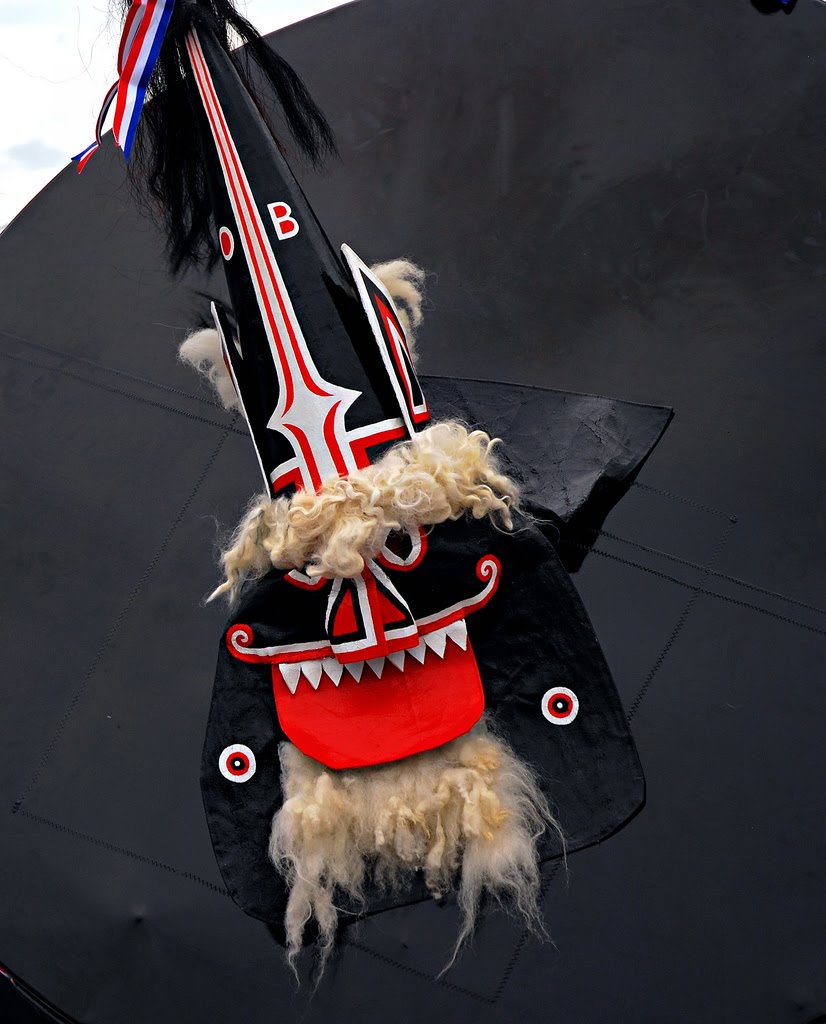 Thought I'd share this absolutely beautiful tune, which is very appropriate for it being the May Day today. And then there's some background information on what it's all about, in case you're curious about just how odd some people's customs are...
Chris Wood & Andy Cutting - Following the Old Oss
Lyrics by Tony Deane
Here's adieu to winter's wailing.
From now on it's plain sailing:
For the summer is a coming today
As we welcome the first of May.
- Chorus (after each verse):
- And we're following the old 'oss through the town
And we're following the old 'oss Padstow round,
All on a bright May morning,
All on the first of May.
And we'll rise in the morning early
And remember Merv and Charlie,
By the Golden Lion we'll stand and greet
The old 'oss onto the street.
And there'll be no cries or cribbin'
We'll not wear the blue ribbon.
It's the Old Red Horse and a crate of beer
That brings us our good cheer.
And we'll sing from noon till nighttime
And for one song it's the right time.
Only in Padstow will you hear
The day song loud and clear.
So good men, don't ignore us,
Join in a May day chorus;
Dance with the old 'oss, it's no sin
To watch the summer come in.

'Obby 'Oss festival
From Wikipedia, the free encyclopedia


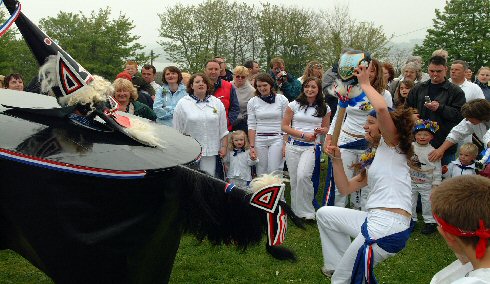
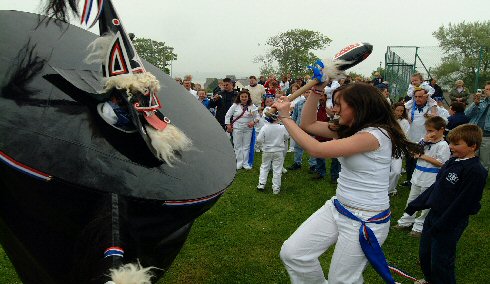
Padstow, in Cornwall, UK is internationally famous for its traditional 'Obby 'Oss day (dialect for Hobby Horse). Held annually on May Day (1 May), which in Cornwall, largely dates back to the Celtic Beltane, the day celebrates the coming of Summer.
The celebrations were the basis of the song "Padstow" by Steeleye Span.
The origins of the celebrations in Padstow are unknown. There is extensive documentary evidence of British community May Day celebrations in the 16th century and earlier, although the earliest mention of the Obby 'Oss at Padstow dates from 1803. An earlier hobby horse is mentioned in the Cornish language drama Beunans Meriasek, a life of the Camborne saint, where it is associated with a troupe, or "companions."
Origins
It has been speculated that such festivals have pre-Christian origins, such as in the Celtic festival of Beltane in the Celtic nations, and theGermanic celebrations during the Þrimilci-mōnaþ (literally Three-Milking Month or Month of Three Milkings) in England. It has also been proposed that the worship of horse deities such as Epona was found in ancient Celtic societies such as the possibly related Mari Lwyd ('Grey Mare') traditions of South Wales.
Festival practice
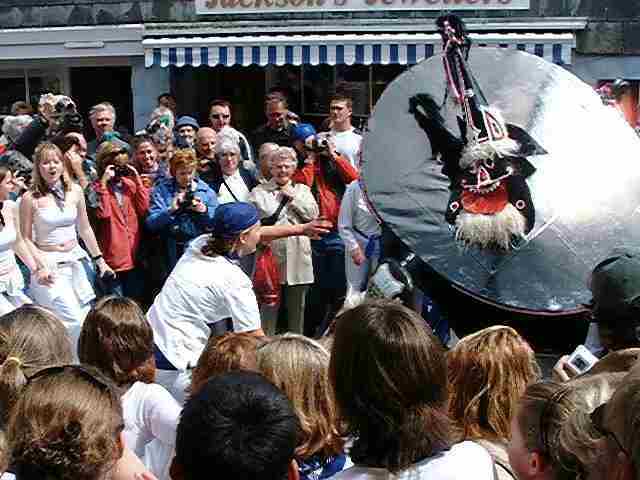
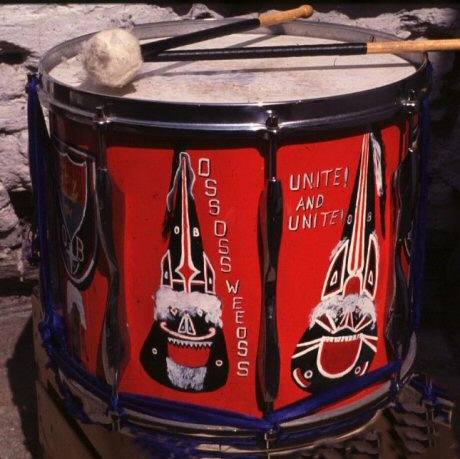
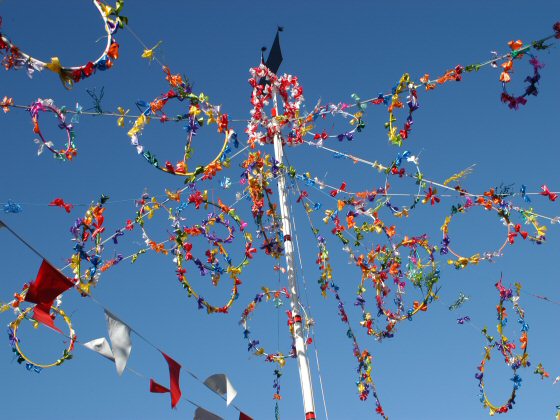
The festival itself starts at midnight on May 1 with unaccompanied singing around the town starting at the Golden Lion Inn. By the morning, the town is dressed with greenery, flowers and flags, with the focus being the maypole. The climax arrives when two groups of dancers progress through the town, one of each team wearing a stylised recreation of a 'horse.' The two 'osses are known as the "Old" and the "Blue Ribbon" 'osses. During the day a number of "Junior" 'osses appear, operated by children. Accompanied by drums and accordions and led by acolytes known as "Teasers", each 'oss is adorned by a gruesome mask and black frame-hung cape under which they try to catch young maidens as they pass through the town. The Blue ribbon oss is apparently of more recent origin. In the late 19th century it was supported by members of the Temperance movement who were trying to discourage the consumption of alcohol associated with the "old" 'oss followers. After the first world war the imperative of temperance was lost, and the 'oss became known as the Peace 'Oss. Each 'oss has a "stable" (in the case of the Old 'Oss, the Golden Lion Inn and the Blue Ribbon 'Oss, the Institute, from which they emerge at the start of the day's proceedings and retire at the end. Some time in the late afternoon the 'osses may meet at the maypole and dance together.
Night song
- Unite and unite and let us all unite,
- For summer is acome unto day,
- And whither we are going we will all unite,
- In the merry morning of May.
- I warn you young men everyone,
- For summer is acome unto day,
- To go to the green-wood and fetch your May home,
- In the merry morning of May.
- Arise up Mr. ..... and joy you betide,
- For summer is acome unto day,
- And bright is your bride that lies by your side,
- In the merry morning of May.
- Arise up Mrs. ..... and gold be your ring,
- For summer is acome unto day,
- And give to us a cup of ale the merrier we shall sing,
- In the merry morning of May.
- Arise up Miss ..... all in your gown of green,
- For summer is acome unto day,
- You are as fine a lady as wait upon the Queen,
- In the merry morning of May.
- Now fare you well, and we bid you all good cheer,
- For summer is acome unto day,
- We call once more unto your house before another year,
- In the merry morning of May.
Day Song
- Unite and unite and let us all unite,
- For summer is acome unto day,
- And whither we are going we will all unite,
- In the merry morning of May.
- Arise up Mr. ..... I know you well afine,
- For summer is acome unto day,
- You have a shilling in your purse and I wish it were in mine,
- In the merry morning of May.
- All out of your beds,
- For summer is acome unto day,
- Your chamber shall be strewed with the white rose and the red
- In the merry morning of May.
- Where are the young men that here now should dance,
- For summer is acome unto day,
- Some they are in England some they are in France,
- In the merry morning of May.
- Where are the maidens that here now should sing,
- For summer is acome unto day,
- They are in the meadows the flowers gathering,
- In the merry morning of May.
- Arise up Mr. ..... with your sword by your side,
- For summer is acome unto day,
- Your steed is in the stable awaiting for to ride,
- In the merry morning of May.
- Arise up Miss ..... and strew all your flowers,
- For summer is acome unto day,
- It is but a while ago since we hove strewed ours,
- In the merry morning of May.
- O! where is St. George,
- O!, where is he O,
- He is out in his long boat on the salt sea O.
- Up flies the kite and down tails the lark O.
- Aunt Ursula Birdhood she had an old ewe
- And she died in her own Park O.
- With the merry ring, adieu the merry spring,
- For summer is acome unto day,
- How happy is the little bird that merrily doth sing,
- In the merry morning of May.
- The young men of Padstow they might if they would,
- Far summer is acome unto day,
- They might have built a ship and gilded her with gold,
- In the merry morning of May.
- The young women of Padstow might if they would,
- For summer is acome unto day,
- They might have made a garland with the white rose and the red,
- In the merry morning of May.
- Arise up Mr. ..... and reach me your hand,
- For summer is acome unto day,
- And you shall have a lively lass with a thousand pounds in hand.
- In the merry morning of May.
- Arise up Miss ..... all in your cloak of silk,
- For summer is acome unto day,
- And all your body under as white as any milk,
- In the merry morning of May.
- O! where is St. George,
- O!, where is he O,
- He is out in his long boat on the salt sea O.
- Up flies the kite and down tails the lark O.
- Aunt Ursula Birdhood she had an old ewe
- And she died in her own Park O.
- Now fare you well and bid you all good cheer,
- For summer is acome unto day,
- We call no more unto your house before another year,
- In the merry morning of May.
Similar Hobby-Horses
'Obby 'Oss traditions also exist in nearby Barnstaple and Combe Martin. There is documentary evidence of an 'Oss' at Penzance in the late 19th century, made with a caped stick and skull which has formed the basis of the Penglaz Obby Oss which appears during the Golowan festival and the Montol Festival the oss is strikingly similar to the Mari Lwyd in Wales. There are some similarities between this festival and the Lajkonik hobby-horse festival in Kraków, Poland. In particular the idea that young women may be captured or struck with a stick in order to bring them "luck" or fertility suggests a pagan, or at least medieval origin. Lajkonik is 700 years old. Rather more recent is the Banbury Hobby-Horse festival, which started in 2000.

Note: this section didn't quite come out right. You might want to see the original page... The Mystery of Mayday | ||||||||||
CEREMONY AND CELEBRATION : TWO ‘OSSES - ONE TRADITION. Throughout the world communities carry out celebrations that are special to the people in those places. They have often taken place for so long that the origins have become obscured. This is true of the Padstow May Day celebrations, which are not entirely unique, but have retained a special character that sets them apart. The man beneath the gown wearing the fearsome mask assumes a certain menace. Another personality. A sense of magic and of time standing still electrifies the atmosphere on this day. How old is it? Pre- Christian ritual or rustic Elizabethan fundraiser? Who knows? More likely fragments of both, surviving because a community refused to let it die, emerging in the 21stcentury as a symbol of community spirit in an ever-changing world. Listen to the words of the song "Unite and unite and let us all unite for summer is acome unto day". WHAT PEOPLE WEAR. White tops and trousers once only worn by a few ex sailors have become the standard dress for both parties. The piratical look favoured by the Old ‘Oss party was introduced in the 1950’s. The wearing of spring flowers, the flags the greenery and the May Pole are all part of the May Day experience. Cowslips have special significance and are much in demand in the run up to the day. Once gardens were raided for tulips etc. but thankfully such anti-social behaviour is a thing of the past. (well almost!) "With the merry ring adieu the joyful spring" the song goes and at times the ’Oss dies a symbolic death only to leap up with renewed vigour. Ancient Fertility Rite some say, and don’t forget it is said that if a maid is seen caught under the gown she will become pregnant before the year is out. Who can argue with such a potent image? The "GREAT WAR" 1914-1919 THE PRESENT AND THE FUTURE. THE MYSTERIOUS MASK It is not known where the design for the Mask came from. The details are carefully copied year after year, including the letters O B that have long since lost their significance
NIGHT SINGING The night singing remains unaccompanied, a simple and almost reverential start to the proceedings after the Church clock has struck midnight. The route, mainly in the old part of town, visiting well-known residents and singing appropriate verses. This part of the proceedings is led by the Old ‘Oss Party and begins outside the Golden Lion Inn, finishing somewhere "uptown" in the early hours. "Rise up Alec Rickard and Gold be your ring, for Summer is acome unto day’ and bright is your bride as she lays down by your side, in the merry morning of May" "I warn you Young Men everyone, for Summer is acome unto day, to go into the greenwood and fetch your May home, in the merry morning of May. "Now we fare you well and bid you all good cheer, for summer is acome unto day, we’ll call once more unto your house before another year, in the merry morning of May". THE GOWN OR SKIRT THE TEASER
THE MUSICIANS
THE MAYPOLE. These were once common throughout Europe. In Padstow we know that one used to be erected in front of Cross House. The pebble cross was dug up each year and a decorated pole provided by the occupant, at that time the Tredwen shipbuilding family. The site itself could very well have had ritual significance but after complaints the pole was moved to its present position in Broad St where it is an impressive focal point.
CHILDREN'S OSSES. There seems never to have been a time when colts or junior Osses have not been a part of May Day. They start out much earlier than the main parties and usually finish before 10.30am. Their numbers and presentation may vary but the enthusiasm is undimmed.
THE PROGRAMME. THE FAREWELL. "I go where duty calls me, I go what ere befalls me, Farewell Farewell, my own true love."
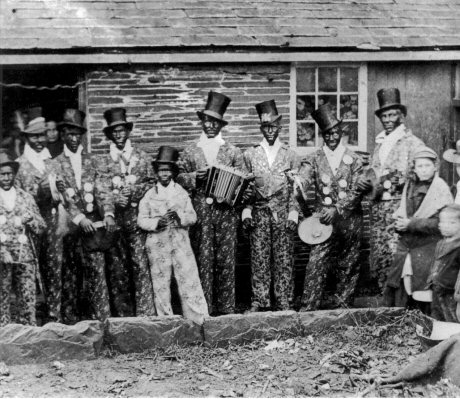
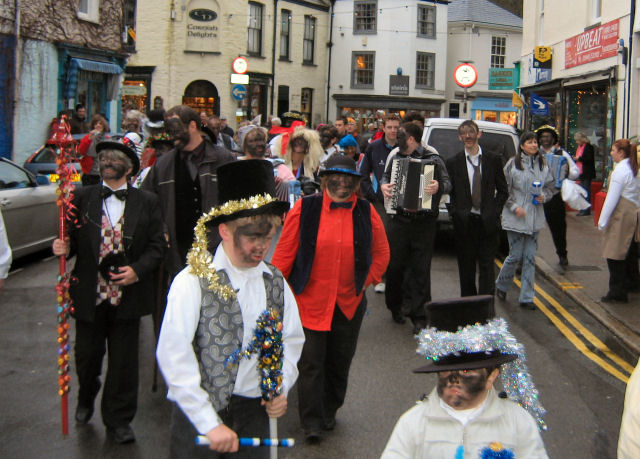
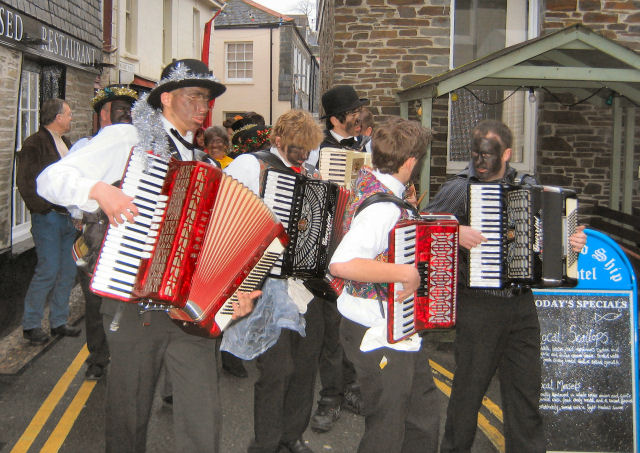
MUMMERS and MINSTRELS One could say that the May Day tradition has given Padstow an advantage over many communities in that a special awareness of this unique day makes other less high profile customs no less important to keep up. This is true of the Carols sung in December and the Boxing Day and New Years Day celebrations. On these days the drums and accordions are present as on May 1st but the numbers are relatively small and the dress echoes the minstrel groups that were such a big part of the popular music culture for over a century. The music repertoire also reflects this era – fragments of once popular songs strung together performed with noisy enthusiasm. It is perhaps just as well that some of the words pass unnoticed. Where else but in Padstow would the fate of "poor old Ned" who’s "gone where the good niggers go" be mourned with such feeling. Stephen Foster wrote this song and any suggestion that slaves may have sung it on the quayside of Padstow is unfortunate conjecture. It is worth noting that the concept of "black face" had been around in Europe long before white Americans started mimicking black entertainers. Mummers and Morris Dancers blackened their faces to avoid recognition and to assume an ‘other’ identity. On this basis we can readily assume that the arrival of the "minstrel" idea in Padstow replaced an earlier mumming tradition that is known to exist. It is claimed that visits to Capetown S.A. by minstrel groups inspired the formation of the ‘Coon Carnival’ also known as the ‘Minstrel Carnival’ which still takes place, post Apartheid, on New Years Day among the Cape Coloured community of that city. Old customs of the people, performed by the people, adapting to an every changing world Recommended reading – Demons of Disorder – Dale Cockrell – Cambridge University Press. The Mayday Photograph below right shows an interesting mix of costumes, some with black faces.
-------------------------------------- EXTRACTS FROM VARIOUS PUBLICATIONS RELATING TO MAYDAY May Day Mystery Update Feb 2005 In our various quotes from several 19c sources on Padstow and May Day we have previously omitted one of the earliest observations from C.S.Gilbert’s Historical Survey of the County of Cornwall published in 1820. It is significant in that it states "the inhabitants dress up a man in a horse’s skin". This description is not the same as the one detailed in the Bible Christian Magazine just a few decades later which relates fairly closely to the scene we witness today. (See Padstow Echo reprints) We are left wondering where Mr. Gilbert got his information from. However there is no mistaking the general feel for the occasion. The Rev Charles Prideaux-Brune was at this time the Lord of the Manor. He was the first in the Prideaux family to inherit the name Brune. Not yet finished was the mansion of Thomas Rawlings at Saunders Hill. Gilbert writes – "The streets of Padstow are in general narrow and uneven and many of the buildings have an ancient appearance, yet the town has been greatly improved within the last thirty years by the erection of several houses, which are in general very neat. These together with the numerous gardens which line the sides of the vale, in which the whole is situated, produce when viewed from the water, a very pleasing effect. There is an annual jubilee kept up at Padstow, on May 1st, known by the name of the Hobby Horse, in illusion to which, the inhabitants dress up a man in a horses skin, and lead him through the different streets. This odd looking animal amuses, by many whimsical exploits, the crowd which follows at his heels, particularly by taking up dirty water, wherever it is to be found, and throwing it into the mouths of his gaping companions. These tricks naturally produce shouts of laughter, and the merriments are accompanied by songs made for the occasion. The origin of this festival appears to be unknown." Taken from, "An Historical Survey of the County of Cornwall" by C.S. Gilbert – pub 1820. As well as the animal skin comment the "splashing" actions are interesting. Quoting from "Folklore of Cornwall" by Deane and Shaw (Tempus new edition 2003). Writing about May dew customs they say: "The importance of dew may have had some link with the May Day practice of sprinkling with water, ‘dipping’, to bring good luck. We have already noted that the Padstow Oss once visited Treator Pool for this purpose and all over Cornwall, dipping was a common custom. In Polperro and Pelynt anyone not wearing a lucky ‘may’ blossom was dipped, while in Looe, the boys went around carrying bullock horns filled with water. They walked through the town singing. "The first of May is Dipping Day The sixth of May is Looe Fair Day."Dipping as we are into the comments made on May Day in years gone by we end with those of Mr. George Rawlings who wrote to Robert Hunt the author of "Romances of the West of England" on Sept 1st 1865. "Formerly all the respectable people kept the anniversary decorated with the choicest flowers but some unlucky day a number of rough characters from a distance joined it, and committed some sad assaults on old and young – spoiling all their nice summer clothes, and covering their faces and persons with smut. From that time – fifty years since – the procession is formed of the lowest. The maypole was once decorated with the best flowers – now with only some elm branches and furze in blossom. The horse is formed as follows :- The dress is made of sailcloth painted black – a fierce mask – eyes red – horse’s head – horse hair mane and tail distended by a hoop. Some would call it very frightful. Carried by a powerful man – they could inflict much mischief with the snappers. No doubt it is a remnant of the ancient plays, and it represents the devil, or the power of darkness. They commence singing at sunrise". MAY DAY IS NOT LIKE IT WAS YEARS AGO Padstow Echo No 110 May 1999. Nothing new or startling with this statement, as we come round once again to this day of days for all Padstow people. Much has been written on the whys and wherefores of this ancient custom of ours and the story of when Thomas Tregaskis the Bible Christian miller tried to stop May Day has been quoted many times. His objections were not against revelry as such; otherwise why offer an Ox to be roasted for at least a seven-year period at considerable personal expense, but to that aspect that he saw promoted drunkenness. He had his supporters then and I suspect there are those today who would support his sentiments. He died in 1873, twenty-eight years after the Ox incident and we have from a memoir printed in the Bible Christian Magazine at that time a description of the day. The writer I feel was not totally disapproving of the event that he describes in such detail. "The people have long been in the habit of singularly dressing up some strong man on the first of May, and following him with noisy mirth" "There is the "gown" to begin with, made of canvas or some coarse material of the kind, painted black, caused to swell out to its proper dimensions by an enormous hoop at the waist, from which it tapers up to the neck; then the conical headpiece, answering the two-fold purpose of hat and mask, having a mixture of red and black, with a tuft of horse hair at the top. Attached to the hoop behind is a great sweeping tail and in front the "snappers" with iron teeth, and hair hanging down from it goat fashion; it is made to "snap" at the pleasure of the man inside, who holds a string in his hand, slackening which the under jaw drops with its own weight and a twick brings it up with a sharp sound to the upper-jaw. A great part of the fun consists in the man who carries the dress running after people making as if he would snap at them, or lift the gown over their heads." "The opinion which prevails among the more intelligent is that it is a relic of druidism, and verily it is worthy to have descended from the days of barbarism" "On the evening of April 30th, it might be seen that the town was all astir; for strong young men from the different yards were bringing up the "maypole"; adorning it with furze erecting it and making it sure with ropes, for the great events of the night. May morning comes, and at a given hour in the forenoon hundreds of young and old are at the windows, watching for a glimpse of the Hobby Horse. The eye of expectation was turned towards the Public House at the bottom of the central street. Here he comes! Crowds outside saluting him with loud cheering and firing of pistols over his head, loaded of course with powder only. There is dancing too and singing of "May Songs" Out into the country first thing, the air rending with frantic noises. Perambulating the town in the afternoon, getting up money, eating and drinking during the day, as they may. Now may be seen the special appendage of "smutting" - powder made into paste spread on the palm of the hand, then rubbed into anybody’s face, the clearer and fairer the face the greater the fun. Sometimes in place of Powder paste Lamp Black is used. The day finishes up with dancing, drunkenness, fighting &c. It is as if the Hobby Horse were Bacchus with his many worshippers." The writer obviously knew his May Day; I leave it to the reader to seek out the differences with the present day. The full text can be read in the Courtney Library at Truro Museum in the Bible Christian Magazine for 1873 (pages 309/10) or ask me for a copy. MAY DAY 1896 APRIL 30th MAY 7th 1896 "The influence of Bank Holidays has hardly reached this remote place… On the other hand May Day in Padstow when almost every other City, Town and Village is in its usual working order is a season of rejoicing amongst the lower classes of a kind beyond ridiculous." These words from over a hundred years ago send their own message to the present day custodians of the "Obby Oss" tradition. I’m sure our sympathetic reporter of the past along with "Boss" Harding the Headmaster for the "new" (1876) school’s first seventeen years, would be truly amazed at the way things are today. News reports taken from copies held in the Courtney Library Truro Museum, Headmasters Log Book, Padstow School, available for inspection by appointment at County Record Office, Truro.
Extracts from the PADSTOW ECHO Issue 113 May 2000 Another May Day has arrived. Shaped by countless generations of Padstonians from time "immemorial". Where did it all come from? What is it all about? You could say "just enjoy it me ansum" and be right. Does it really matter? The important thing is to "keep er gain". Part of the magic of this day lies in the fact that after centuries of adaptation it’s origins have become obscure. This has fuelled the curiosity of locals and visitors for many years you can read about it in Donald Rawe’s excellent book "PADSTOW’S OBBY OSS" or in Ronald Hutton’s "THE STATIONS OF THE SUN" a wider drawn account of the many Calendar Customs in Britain. From the early times of the Victorian "Folklore" collector comparisons have been made with similar customs involving ritual and masked figures in other countries and here are three examples. The first was noted in 1912 by Thurstan Peter an eminent Cornish Historian who was struck by the similarities in appearance with the "Duk Duk" in New Guinea. My recent enquiries have unearthed details of village theatre in the Eastern Highlands (National Geographic) that is very much alive and I have hopes to track down the "Duk Duk" sometime. Also from this source came details of a custom in LIBERIA where "An animated Hay Stack with ebony head dances to the throb of drums. It drives away evil spirits" the reporter was warned not to go too close. Thanks to my friends in the Strand Book Shop I obtained an old copy of the "Cornishman" magazine containing an article by Mary Utton describing a Dance held in Mexico called "SHALAKO" (Yes there was a movie, Sean Connery, Bridgett Bardot!!) the author had seen our "Oss" and was struck by the similarities. As in New Guinea there were strong elements of initiation and fertility in the ceremony. "The central figure was decorated with a feathered head-dress, while a tent like garment covers the dancer. The mask also has a wooden "beak" which the dancer snaps open and shut at certain points in the dance. Accompanying the "Shalako" was a side dancer. Together the two dancers stamped out the measured steps of the dance. The songs changed but the dance was always the same, and was to continue for six hours without respite. As a religious ceremony it was impressive; and as a physical feat of endurance it was no less so. Great reverence and awe was noticeable, especially on the part of the older Indians, while the children were frankly terrified and often hid beneath their mothers skirts." What do these glimpses tell us? Perhaps nothing more than the fact that, in so many ways, people from other races and cultures, are not so different from us. This yearning to understand and identify our "place" in life unites us all. If you feel that special feeling on the day, you will know what I mean. A hooden "horse" called "Hob nob" once accompanied a giant figure in parades at Salisbury Wilts. He can be seen in the City Museum there.
Ritual Animal Disguise Padstow Echo May 2001 We should not be surprised at the amount of stuff written about May Day over the years. One book written 23 years ago by E.C. Cawte recently came to my notice called RITUAL ANIMAL DISGUISE it puts Hobby Horses into the context of other similar customs, sensibly urging readers to go to the original sources so that they make their own judgements urging that they read this book with care so that they do not misinterpret it. Sound advice indeed. At the end of Chapter X the author makes some interesting comments on SEASONS OF PERFORMANCE. "The structure of the Padstow ceremony suggests that a May ceremony of a typical kind has had a horse attached to it, so that the Padstow Horse may, at one time, have had a different time of performance which could have been Christmas, like the Penzance horse, the only other one known in Cornwall. (Edmonds 1858 concerning guise dancers). Similarly the structure of the Coombe Martin ceremony suggests that the horse and fool represent a separate performance. There is nothing in the Minehead performance to suggest that it has ever taken place at a season other than May. However, the vast majority of horses appear at about Christmas, the Penzance horse certainly did, and it seems possible, no more, that these horses may all at one time have appeared at Christmas. Certainly the designs and ceremonies of these horses are unusual, and they must surely represent local adaptations of customs acquired from elsewhere." A fascinating study. Get it out from the Library it’s no longer in print. JB. |




April 28, 2010
The Truth will Set You Free...

The music business is a cruel and shallow money trench - a long plastic hallway where thieves and pimps run free, and good men die like dogs. There's also a negative side."
- Hunter S. Thompson
April 24, 2010
'Spider' John Koerner - Spider Blues

Well it's been forever since I've posted anything blues- or jug-band-related, so I thought I'd reward the patience of my blues-loving readers and post this rarity. The most striking thing about this record, to me, is how it just feels subtly 'off'. As in, this is a white kid trying his very best to sound like a big black guy, and getting really close - I mean blindfold test close! He even took the 'handle' of Spider to add to his name. A la Blind Joe Death, you know? Same impulse, different direction. Like John Hammond too. But it's still, not quite right: not quite natural. But it's a subtle point, and aside from that, the record's really fun, the sound sparse bouncy, the playing finely honed but still raw. Really it's worth the price just for the last track, Rent Party Rag, in which Spider John sounds like a one-man-jug-band. And, apparently, he was the primary influence on Peter Lang in his early development.
"Alone among the young blues revivalists, Koerner had a sound that was completely idiosyncratic and personal. From the first guitar riff, there was never any doubt about who was playing. Today the material has changed but the sound is intact...spare and funky, with lots of open spaces between oddly placed notes, all of it held together with his impeccable timing."--Blueswire

Anyone who maintains that a white man can’t sing the blues has likely never come across “Spider” John Koerner. A Rochester native who was integral to the Minneapolis, Minnesota folk scene of the ’60s, Koerner has spent much of his career creating albums that inspired generations of white folk artists to explore their roots.
Bob Dylan, who encountered him in the Dinkytown neighborhood near the University of Minnesota, sang his praises in Chronicles; so have artists as diverse as Bonnie Raitt and David Bowie. Unlike the popular pop adaptations of stolen and reinterpreted songs in the folk style that were passed off as real folk music (from the Kingston Trio, the Weavers and Peter, Paul and Mary), Koerner and his associates Dave “Snaker” Ray and Tony “Little Sun” Glover made music that felt authentic. Though Ray passed away some years back, Koerner has performed consistently both with Glover and also solo, which is a boon to those who remember the ’60s as well as those who experienced it on TV.
As any self-respecting listener is well aware, the history of American popular music is a rather messy affair, characterized by a rape and tiptoe two-step that’s anything but pretty. What’s more difficult to admit is that sometimes both tendencies appear in the foreground at once; when a British “blues” band co-opts a Robert Johnson tune in full, it’s not entirely clear whether they’re playing tribute or trampling or both. It may be better to trust your gut, and it’s hard to trust the saccharine cleanliness of blues better heard in the parlor than in the barroom. And the brilliant thing about Koerner, Ray and Glover is that there appears to be less of a gulf between them and Huddie Ledbetter than with many of their Minnesota contemporaries. Blues is a dirty affair, after all, and Koerner’s music is anything but pristine.
Woe to the musician whose second album was praised in the liner notes for its “real understanding of Negro musical styles” and how it is “unbelievable that any white musician could come so close to the sound of Negro performance.” But it’s a challenge to listen to “Hangman” and “Ramblin’ Blues” from Blues, Rags & Hollers and distinguish the Ledbetter from the Koerner.
Speaking to him from his home on New Year’s Eve, Koerner admitted that the whole thing was, in a sense, pretty “weird.” “It’s kind of strange that at that age, I wanted to act like a black guy. And be like black guys — some of whom didn’t know how to read. Here we were, college kids, who got it in our mind to do like it was in the songs — drinking and partying, and chasing women.” Whatever the intentions, though, Koerner, Ray and Glover created music that went beyond mirroring the idiom of blues to create something wholly original within a tradition. It is nothing less than inspiring that Koerner is keeping the flame burning.
[Text by Luke Z. Fenchel; From the Ithaca Times]

Biography by William Ruhlmann
"Spider" John Koerner has been an influential practitioner of traditional folk music and country blues since the days of the late-'50s/early-'60s folk revival. Both in his group, Koerner, Ray & Glover, and on his own, he has helped popularize early folk and blues music through his performances and recordings, directly affecting the careers of Bob Dylan and Bonnie Raitt, and influencing many others.
Koerner grew up in Rochester, NY, where he was initially interested in flying, not music. He obtained a student glider-pilot license at 15, and when he graduated from high school in 1956, he enrolled at the University of Minnesota in Minneapolis to study aeronautic engineering. But in 1958, he was introduced to folk music by a campus acquaintance and took to it heavily, learning to play the guitar and dropping out of college to travel the country as a folksinger. He briefly joined the Marine Corps, then returned to Minneapolis in the fall of 1959, where he became a fixture in the coffeehouses of Dinky Town, the bohemian area around the University of Minnesota. There he encountered and played with a new undergraduate, Bob Zimmerman, who soon took the stage name Bob Dylan. He also met guitarist Dave Ray, who introduced him to harmonica player Tony Glover in the spring of 1962 while they were in New York City. The three began to play together there and back in Minneapolis formed the group Koerner, Ray & Glover. They adopted nicknames in the manner of old blues players: Ray became "Snaker," Glover "Little Sun," and Koerner, in reference to his long, skinny arms and legs, "Spider."
Koerner, Ray & Glover recorded an album, Blues, Rags & Hollers, that was released on the tiny Milwaukee-based independent Audiophile Records label in June 1963. Folk label Elektra Records then signed the group and bought the album from Audiophile, reissuing it in an abridged form in November. Lots More Blues, Rags & Hollers followed in June 1964. The trio appeared at the Newport Folk Festival in July, and their performance was recorded for the Vanguard Records album Newport Folk Festival 1964: Evening Concerts III (released in May 1965) and filmed for the motion-picture documentary Festival (which opened in October 1967). The group was always a loose aggregation, frequently breaking down in performance into duos and solos, and it was natural for the three to play separately. In 1965, Koerner and Ray each made solo albums for Elektra (actually assembled by the label from solo performances done at Koerner, Ray & Glover recording sessions). Koerner's was Spider Blues, released in May. He then appeared at the 1965 Newport Folk Festival, his performance captured on the Vanguard LP Festival -- Newport Folk Festival 1965, released in 1966. Koerner, Ray & Glover made one more album for Elektra, The Return of Koerner, Ray & Glover, released in October 1965, and an archival album of 1963-64 live recordings, Good Old Koerner, Ray and Glover (aka Live at St. Olaf Festival), was released by Mill City Records in January 1972. But the trio ceased to be a full-time act by 1966.
Koerner continued to play the folk circuit as a solo performer, appearing at such prestigious clubs as the Ash Grove in Los Angeles and Club 47 in Cambridge, MA. He made a trip to England in 1968 and again appeared at the Newport Folk Festival in 1969. That year, Elektra released his second album, Running, Jumping, Standing Still, which featured piano player Willie Murphy and included many original compositions, among them "I Ain't Blue," which Bonnie Raitt later covered on her self-titled debut album. By the early '70s a lack of success prompted Koerner to retire to Copenhagen, Denmark, after recording the album Music Is Just a Bunch of Notes for Dave Ray's Sweet Jane Records label. (The LP was released in May 1972.) His European retirement lasted for a year or so, its ending formally marked by another Sweet Jane release, Some American Folk Songs Like They Used To, in October 1974. The album showed that he had moved more toward traditional folk music rather than the folk-blues with which he had been associated.
Koerner moved back to Minnesota in 1977 and maintained his career on a part-time basis while also working outside music. He returned to greater national visibility due to his association with Red House Records, which released his first album in more than 11 years, Nobody Knows the Trouble I've Been, in 1986 (it had been recorded in 1980), followed by Raised by Humans in March 1992 and StarGeezer in May 1996. Red House also reissued the Koerner, Ray & Glover albums Blues, Rags & Hollers, Lots More Blues, Rags & Hollers, and The Return of Koerner, Ray & Glover, as well as Koerner's Running, Jumping, Standing Still, on CD. In 1997, a new Koerner, Ray & Glover live album, One Foot in the Groove, was released on Tim/Kerr Records. Koerner underwent emergency triple bypass surgery in January 1998, but recovered and returned to performing. Lacking health insurance, he suffered astronomical medical bills, but a series of benefit concerts paid them off. In the early years of the new millennium, he continued to perform, both solo and as a member of Koerner, Ray & Glover.

John Koerner - Spider Blues
Year: 1965
Label: Elektra
Side A
- Good Luck Child *
- I Want To Be Your Partner
- Nice Legs
- Spider Blues *
- Corrina
- Shortnin' Bread
- Ramblin' And Tumblin'
- Delia Holmes
Side B
- Need A Woman
- I Want To Do Something
- Baby, Don't Come Back
- Hal C. Blake
- Things Ain't Right *
- Rent Party Rag
* with Tony Glover on mouth harp
note, a couple of tracks have some ripping errors, due to my computer's low-memory. I might try to do a re-rip at some point but just enjoy the bizarre time-changes for now...
vinyl, cleaned | mp3 >256kbps vbr | w/o cover
This album so far as I know has never been reissued, either in physical or digital form.
But you can find others On Muddy Sava Riverbank, and be sure to check out the man's website - he's still gigging!
Subscribe to:
Posts (Atom)