Donate to the Grapevine

Express your thanks by leaving the pirate a tip!

August 29, 2010

Modern Mandolin Quartet - Modern Mandolin Quartet


I really ought to post more classical albums. There's some really terrific stuff in that mega-genre, and while some of it is geared for pampered victorian prunes, plenty of it can be enjoyed by those with a flair for the earthy wilderness of folk music, like myself. With that said, I've noticed that the classical pieces I tend to gravitate towards are for small ensembles. Maybe it's because a group of 4 musicians can just play so much more together than 80 or 100. And because I like to hear the sound of the instruments and hear their overtones, which get lost when you move to a symphonic scale (though you gain other shimmering qualities).

Of course, another reason I don't post a lot of classical music is that I'm not enough of a follower of the classical blogs to know what's out there and what's not, nor am I enough of a connoisseur to be able to have a lot to say about the works. It seems that to be a classical reviewer, one needs to have an encyclopedic knowledge of other versions of whatever piece one is describing, in addition to having a keen enough ear and long enough attention-span to say something meaningful. And I'm a young lad. I don't have those things. Even my frequent trips to the library to procure and rip whole sets of classical performers, composers, etc. have had small effect on me. I cut my teeth on heavy metal and prog-rock, before I turned to folk and blues and bluegrass. I just don't have a classical ear.

What I do have, however, is a cheerful irreverence to tradition and a fresh perspective that comes from the hodgepodge of musical ephemera that is the source material for my life. And I have the advantage of never having studied music in any formal capacity. So I relate to this music like any string band or dixieland band or bluesman. I just listen. And I notice a few things.

This album is really sparkling. Having plucked instruments rather than bowed instruments gives a totally different tonal quality to these well-known pieces, and these players play with such phenomenal precision that they pluck as one. And they pick both aged and modern pieces that have each earned their right in the canon of well-regarded classics. But the treatment they get here makes them sound as fresh as if they were written yesterday (and for a 22-year-old album, that's pretty good). But this isn't a crossover album either. They don't take the 12 'Greatest Hits' of the string quartet repertoire and give them paltry mandolin arrangements. There's serious music here, and serious arrangements. But of course, Mike Marshall's around, so nothing gets so serious that it can't have a crooked smile in there somewhere...


Modern Mandolin Quartet is:
Chamber group using the instruments of the mandolin family (two mandolins, mandola and mando-cello) to perform classical and contemporary compositions from around the world.

"MMQ play dead-straight, spot-on, and packed with freshness and vitality of a kind that is rare in material of this type. These are not down-scaled, make-em-easy, just-for-kicks charts either - they are a Major Thing. TRIPLE MUST!"
-FANFARE MAGAZINE


About the MMQ:
The Modern Mandolin Quartet was formed in 1985 to give a new voice to that most American of musical instruments, the mandolin. Following the tradition of the mandolin orchestras and chamber groups from the early twentieth century, the MMQ uses the instruments of the mandolin family which correspond to the conventional string quartet (two mandolins, mandola, and mandocello).

The Quartet's goals are to introduce audiences to the modern mandolin family of instruments, to increase the repertoire of original and arranged music for the instrument, and to bring the mandolin into the next millennium by commissioning new works.

Their early recordings, Modern Mandolin Quartet and Intermezzo, were explorations of the world of classical music using mostly transcriptions; Nutcracker Suite featured the first piece composed for the group, the first guest artists and the first complete transcription of a major work. Their 1994 recording, Pan American Journeys, explored music of the Americas; their 1999 recording, Modern Mandolin Quartet - Interplay, features pieces specially commissioned from David Balakrishnan (of Turtle Island String Quartet fame) and Utah composer Tully Cathey, as well as a string quartet by Terry Riley.

The Modern Mandolin Quartet members are Dana Rath and Matt Flinner (mandolins), Paul Binkley (mandola), and Adam Roszkiewicz (mandocello). The members of the Quartet come from diverse backgrounds including classical, jazz, rock, and folk.

To date the Quartet has arranged and performed over 90 works originally written for orchestra, chamber ensemble, piano, guitar, and string quartet, including arrangements of traditional classical music (Vivaldi, Bach, Corelli, Mozart, Ravel, Bernstein), string quartets (Mozart, Bartok, Dvorak, Villa-Lobos, Terry Riley), music from the mandolin's historical roots, (American Bluegrass, Brazilian Choro, Italian folk songs), and commissioned works (David Jaffe, Tully Cathey, David Balakrishnan, Philip Bimstein, Larry Polansky, and Edgar Meyer).

The Modern Mandolin Quartet began recording in 1988 with Windham Hill/BMG; they have released four albums to date, with sales in excess of 130,000 units worldwide. In addition to their own albums, the group appears on samplers from Polygram Records, Well Tempered Productions, and Acoustic Disk. In 1994 the Quartet received a National Endowment for the Arts Chamber Music grant to tour and perform new American music. They are the 1995 recipients of a grant from the Meet the Composer/Lila Wallace - Reader's Digest Fund Commissioning Program, which funded David Balakrishnan's Interplay and Tully Cathey's Elements. These works premiered in 1997 at Merkin Hall in New York City; both are featured on Interplay.


Modern Mandolin Quartet - Modern Mandolin Quartet

Year: 1988
Label: Windham Hill (don't be fooled! this is not new-agey!)

Biography by Linda Kohanov
This ensemble was formed in the mid-'80s as the brainchild of Mike Marshall, an internationally acclaimed mandolin player best known for his work with David Grisman and Montreux. Marshall was looking for a way to bring respectability to an instrument primarily known for bluegrass and quaint folk tunes. Toward this end, he established a string-quartet-style group featuring the extended family of mandolin instruments. Marshall and Dana Rath play standard mandolins (which take the place of violins), John Imholz plays mandocello (with a range similar to the cello), and Paul Binkley holds up the middle with his mandola (the alto counterpart to the viola). Together they interpret well-known classical works and premiere newly commissioned compositions of "serious mandolin music."

Review by Linda Kohanov
A fine debut for Windham Hill, it's not quite as sophisticated as Intermezzo.

Tracks
1 Concerto in D Minor for Two Violins (Vivace) - Bach - 3:22
2 Canzonetta - Mendelssohn - 4:07
3 Abendkonzert - Hindemith - 2:48
4 Teasing Song/Limping Dance - Bartok - :48
5 Pizzicato - Bartok - :54
6 Asturiana - DeFalla - 2:07
7 La Vida Brevé (Dance #1) - DeFalla - 3:40
8 Galop - Stravinsky - 1:52
9 Assez Vif et Bien Rythme - Debussy - 4:34
10 Pavane Pour la Belle au Bois Dormante - Ravel - 2:07
11 Lebhaft - Hindemith - 1:09
12 Langsam - Hindemith - :53
13 Dance of the Maramaros - Bartok - :37
14 Valse (Ma Mie Qui Danse) - Bartok - 3:25
15 Alla Danza Tedesca - Beethoven - 3:46

* out-of-print


August 24, 2010

The Music Gatherer


Hey folks,
Sorry I haven't been posting much lately. 'Real life' has gotten increasingly busy.

Here's a great blog I just discovered:

The Music Gatherer:
Rare and Obscure Scottish Folk and Traditional Music

Beautiful stuff!

July 21, 2010

Rachid Halihal - Traditional Songs of Fez, Morocco


I'd never heard of this guy before picking up the cd used a year ago. But it's pretty damn good music, I must say. It might be worth mentioning that all the guitars and fiddles in the world have evolved from things basically like what Rachid plays (oud & Moroccan fiddle), and he's quite masterful on both.

How to describe this music?
It's like a a party that's a devotion at the same time. Like your call-and-response exquisite church music got a life and became ecstatic call-and-response festival. And it has all these crazy microtones - in the singing, the oud and violin playing. It's actually quite affecting to hear someone whose voice can be gruff and guttural one moment reach scintillating heights of delicacy the next. Kinda like Blind Willie Johnson... only different.

Anyway, I don't have too much to say about this. It's just thoroughly enjoyable. So enjoy!


Artist’s biography for Rachid Halihal:
As a world-class musician, Rachid Halihal brings to the community the true character and spirit of musics from the classical Egyptian repertoire which is much loved throughout the Middle East; from the Fertile Crescent; from diverse regions of Morocco and North Africa; and also the mezmerizing music of the Arabian Gulf.

As a child, growing up in Fez, Morocco, Rachid played the nei and sang, imitating the famous singers of the time. At age fourteen he entered "Dar Aadyil" the Conservatory of Music in Fez. At first he studied Western classical and Andalus music on piano and violin. He soon expanded to include a variety of other instruments in order to better express his native music. In addition to his voice, which is best featured in the Andalus style, his strongest instruments are the oud (similar to a lute without frets) and the violin, which he plays in both the classical manner and upright resting on the knee for Moroccan folkloric music.

Until 1986, Rachid played in an Andalus orchestra in Fez, and at various occasions throughout Casablanca. Then, over a span of fourteen years, he presented his music to a more varied audience. This included an extended stay in the Ivory Coast; one year in Sweden; one year in Finland, where he and his seven piece band played at the Helsinki International Music Festival sharing the bill with Cheb Khaled; and in the coastal city of Agadir, Morocco, Rachid fully managed a night club, its musicians, and folkloric troupe for seven of those years, playing his music every night for the club’s primarily touristic and Arabian clientele. On his violin, he accompanied many of Morocco's well known singers who toured to Agadir. On many occasions he played with Mohammed Abdo, one of the Arabian Gulf's most loved singers. During two years, Rachid was invited numerous times to the Arabian Gulf as a singer and oud player in his own right.

In Summer 2004 Rachid toured the USA with The Chicago Classical Oriental Ensemble playing Moroccan Andalus music with Abdelfattah Bennis, including Genesis at the Crossroads Festival in Chicago. He was presented at Columbia University in concert with visiting Israeli singer, Michel Cohen, with Moroccan singer Pinhas in New York and Miami, as well as other ethnic concerts and events throughout New York City. In 2003-4, Rachid was presented with his band at Denver's Global Groove World Music Festival, with Nawang Kechong in Aspen, in two separate Mid-East Dance concerts at the Boulder Theater, Colorado, with Souhail Kaspar in Denver, Boulder, Portland, and Los Angeles. Rachid also played at the Los Angeles County Museum of Art for the inaugural King Tut exhibit in the US on June 15, 05. In Summer of '05 Rachid toured the USA and Canada with Rachid Taha (Algerian/French) Rai-rock band.


Rachid Halihal - Traditional Songs of Fez, Morocco

Year: 2006

Tracks:
01 Allala Ylali
02 Dor Biha
03 Lemlain
04 Elazri
05 Mahani Ezin
06 Khalini Maak
07 Kaftank Mahloul
08 Jeet Nsaydou
09 Lattar
10 Ana Dene Den Allah
11 Ane Layle Moulate
12 Fen Shak Leatetk
13 Rasael Algeran

July 20, 2010

Bertram Levy & Peter Ostroushko - First Generation


Back to some vinyl again!
We have here another incredible out of print Flying Fish LP. There is no information on this album pretty much anywhere, and little to none about Bertram Levy. Peter Ostroushko, however, is known as one of the finest mandolin and fiddle players in America. Aside from being able to play anything from bluegrass to klezmer to classical, Ostroushko is always characterized by a sparklingly clear and beautiful tone. Like Doc Watson, he can play dazzlingly fast runs, but never puts in a note that isn't needed. If in doubt, he takes the conservative approach rather than the showy one. Let the music breathe a little, you know? Let the silence speak.

This album is the only album made by a group of musicians calling themselves First Generation. They are all first generation immigrants to the US. And that is what gives this album its most distinctive and blogworthy quality. In fact, that is what gives the USA its most distinctive and noteworthy quality. The meeting ground. The melting pot. All American music is the product of immigrants coming together, interbreeding, intersocializing, and interspersing. But sometimes people forget that, and bluegrass fans boo black musicians, and white folks get accused of ripping of jazz & blues musicians, and everyone conveniently forgets that Native Americans exist. So these first generation immigrants remind us. Fruitful births happen when different people come together. Monocultured tradition breeds sterility and hemophilia. That's what a hick is. You'll find them still in royal families... Dynamism comes from the interplay of radically different bodies. Polyculture is permaculture. To blindly follow a tradition in a rapidly changing world is to render oneself an irrelevant artifact of the past before one has even entered the present. That's why World Fusion music works. The cultures of our world are fusing anyway, faster than we can even know. May as well have a music that's relevant. Lots of folks are realizing that now. First Generation realized it 25 years ago.

And actually, the ironic thing is that they manage to keep the traditions separate and distinct even as they meld themselves together in playing them. It's less like a melting pot than a meal with a bunch of different dishes, each from a different part of the world, but all cooked by the same team of crazy chefs.

Enjoy this, because I don't often post Celtic Ukranian Polka Hoedowns.

A little info on Bertram Levy thanks to Gadaya:
He played mandolin with The Hollow Rock String Band (with Alan Jabbour on fiddle) at the end of the 1960's , recorded a superb solo banjo lp ("That old gut feeling") at the beginnig of the 1980's and became a great concertina player as well. A few years ago he became interested in Tango music and learned the bandoneon. A complete and versatile musician that's for sure..


Peter Ostroushko

Biography by Craig Harris

The musical traditions of the Ukraine are fused with an aural reflection of America's Midwest by mandolin and fiddle player Peter Ostroushko. Best known for his regular appearances on National Public Radio show, A Prairie Home Companion, Ostroushko (pronounced: Oh-STREW-shko) has consistently achieved high standards with his solo recordings and duo albums with Minnesota-based acoustic guitarist Dean Magraw. Equally skillful on fiddle and mandolin, Ostroushko is, according to flatpicking guitar wiz Norman Blake, "the next Jethro Burns and Johnny Gimble rolled into one."

Ostroushko has been playing music most of his life. As the son of Ukrainian immigrants, Wasyl and Katerina Ostroushko, Ostroushko grew up listening to his father, a shoemaker, playing traditional songs of his homeland on guitar and mandolin.


Although he appeared on A Prairie Home Companion, in 1974, the first year that the show was broadcast on Minnesota Public Radio, Ostroushko didn't become a full-time cast member until the show went national in 1980. During the six years in between, Ostroushko worked as a session musician in Nashville. In addition to working on albums by Jethro Burns, Emmylou Harris, Willie Nelson, Chet Atkins, and Johnny Gimble, Ostroushko played mandolin, though uncredited, on the tune, "If You See Her, Say Hello," from Bob Dylan's album, Blood on the Tracks. Ostroushko also toured with Robin & Linda Williams and Norman & Nancy Blake.

Sluz Duz Music, Ostroushko's debut solo album, was released in 1982. The title referred to Ostroushko's description of his music, based on the Ukrainian words meaning "over the edge" or "off his rocker". Ostroushko's second effort, Down the Streets of My Neighborhood, released in 1986, included a medley of Ukrainian songs and an interpretation of Hank Williams' "Hey, Good Lookin'" sung in Ukrainian.


Ostroushko's albums have featured an illustrious list of supportive musicians. The Mando Boys, Ostroushko's third album, released in late 1986, featured a fez-wearing group that began when Ostroushko formed The Lake Woebegone Municipal Mandolin Orchestra for a tour with Garrison Keillor and the cast of A Prairie Home Companion. The same year, Ostroushko recorded First Generation with anglo concertina player Bertram Levy. Ostroushko's next album, Buddies of Swing, released in 1987, was a jazz-tinged collaboration with Jethro Burns (mandolin), Johnny Gimble (fiddle), Butch Thompson (piano), Dean Magraw (guitar), and Prudence Johnson (vocals). After recording a solo album, Blue Mesa, released in 1989, with guest appearances by Norman & Nancy Blake, Daithi Sproule, and Magraw, Ostroushko and Magraw collaborated on an album, Duo, released in 1991. Ostroushko's most successful recording, Heart of the Heartland, released in 1995, was an all-instrumental exploration of the Midwest. In addition to receiving a NAIRD award as "best independently released folk instrumental album," the album was featured on Ken Burns' PBS documentary, Lewis and Clark. The following year, Ostroushko released, Pilgrims on the Heart Road, which he described in the liner notes as "a collection of songs that are a companion piece to Heart of the Heartland." Sacred Heart followed in 2000.

Ostroushko has worked closely with the Children's Theater in Minnesota and the ACT Theater. One of his most ambitious projects was an appearance as lead ukulele player, with the Minnesota Symphony Orchestra.


2nd Bio:

When they write the book on Peter Ostroushko, they may mention that he loved his family and music and cooking and baseball. But there's no doubt they'll say he was one of the most accomplished instrumentalists and gifted composers of his generation.

The die was cast early on. Growing up in the Ukrainian community of northeast Minneapolis, Peter heard mandolin, balalaika and bandura tunes played by his father and family friends at get-togethers in their home and in church. It's the music that still echoes in Peter's memory and provides the basis for many of his compositions.


The musical road that led Peter to this point has had its share of twists and turns. He was still in high school when his career as a professional musician began. Asked to compose and play the music for a one-man staging of A Christmas Carol, Peter fell in love with theater. Soon he was honing his skills at the Children's Theatre School in Minneapolis.

He began to take up instrument after instrument, finally opting to concentrate on fiddle and mandolin. During the next three decades, he made his mark as a sideman, session player, headliner and composer. His first recording session was an uncredited mandolin set on Bob Dylan's Blood on the Tracks. He toured on a regular basis with Robin and Linda Williams, Norman Blake and the Rising Fawn Ensemble, and Chet Atkins. He also worked with the likes of Jethro Burns, Emmylou Harris, Willie Nelson, Johnny Gimble, Greg Brown, John Hartford and Taj Mahal, among a host of others.

As a solo performer, Peter has produced a number of recordings, including Down the Streets of My Old Neighborhood, Slüz Düz Music, and the three albums that make up his Heartland Trilogy: Heart of the Heartland, Pilgrims of the Heartroad and Sacred Heart. His latest is Meeting on Southern Soil, a collaboration with longtime friend Norman Blake.

Peter has spent more than 25 years as a frequent performer on A Prairie Home Companion, and for a few seasons, he did a stint as Music Director for the popular radio show. You may have caught Peter on TV, too. He's appeared on Austin City Limits, Late Night with David Letterman, even Mr. Rogers' Neighborhood.


Peter's talents extend beyond the realm of folk and jazz. Several years ago, the Minnesota Orchestra hired him to play Mahler's Seventh Symphony. The whole piece only has about 15 minutes of mandolin – and that's not until the fourth movement. Peter figures that Mahler must have had a brother-in-law who played mandolin and needed work. You can bet if Mahler had known Peter, he would have written the mando a bigger part.

When the Saint Paul Chamber Orchestra's season included a mandolin concerto by 18th-century composer Giovanni Paisiello, they called – who else – Peter Ostroushko. And they did the same when they presented Vivaldi's mandolin concerto and his concerto for viola d'amore and mandola. Finally, they decided to perform one of Peter's own compositions, the exquisite Prairie Suite.

Composer Peter Ostroushko has undeniably come into his own. His works have been performed by the Saint Paul Chamber Orchestra, the Minnesota Sinfonia, the Rochester (Minnesota) Symphony Orchestra, the Des Moines Symphony and the Kremlin Chamber Orchestra, among others. Twin Cities Public Television commissioned Peter to provide music for their nationally distributed programs, The Dakota Conflict and Grant Wood's America. Ken Burns used music from Heart of the Heartland for his PBS documentary Lewis & Clarke, and Peter's haunting arrangement of Sweet Betsy from Pike was underscore for Burns' Mark Twain.
And remember the Children's Theatre Company, where a teenage Peter Ostroushko first developed his interest in performance? Decades later, they commissioned their one-time student to write the music for a production of Little Women.

In 2001, Peter was the recipient of a Bush Artist Fellowship for Music Composition. And, along the way, he has picked up a N.A.I.R.D. Indie Award, and a couple of Minnesota Music Awards. His music has made its way around the world. Wherever it's heard, there's another bunch of fans eager for more.

Peter, with his wife and daughter, still makes his home in Minneapolis. He continues to compose and perform. He can still whomp up a first-rate batch of borscht. And he still roots for the Twins. Some things never change.


Bertram Levy & Peter Ostroushko - First Generation

Year: 1986
Label: Flying Fish


Tracks:
01 Paddy-rocker
02 Shifting Sands {Klezmer frailach}
03 Swallow's Tail and High Reels {Irish}
04 Hommage a Dorothee {Quebec waltz}
05 Jig Medley: Fiddle Hill/Fair Jenny/Always Able {New England}
06 Reb Dovidls Nign {Klezmer}
07 Ukranian Polka {Ukraine}
08 Medley: Doc Kammerer's {Utah}/Flowers of Edinburh {Revolutionary dance tune}
09 Les Amantes Infideles {Parisian cafe waltz}
10 Southern Sonata: Howdown - Old Molly Hare / Gospel - My Sorrows Encompass Me Round / Moonshine - Boatin' Up Sandy / Hospitality - Rock the Cradle Joe

vinyl, cleaned, mp3 >256kbps
* out-of-print

and in the spirit of Spirits & Spices, here are some Musical Recipes by Peter


July 19, 2010

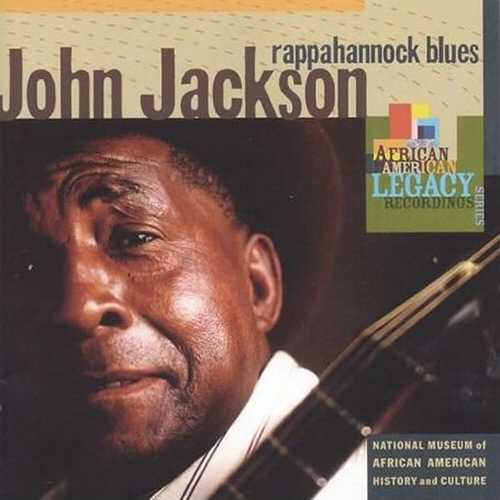
John Jackson - Rappahannock Blues


I haven't really posted much of anything lately, owing to the fact that I now have two jobs and little time for reviews... so I also neglected to post this news which is now a month late, about a newly-released album by folk-blues troubador John Jackson, which was sent to me by Smithsonian Folkways. Without further ado:

John Jackson represented, if anything, the crossroads. No, not the silly Robert Johnson devil-styled crossroads. I mean the place where different traditions meet. Blues, Folk, Minstrel/Medicine-Show Tunes and Appalachian banjo styles all came together in a single man with a warm Virginia country voice. John Jackson is the place where Blind Blake meets Mississippi John Hurt, Furry Lewis, Brownie McGhee, the Delmore Brothers, Blind Boy Fuller, and Hobart Smith. John Jackson is the place where they all sit down on a shady southern mountain house porch and pick some guitars after they've done all the picking of cotton & corn. There is nothing about this music that is not raw. Like fresh-picked wheatgrass, it will wake you up. Like a fresh-dug grave, it will lay you to rest in a deep, warm, earthy bed. And you'll be dreaming of candy on a stick, rocks and gravel, and a long Cadillac car with a little bump in the back-left wheel.


Biography by Barry Lee Pearson
For much of his life, John Jackson played for country house parties in Virginia, or around the house for his own amusement. Then in the '60s he encountered the folk revival, becoming the Washington, D.C. area's best-loved blues artist. Undoubtedly one of the finest of traditional Piedmont guitarists, Jackson exemplified the songster tradition at its best. His eclectic repertoire embraced the music of his guitar heroes Willie Walker (who once visited his father's house), Blind Boy Fuller, and -- most notably -- Blind Blake. Besides the blues, rags, and dance tunes associated with these masters, Jackson played ballads, country songs, and what he termed "old folk songs," such as "The Midnight Special." His confident fingerpicking, down-home Virginia accent, and contagious good humor marked his performances, live or on record, as something special. A world-class storyteller and party-thrower as well as a National Heritage Award-winning musician, Jackson recorded a half-dozen albums and toured the world as often as he wanted to. He died of liver cancer on January 20, 2002.


John Jackson
By Greg Johnson

For over 36 years, John Jackson was arguably the purest exponent of Piedmont Blues working the festival circuit. An artist in possession of a wealth of musical knowledge, along with his strong baritone vocals, he kept the sound of the traditional southeastern United States alive. Passing on the songs of artists such as Blind Blake and Blind Boy Fuller to younger generations, as well as introducing his own finely-crafted material. His recent death has left a void that'll surely be hard to replace.

John Jackson was born in Woodville, Virginia, at the foothills of the Blue Ridge Mountains in Rappahannock County on February 25, 1924, the seventh of fourteen children. His parents were farmers by trade, but they also were working musicians who played for parties on holidays and weekends. This exposure captured young John's attention early and he began teaching himself to play his father's guitar by the age of four. It was evident to his family that there was something magical in the child's desire and an older sister purchased a guitar for him when he was just five.

Along with his family's participation as active performers, John also loved to listen to the collection of records his parents owned. They consisted of early Country and Blues artists; people such as Jimmie Rodgers, Blind Lemon Jefferson, Blind Boy Fuller, and especially Blind Blake. John studied the 78s passionately, learning the chord progressions as closely as he could. Another individual that the youngster found as a teacher came from the unlikely source of a water boy on a chain gang who went by the name of Happy. While working on the construction of I-29-211, Happy found the time to offer lessons to young Jackson.

Jackson never truly had a formal education. He was forced to leave school after only attending a few short months in the first grade to assist his family on the farm. Because of this, Jackson never learned to read or write.

By the time he was in his early teens, he had joined his parents working the local house-parties. He continued to play with them throughout the 1930s and well into the 1940s. But, by the end of the `40s, he became disenchanted with music, feeling that it led to violent behavior and walked away from it altogether.

In 1950, John Jackson moved to Fairfax County, Virginia, near Washington, D.C. Now a family man himself, with his wife Cora and their children, Jackson took work on a dairy farm. In 1954, he took on the occupation of a grave digger at the Oakwood Cemetery in Falls Church, Virginia. It was a job that he enjoyed and would hold onto throughout his life, even well after he became a recognized musician. Music came back into Jackson's life around this same time. A friend in need of money sold his guitar to Jackson and soon he was playing for family friends and local children in his spare time.

While driving through Fairfax County in 1964, folklorist Chuck Perdue stopped at an Amoco gas station. What he didn't expect to find was Jackson, teaching guitar to a mailman. Stunned by the brilliant playing of Jackson, he introduced himself and soon had the guitarist performing in coffee houses in the greater Washington area. It was at the height of the age of "Rediscovery" for Blues and Folk artists and Jackson's knowledge of the Piedmont style was a natural fit.

John Jackson recorded his first album for the Arhoolie label in 1965. Titled, "Blues And Country Dance Songs From Virginia" it was a fine example of his deep repertoire, containing Reels, Rags, Gospel, Hillbilly tunes and Blues. It was the first of eight albums that Jackson would release for Arhoolie during his lifetime and it opened the door for his demand at festivals around the world.

Despite that demand, Jackson very rarely liked to travel far from his home in Falls Church. Over his career, he would play in more than 60 countries, at venues such as Carnegie Hall and the Royal Albert Hall. He would play for royalty and also was a featured performer at the White House for the annual Labor Day Picnic during Jimmy Carter's term as president. In 1986, Jackson was also honored with a National Heritage Fellowship from the National Endowment for the Arts. But, it wasn't until 1999 that he actually played formally for his own hometown when he appeared at the annual Falls Church Watch Night held to celebrate New Year's Eve, an event he would repeat for the remaining two years of his life.

Nineteen ninety-nine also saw the release of Jackson's final recording, "Front Porch Blues" on the Alligator label. The album would recap three W.C. Handy nominations that year, including one for the "Acoustic Album of the Year".

Shortly after Christmas 2001, John Jackson was diagnosed with liver cancer. It was unfortunately in such an advanced state that surgery was not an option. Despite his condition, Jackson appeared at the Falls Church Watch Night celebration a few days later, which would be his final performance. On the afternoon of January 20, 2002, he died while at home of kidney failure. It was reported that he was comfortable and not in pain. He was 77.

On the following Thursday, January 24, the life of John Jackson was celebrated by his friends and family. Many musicians, including the members of Saffire - The Uppity Blues Women and Cephas & Wiggins were all in attendance offering reminiscences of Jackson while his music quietly played in the background. He was later buried at Pleasant Valley Memorial Park, in Annandale, VA.

During his career, John Jackson was called the "King of the Piedmont Blues." But, he was more than just a musician; he was also a strong participant in the Civil Rights movement for Northern Virginia. Falls Church was the location of the first rural chapter of the NAACP and Jackson was a key member from its inception. He very rarely turned down any offer to perform as a benefit for this cause. He also wished to see the tradition of Piedmont's music to be remembered and to prosper as well. During the last month of his life, Jackson had began planning for a Center for Piedmont Blues in Falls Church in association with the local Tinner Hill Heritage Foundation. His musical legacy will surely carry on through this endeavor.


Obituary by John Pareles:

John Jackson, a master of the Piedmont tradition of blues, country and ragtime, died on Jan. 20 at his home in Fairfax, Va. He was 77.

The cause was kidney failure, but he had also suffered from lung and liver cancer, said his manager, Trish Byerly.

In a honey-cured Virginia drawl, backed by the gentle, spunky fingerpicking of his acoustic or steel guitar, Mr. Jackson sang a repertory that summed up rural life in the early 20th century. There were sly blues, hoedown tunes, storytelling ballads and God-fearing warnings of mortality. Mr. Jackson had only a first-grade education, and he continued to work as a gravedigger for decades after he was discovered during the 1960's blues and folk revival. In 1986 he was given the National Heritage Fellowship by the National Endowment for the Arts.

Mr. Jackson was born Feb. 25, 1924, the seventh of 14 children in a farm family in Rappahannock County, Va. His parents, Suttie and Hattie Jackson, played at parties on weekends, and Mr. Jackson started playing guitar when he was 4.

He learned songs from his parents and from the family Victrola, listening to records by rural bluesmen like Blind Lemon Jefferson and Blind Blake, as well as by country singers like Uncle Dave Macon and Jimmie Rodgers. Mr. Jackson learned slide guitar from a chain gang convict named Happy.

He dropped out of school to do farm work and learned to read and write later in life. Mr. Jackson continued performing with his parents into the 1940's, but because he felt music encouraged violent behavior, he quit by 1950.

He married and moved with his wife, Cora, to a dairy farm in Fairfax, Va., where he worked as a cook, driver and caretaker for the farmer.

In the early 60's two friends pawned him a Gibson J50 guitar for $50. Mr. Jackson started playing again, entertaining children. He kept the guitar for the rest of his career, calling it Stand By because, he said, it always stood by him.

A mailman heard Mr. Jackson playing for neighbors and asked for lessons. Mr. Jackson was instructing him at the local gas station, where the mailman had a second job, when the president of the Folklore Society of Greater Washington, Chuck Perdue, pulled in for gas and stayed to listen. He encouraged Mr. Jackson to start performing at coffeehouses around Washington.

Arhoolie Records released Mr. Jackson's first album, ''Blues and Country Dance Songs From Virginia,'' in 1965, and he made his way onto the blues-festival circuit. He performed at a Labor Day picnic at the White House during the administration of President Jimmy Carter.

In 1980 he was part of the United States Information Agency's ''Southern Music U.S.A.'' tour, which went to Asia, the Middle East and the Balkans. Mr. Jackson made albums for Arhoolie (which released more material from his 1964 sessions in 1999), Rounder and Alligator Records, most recently ''Front Porch Blues,'' released by Alligator in 1999. His final show was on Dec. 31 in Falls Church, Va.

Mr. Jackson is survived by two brothers, Freddie and Thomas, and a sister, Roberta Wigington; four children, Lee Jackson, James Jackson, Timothy Jackson and Cora Beth Johnson; seven grandchildren; and five great-grandchildren.

Although he regularly played 100 to 125 shows a year, Mr. Jackson also continued to work as a gravedigger.

''He took pride in being a good gravedigger,'' said Joe Wilson, the executive director of the National Council for Traditional Arts, who produced ''Front Porch Blues.'' ''His holes were always exactly squared off. He was a workman.''

- from the Times

Read an essay called 'Rememberin John Jackson' here.


SMITHSONIAN FOLKWAYS SPOTLIGHTS BLACK APPALACHIAN MUSICIAN JOHN JACKSON'S 'RAPPAHANNOCK BLUES’ OUT JUNE 15

Smithsonian Folkways is releasing 'Rappahannock Blues,' a 20-track album by John Jackson, on June 15. Jackson (1924–2002) was the most important black Appalachian musician to come to broad public attention during the mid-1960s. The album is the latest addition to Smithsonian Folkways African American Legacy Recordings series, co-produced with the Smithsonian National Museum of African American History and Culture.

Raised in a large, musical farm family in Rappahannock County, Virginia, Jackson got his first guitar, bought by his oldest sister Mary for $3.75 from a catalog, when he was nine. He learned a wide-ranging stock of songs from his father, his aunt Etta and from 78-rpm recordings by the Carter Family, Jimmie Rodgers, Blind Blake and Blind Lemon Jefferson, but after a fight at a house party in 1946, didn't touch an instrument for nearly 20 years.

Rediscovered at a gas station by folklorist Chuck Perdue, Jackson was quickly recorded by Arhoolie in 1964, laying down 90 songs in 12 hours in his first session. For the next three decades, he enthralled audiences with his vintage style and repertoire, though he worked day jobs his entire career, including a long-stint as a gravedigger and cemetery caretaker.

Although black Appalachian music never received the attention given to the transition from Delta blues to Chicago blues and then to rock and roll, in the mountains a shared black and white string band tradition served as the basis for American roots music, ranging from bluegrass to regional rockabilly. Emphasizing that shared heritage, Jackson toured Asia in 1984 with Ricky Skaggs, Buck White and Jerry Douglas. Two years later, he was designated a National Heritage Fellow by the National Endowment for the Arts.

Culled from hundreds of live concert recordings in the Smithsonian Folkways archives, the twenty tracks of 'Rappahannock Blues,' which include Blind Blake's "Too Tight Rag," "West Coast Rag" and "Diddy Wah Diddy," Mississippi John Hurt’s “Candy Man," and "Red River Blues," recorded by Josh White as “Blood Red River” and by Blind Boy Fuller as “Bye Bye Baby,” highlight John Jackson the way he said he most wanted to be remembered — as a bluesman. All but two of the tracks are previously unreleased.

The release of 'RAPPAHANNOCK BLUES' will be celebrated at the “2010 Tinner Hill Blues Festival – A Tribute to John Jackson”, June 10-13, 2010 in Falls Church, VA (Washington DC area). For more information, visit http://www.tinnerhill.org/blues/

John Jackson - Rappahannock Blues

Year: 2010
Label: Smithsonian Folkways


Review by Steve Leggett
Appalachian guitarist, banjo player, and singer John Jackson, who died in 2002, was a bona fide American treasure whose recorded work and live performances were amazingly consistent and refreshingly real and unadorned. He was a fine guitarist in several styles -- he could fingerpick in the Piedmont style, then pick up a slide and go Delta -- and his claw-hammer banjo style bubbled with joy, while his singing was strong, warm, and always appropriate to whatever song he was doing. This set is drawn from live performances Jackson did between the mid-'70s and the late '90s, and it focuses on the blues end of his repertoire with solid and refreshing versions of blues pieces like “Rocks and Gravel” and “Frankie and Johnny,” as well as a gorgeous slide guitar take on the traditional “John Henry.” He also tackles a rag with “John Jackson’s Breakdown,” and pulls out the banjo for the string band reel “Cindy,” making this a fine introduction to a remarkably gifted folk musician.

Track Listing
1. Rocks and Gravel (John Jackson) *
2. Too Tight Rag (Blind Blake) *
3. Candy Man (Mississippi John Hurt) *
4. Truckin’ Little Baby (Blind Boy Fuller)*
5. Railroad Bill (traditional)
6. Nobody’s Business (If I Do) (traditional) *
7. Don’t You Want to Go Up There (trad.; arr. John Jackson) *
8. The Year Clayton Delaney Died (Tom T. Hall) *
9. John Jackson’s Breakdown (John Jackson) *
10. Red River Blues (traditional) *
11. Brown’s Ferry Blues (The Delmore Brothers) *
12. Cindy (trad.; arr. John Jackson) *
13. You Ain’t No Woman (Bill Jackson) *
14. John Henry (traditional)
15. Diddy Wah Diddy (Blind Blake) *
16. Just a Closer Walk with Thee (Kenneth Morris) *
17. Frankie and Johnny (traditional) *
18. Don’t Let Your Deal Go Down (trad.; arr. John Jackson) *
19. Step It Up and Go (Blind Boy Fuller; arr. John Jackson) *
20. West Coast Rag (Blind Blake) *

(*denotes previously unreleased track)

Cheers to Smithsonian Folkways for continuing to release these important recordings; check out the album here, where you can listen to all the tracks, download the booklet, and get a free download Frankie and Johnny, plus the opportunity to purchase a physical or downloadable copy of the album. Remember, Folkways is a non-profit. They're good people to support!


also see their Artist Spotlight page on him, with video, text, & rare photos.

also check out the Wirz Discography


July 4, 2010

Portrait of America #1 - Allen Ginsberg

America

by Allen Ginsberg

America I've given you all and now I'm nothing.
America two dollars and twenty-seven cents January 17, 1956.
I can't stand my own mind.
America when will we end the human war?
Go fuck yourself with your atom bomb
I don't feel good don't bother me.
I won't write my poem till I'm in my right mind.
America when will you be angelic?
When will you take off your clothes?
When will you look at yourself through the grave?
When will you be worthy of your million Trotskyites?
America why are your libraries full of tears?
America when will you send your eggs to India?
I'm sick of your insane demands.
When can I go into the supermarket and buy what I need with my good looks?
America after all it is you and I who are perfect not the next world.
Your machinery is too much for me.
You made me want to be a saint.
There must be some other way to settle this argument.
Burroughs is in Tangiers I don't think he'll come back it's sinister.
Are you being sinister or is this some form of practical joke?
I'm trying to come to the point.
I refuse to give up my obsession.
America stop pushing I know what I'm doing.
America the plum blossoms are falling.
I haven't read the newspapers for months, everyday somebody goes on trial for murder.
America I feel sentimental about the Wobblies.
America I used to be a communist when I was a kid and I'm not sorry.
I smoke marijuana every chance I get.
I sit in my house for days on end and stare at the roses in the closet.
When I go to Chinatown I get drunk and never get laid.
My mind is made up there's going to be trouble.
You should have seen me reading Marx.
My psychoanalyst thinks I'm perfectly right.
I won't say the Lord's Prayer.
I have mystical visions and cosmic vibrations.
America I still haven't told you what you did to Uncle Max after he came over from Russia.

I'm addressing you.
Are you going to let our emotional life be run by Time Magazine?
I'm obsessed by Time Magazine.
I read it every week.
Its cover stares at me every time I slink past the corner candystore.
I read it in the basement of the Berkeley Public Library.
It's always telling me about responsibility. Businessmen are serious. Movie producers are serious. Everybody's serious but me.
It occurs to me that I am America.
I am talking to myself again.

Asia is rising against me.
I haven't got a chinaman's chance.
I'd better consider my national resources.
My national resources consist of two joints of marijuana millions of genitals an unpublishable private literature that goes 1400 miles and hour and twentyfivethousand mental institutions.
I say nothing about my prisons nor the millions of underpriviliged who live in my flowerpots under the light of five hundred suns.
I have abolished the whorehouses of France, Tangiers is the next to go.
My ambition is to be President despite the fact that I'm a Catholic.

America how can I write a holy litany in your silly mood?
I will continue like Henry Ford my strophes are as individual as his automobiles more so they're all different sexes
America I will sell you strophes $2500 apiece $500 down on your old strophe
America free Tom Mooney
America save the Spanish Loyalists
America Sacco & Vanzetti must not die
America I am the Scottsboro boys.
America when I was seven momma took me to Communist Cell meetings they sold us garbanzos a handful per ticket a ticket costs a nickel and the speeches were free everybody was angelic and sentimental about the workers it was all so sincere you have no idea what a good thing the party was in 1835 Scott Nearing was a grand old man a real mensch Mother
Bloor made me cry I once saw Israel Amter plain. Everybody must have been a spy.
America you don're really want to go to war.
America it's them bad Russians.
Them Russians them Russians and them Chinamen. And them Russians.
The Russia wants to eat us alive. The Russia's power mad. She wants to take our cars from out our garages.
Her wants to grab Chicago. Her needs a Red Reader's Digest. her wants our auto plants in Siberia. Him big bureaucracy running our fillingstations.
That no good. Ugh. Him makes Indians learn read. Him need big black niggers.
Hah. Her make us all work sixteen hours a day. Help.
America this is quite serious.
America this is the impression I get from looking in the television set.
America is this correct?
I'd better get right down to the job.
It's true I don't want to join the Army or turn lathes in precision parts factories, I'm nearsighted and psychopathic anyway.
America I'm putting my queer shoulder to the wheel.

June 23, 2010

Kabir, Spirits, & Spices


The Clay Jug

Inside this clay jug there are canyons and pine mountains, and the maker of canyouns and pine mointains!
All seven oceans are inside, and hundreds of millions of stars.
The acid that tests gold is there, and the one who judges jewels.
And the music from the strings no one touches, and the source of all water.

If you want the truth, I will tell you the truth:
Friend, listen: the God whom I love is inside.

- Kabir, trans. Robert Bly


The Unknown Flute

I know the sound of the ecstatic flute,
but I don't know whose flute it is.

A lamp burns and has neither wick nor oil.

A lily pad blossoms and is not attached to the bottom!

When one flower opens, ordinarily dozens open.

The moon bird's head is filled with nothing but thoughts of the moon,
and when the next rain will come is all that the rain bird thinks of.

Who is it we spend our entire life loving?

- Kabir, trans. Robert Bly


Music

Have you heard the music that no fingers enter into?
Far inside the house
entangled music--
What is the sense of leaving your house?

Suppose you scrub your ethical skin until it shines,
but inside there is no music,
then what?

Mohammed's son pores over words, and points out this
and that,
but if his chest is not soaked dark with love,
then what?

The Yogi comes along in his famous orange.
But if inside he is colorless, then what?

Kabir says: Every instant that the sun is risen,
if I stand in the temple, or on a balcony,
in the hot fields, or in a walled garden,
my own Lord is making love with me.

- Kabir, trans. Robert Bly


The Failure

I talk to my inner lover, and I say, why such rush?
We sense that there is some sort of spirit that loves birds and animals and the ants--
perhaps the same one who gave a radiance to you in your mother's womb.
Is it logical you would be walking around entirely orphaned now?
The truth is you turned away yourself,
and decided to go into the dark alone.
Now you are tangled up in others, and have forgotten what you once knew,
and that's why everything you do has some weird failure in it.

- Kabir, trans. Robert Bly


Why Should We Part?

Why should we two ever want to part?

Just as the leaf of the water rhubarb lives floating on the water,
we live as the great one and the little one.

As the owl opens his eyes all night to the moon,
we live as the great one and the little one.

This love between us goes back to the first humans;
it cannot be annihilated.

Here is Kabir's idea: as the river gives itself to the ocean,
what is inside me moves inside you.

- Kabir, trans. Robert Bly


I thought with the sad fate of disappearing blogs, the least I could do is point to a beautiful new blog that's being born:

(and they reminded me how much I like Kabir, and how much I like to do poetry posts)

June 6, 2010

Richard Greene - Duets


I've already introduced Richard Greene here. So I really don't need to say much. You should already be drooling...

This is his first solo album. Each track is just him and one other instrumentalist. Despite that, the sound is amazingly full because Richard's fiddle is able to occupy two octaves at the same time. His playing is so intense!!! Just look at those photos of him. He's lookin' at YOU and his music cuts through whatever ideas you may have had - it's got so much PRESENCE, like a Coltrane wail or a Fahey slide. He honors the beauty of the music, but he never plays it straight. He is a trickster, a maniacal fiddler who knows that the Devil's true gift to humanity is a raised eyebrow and a wicked grin. This is music that takes no prisoners, and leaves an imprint wherever it goes. The best tracks, surprisingly, are the two with Dave Frishberg on organ.

Richard Greene - Duets

Year: 1977
Label: Rounder

Duets, originally released in 1977, is innovative fiddler Richard Greene's first album as a leader, after lending his considerable talents to Bill Monroe's Blue Grass Boys, Jim Kweskin and the Jug Band, and the acoustic fusion ensemble Seatrain. On Duets Greene is backed by a who's who of '70s players including bluegrass virtuosos Tony Rice, David Grisman, Tony Trischka and J.D. Crowe and jazz pianist Dave Frishberg, and his playing ranges from beautifully sublime to jaw-droppingly complex, often on the same arrangement.

Tracks:
1 Alabama Jubilee 02:26
2 Methodist Preacher 02:47
3 Danny Boy 02:54
4 The Young Man Who Wouldn't Hoe Corn 02:21
5 Twinkle Little Star 02:26
6 Fish Scale 03:56
7 Little Rabbit 03:42
8 The Tennessee Waltz 03:14
9 Nick's Noodle 04:07
10 Colored Aristocracy 02:27
11 Anouman 04:19

June 5, 2010

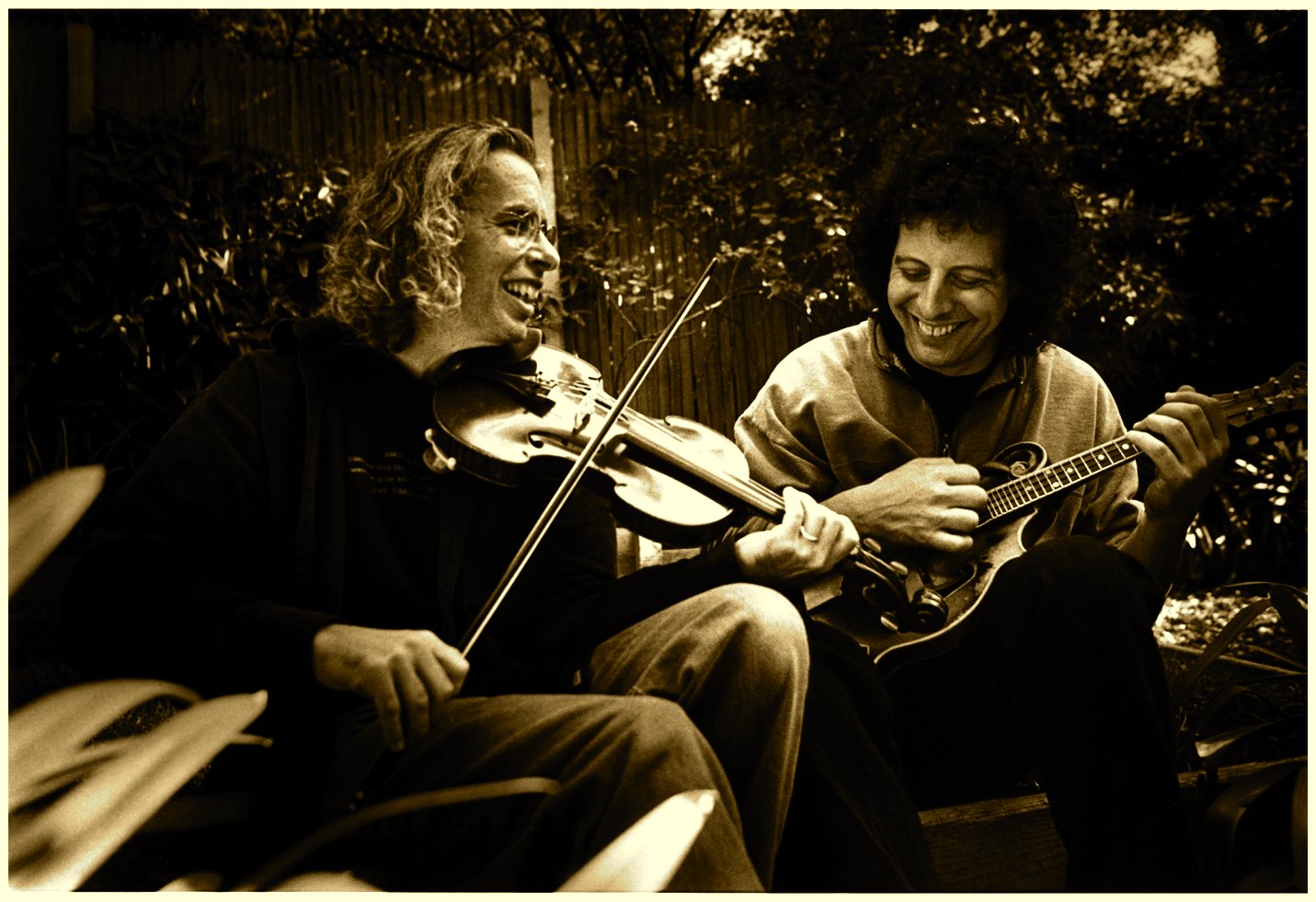
Darol Anger & Mike Marshall

Yeah, you probably saw this post coming. It was only a matter of time before I posted these two alumns of the David Grisman Quintet.

If there were ever two musicians destined to play together, it is Darol Anger and Mike Marshall. Having collaborated for over 30 years, they have something of a psychic connection when it comes to music. They share an aesthetic approach to music, drawing upon a myriad of styles from classical to jazz to rock to bluegrass to world music, and a similar sense of humor and dawged punstery. They anticipate each others' moves. In their hands, mandolin and fiddle become two voices engaged in a dialogue. Though not as deep as Statman, as spacious as Phillips or Wasserman, or as bouncy as Barenberg, they have a grace and comprehensive vision that unites the rests and notes of a hundred different musical whims, drawing them together into a playful and surprising presence. More than anyone besides perhaps David Grisman (and perhaps more than him), they have defined the sound of New Acoustic music. I saw the duo perform with Väsen last summer. Every single person in the audience was a musician. Need I say more?


Darol Anger - Biography by Steve Huey

Violinist Darol Anger has made his mark on new acoustic music with a number of different groups.

From 1975-84, Anger was a key member of new-acoustic pioneers the David Grisman Quintet, whose blend of folk, bluegrass, and jazz virtually defined the new acoustic genre, as well as advancing the harmonic and instrumental frontiers of traditional musics; as a member of the Turtle Island String Quartet in the late '80s and early '90s, Anger also helped bring virtuosic improvisation and boundless eclecticism to what had been an essentially classical, strictly composed musical format. Additionally, Anger co-founded the Montreux Band, a folk- and jazz-influenced group which recorded for Windham Hill in the mid- to late '80s and had an impact on the formation of so-called New Adult Contemporary radio, and with Grisman alumnus Mike Marshall founded the progressive bluegrass outfit Psychograss, which carried on the eclectic Grisman tradition in the 1990s. Again teaming up with Marshall in the late '90s, Anger co-founded the Anger/Marshall Band, which kept him busy into the 2000s alongside his work on the Heritage Folk Music project, his continued appearances with his previous groups, his founding of the American Fiddle Ensemble, and his work as a producer and arranger for other artists.


Mike Marshall - Biography by Craig Harris

Mike Marshall is one of the most innovative players of new instrumental music. Initially rooted in bluegrass, Marshall has consistently explored all the possibilities of his stringed instruments. During the five years (1985-1990) that he was a member of David Grisman's influential Quintet, Marshall toured with Stephane Grappelli, Mark O'Connor, Tony Rice, Bela Fleck, Jerry Douglas and fellow Grisman band member Darol Anger. Following his departure from Grisman's group, Marshall continued to work with fiddler Anger as a duo and, along with pianist Barbara Higbie and bassist Michael Manring, in a folk/chamber music group, Montreux. Marshall and Anger also collaborated, along with bassist Todd Phillips, banjo player Tony Trischka and guitarist David Grier, in a bluegrass/jazz/classical/folk group, Psychograss. Marshall currently leads the Modern Mandolin Quartet and plays Brazilian music with Choro Famoso. Marshall also periodically collaborates with Edgar Meyer, Jerry Douglas, Mark O'Connor and Sam Bush in a bluegrass superband, Strength By Numbers. Marshall has produced numerous albums including recordings by Laurie Lewis, Alison Brown, Jennifer Berezan and Tony Furtado.

A native of Pennsylvania, Marshall grew up in Lakeland, Florida. At the age of 18, he won the Florida state fiddle and mandolin championships. After performing with the Sunshine Bluegrass Boys, Marshall relocated to the West Coast. Soon after working with Grisman on the film score of The King of the Gypsies in 1985, Marshall was invited to join Grisman's Quintet.

Marshall has recorded two solo albums -- 1989's Gator Strut, which spotlighted his jazz-meets-bluegrass approach, and 1997's Brasil: Duets, which focused on the Brazilian influences on his music and featured duets with Edgar Meyer, Michael Manring and Bela Fleck. In 2003, Marshall teamed up with mandolinist Chris Thile to release Into the Cauldron, a fine record of duets between the two exploring everything from classical and traditional music to conteporary numbers written with each other.


Darol Anger - Fiddlistics

Year: 1979
Label: Kaleidoscope F8

Review by Wilson McCloy

Fiddlistics includes an all-star cast of new-grass musicians, and in many ways it is a continuation of the excellent David Grisman Quintet album. In fact, there is a slowed-down version of the composition "Blue Midnight" which first appeared on the innovative Grisman album, and the new-grass suite "Megatones" could easily have been from that session. However, the uniqueness of this album stems from its eclecticism. Anger and mandolin legend Tiny Moore joyfully swing through Charlie Parker's "Moose the Mooche," and Anger takes two duets: one quiet and meditative with pianist Barbara Higbie, and the other a traditional bluegrass romp, at first, which slowly becomes more progressive with George Stavis on banjo. Fans of the David Grisman Quintet, Mike Marshall, Tony Rice, or any of the other participating musicians will not be disappointed because this album is well-worth searching for.

Musicians:
Darol Anger
Tony Rice
David Grisman
Todd Phillips
Mike Marshall
Tiny Moore
Barbara Higbie

Tracks
1 Key Signator
2 Blue Midnight
3 Old Grey Coat
4 Moose the Mooche
5 Ride the Wild Turkey
6 Dysentery Stomp
7 Brann St. Sonata
8 Old Folkies
9 Megatones


Mike Marshall - Gator Strut
Year: 1984
Label: Rounder

Review by Ken Dryden

Mike Marshall is much like Mark O'Connor, a virtuoso on several string instruments, an innovative composer and arranger who refuses to be pigeonholed stylistically, and also an alum of David Grisman's band. Numerous Grisman alumni turn up on this 1984 release, including violinist Darol Anger, bassists Todd Phillips and Rob Wasserman, guitarist Tony Rice, and even Grisman himself, along with dobro player Jerry Douglas, Béla Fleck on banjo, violinist David Balikrishan (who would later co-found the Turtle Island String Quartet with Anger), and pianist Barbara Higbie. Marshall sticks primarily to mandolin on this mostly progressive bluegrass date, though he's also heard on mandola, mandocello, violin, and guitar. Highlights include the funky original "Gator Strut," "Ravel" (a solo effort featuring the leader overdubbed on several instruments while adapting a theme by the French Impressionist composer), a joint arrangement with Anger of John Coltrane's infrequently performed "Giant Hornpipe," and a brilliant interpretation of Thelonious Monk's "'Round Midnight."

Another Review:
In the mood for something a bit unique, random, diverse, spontaneous, and interesting? If so, then check out Mike Marshall’s Gator Strut with Darol Anger and featuring artists like David Grisman on mandolin, Bela Fleck on banjo, and Tony Rice on guitar.

The all-star group travels around music history ranging from classical composers like Ravel and Bach to Jazz masters like Coltrane and Thelonious Monk. They even stop in pop land on one of my all-time favorite Beatles numbers like Because. There are other songs here specifically written by Marshall, who plays mandolin, mandocello, guitar and sometimes violin, while in most cases Darol Anger is on violin or low violin. There are some other talented artists involved as well such as Rob Wasserman on bass, Mike Wollenberg on guitar, Barbara Higbie on synthesizer, Jerry Douglas on dobro, and Todd Philips on bass. With a stack of individuals like this, a vast accompaniment of instruments, and a unique selects of material, this particular recording is unlike any other out there.

Tracks
1 Dance of the Planktons - Marshall - 3:32
2 We Three - Marshall - 4:43
3 Gator Strut - Marshall - 6:07
4 Chief Sitting in the Rain - Traditional - 3:23
5 Assez Vif-Tres Rythme -1:50
6 Giant Hornpipe - Coltrane - 2:41
7 Because - Lennon, McCartney - 2:55
8 Scotch & Swing - Marshall - 3:42
9 Bach Partita No. 3 in E Major for Solo Violin - Public Domain - 4:08
10 Ybor City - Marshall - 3:52
11 'Round Midnight - Hanighen, Monk, Williams - 5:02
12 Gator's Dream - Marshall - 7:37
13 Wake Up - Marshall - 4:01
14 We Three (Reprise) - Marshall - 1:03


Darol Anger & Mike Marshall - The Duo

Year: 1983
Label: Rounder

Review by Linda Kohanov

Violinist Darol Anger and mandolinist Mike Marshall were pioneers of the New Acoustic Music movement, which brought folk, jazz, bluegrass and world music influences together in an instrumental acoustic setting. Here is their groundbreaking 1983 album The Duo, which highlights their virtuosity, creativity and humor in a wide-ranging selection of breathtaking duets. Darol Anger and Mike Marshall were snatched up by Windham Hill soon after this early Rounder release.

Tracks
1 Rotagilla - Anger, Marshall - 3:52
2 Lime Rock - Traditional - 2:20
3 Children's Song #6 - Corea - 2:53
4 Golden Slippers - Traditional - 3:35
5 N.K.F. - Marshall - 4:01
6 Wall of Mando Madness - Marshall - 3:47
7 Donna Lee - Parker - 2:24
8 Free D - Marshall - 4:08
9 Bach Partita #3 in E Major for Solo Violin - Bach - 4:07
10 It's Dark - Anger, Marshall - 5:25
11 Gator's Dream - Marshall - 7:37