Donate to the Grapevine

Express your thanks by leaving the pirate a tip!
Showing posts with label Folk. Show all posts

December 20, 2012

Happy Solstice & Abbots Bromley Horn Dance


On Darkness:
The child is born in the darkness of the womb; the chicken hatched after incubation. Birth begins in darkness, as dawn follows the long night, and spring springs from winter. We must not interrupt the incubation period within us, or force it to bear fruit before its time. To pull a seed out of the earth before it sprouts, to open a chrysalis before the emerging butterfly forms its wings may prevent new life from awakening.
- Torrey Philemon

"You darkness, that I come from,
I love you more than all the fires
that fence in the world,
for the fire makes
a circle of light for everyone,
and then no one outside learns of you.

But the darkness pulls in everything;
shapes and fires, animals and myself,
how easily it gathers them!—
powers and people—
and it is possible a great energy
is moving near me.
I have faith in nights."
- Rainer Maria Rilke, On Darkness


Out of darkness, light: Solstice and the lunar eclipse
by Starhawk, 10-20-2010

Winter Solstice--the shortest day and longest night of the year. For Pagans, Wiccans and Goddess worshippers, this is one of our most sacred holidays. As winter closes in, the darkness grows and the light recedes. For Pagans, darkness is the necessary balance to light. We don't conceive of the dark as evil, but as a place of potential, of gestation--the black, fertile soil where the seed puts forth roots and shoots, the dark womb where new life is nurtured. But being humans, we also have a natural affinity for the light, the time of growth and new beginnings, of warmth and color and bright new hopes. Solstice reminds us that no darkness, no loss, no grief or disappointment is final. Out of darkness, light is born. Every ending gives rise to a new beginning. Out of disappointment and despair comes new courage, new hope.

This year, Solstice coincides with a total lunar eclipse. The last time this happened was in 1544. The earth aligns directly with the sun and the moon, casting a shadow on the moon's face. The moon is a Super Moon, at its closest to the earth. And, so my astrologer friends tell me, we are also directly aligned with our Milky Way's Galactic Center, where the galaxy gives birth to stars. We are in a great birth canal, on the night when mythically Mother Night gives birth to the Sun Child of the New Year.
What does this all mean? For those of you who like to align your meditations and your magic with the movements of the stars, we stand tonight between the past and the future. For the first hour and a quarter of the eclipse, (starting at 1:30 am East Coast Standard Time), it's as if we step out of time. We are free of the past, and we can consciously create the future, for ourselves, for our communities, for the earth.

It's a night to take a good look at what you want to shed. What are the behaviors, the beliefs, the patterns that no longer serve? Let them go. Make the commitment to change.

And it's a night to envision the future you want to create. What world do we want to see? How will we step up to face the huge challenges of healing our communities, our economies, our climate and our environment? What risks will we need to take? What will we need to let go of, and what will we need to embrace?

And hey, even if you think all astrology is bunkum, take a moment tonight to go out, to marvel at the moon with the mark of the earth written across her face, to let go of what you no longer need and call in what you want. And if you can do this with friends, and family, in community, with good food and a warm fire and a few candles, and raise a cup of gratitude for all we have and all we share, you may find that the courage, the support, the power, the love and luck you need for this New Year are born in the depths of the night, and awaken at dawn with the rising sun.

A blessed solstice to you all!


And with that in mind I'd like to share with you this special mysterious ancient solstice tradition that was still being performed the last time there was a full-eclipse on a winter solstice, some hundreds of years ago. I'd like to specially dedicate this post to Joski at Merlin's New Rags and Gadaya at the Old Weird America, for their superb scholarly posts and special collections of different versions of ancient folk tunes.

"Besides for solace of our people, and allurement of the savages, we were provided of Musike in good variety not omitting the least toyes, as Morris dancers, Hobby horses, and Maylike conceits to delight the Savage people, whom we intended to winne by all faire means possible."
The Abbots Bromley Horn Dance

The Abbots Bromley Horn Dance is the oldest surviving ritual dance in the northern hemisphere. The dance dates back at least to the early medieval period. The first written record of its performance is from the Barthelmy fair in 1226. Historians have suggested that it celebrates the purchase of hunting rights in Needwood Forest from the Abbot of Bromley, restoring previous Saxon privileges. It is performed every year on Wakes Monday in the village of Abbots Bromley, in the English Midlands. At 8:00 a.m. the horns are taken from the church, where they are kept during the year, and the dancers make their rounds, stopping at various locations throughout the village and its surrounding farms and pubs, a distance of about ten miles. After dancing all day, the horns are returned to the church in the evening.


The Horn Dance team consists of six Deer-men, a Fool, a Hobby Horse, Maid Marion (a man dressed as a woman), a Bowman (Robin Hood or Boy Cupid), and two musicians. The horns are a mystery. They are large reindeer horns mounted on wooden effigies of stags' heads, with the largest pair weighing about 25 pounds. Chemical dating places them at around 1000 years old. Since there are no records of reindeer living in Britain since Neolithic times, there is speculation that these may have been imported especially for the dance. Three of them are painted black, and three brown. Once they were red and white, said to represent the battle between winter and spring, darkness and light.

<
Does the dance represent a ritual combat between the forces of light and darkness? Or does it reenact a stylized hunt? In primitive societies, the miming of a successful hunt is often used as 'sympathetic magic' to give power over real quarry. The famous wall paintings at Les Trois Frères, France, known as "The Sorcerer" show a naked man dancing in antlers and a deer mask. A carving found at Pin Hole Cave, Creswell Crags, Derbyshire, (known to have been used by Neolithic hunters) portrays a man in an animal headdress. Both suggest that pre-historic shaman used animal disguises in their rituals.


According to the locals, the dance is supposed to bring good fortune to the people and fertility to the crops. In its slow and serpentine windings, is it stirring some ritual magic from a long-forgotten past? There is no way of knowing, and that is part of the enigma of the horn dance.


Although traditionally performed on Wakes Monday, the dance was also performed on other special occasions. For over 400 years now, the leadership of the horn dance has remained in the Bentley family. Although generally performed only by the men, in the 2000 dance Robin Hood was played by a young girl. The mysterious tune generally associated with the dance was first written down in 1857.


>
There are several theories concerning the roots of this peculiar festival. It may well have begun as a Winter Solstice ritual, but it has also been suggested that it was born when King Henry I (1100-1135 AD) granted hunting rights to the people of the area. The dance was supposed to have been created as a mark of gratitude.

The hunting rights theory is suspect, however, because the Horn Dance shows signs of having had a much earlier, pre-Christian beginning when magic and fertility ceremonies were very much aspects of the lives of ordinary people. It's interesting to note that some of the figures to be seen in the world-famous cave paintings at Lascaux look very like the Abbots Bromley Horn Dancers. These figures are over 20,000 years old, so perhaps the true origins of the dance you can see today at Abbots Bromley are far more ancient than most people realize.


The Abbots Bromley Variations

1. Tony Hall - The Abbot's Bromley Horn Dance
2. Martin & Jessica Simpson & Lisa Ekstrom - Abbotts Bromley Horn Dance/In Winter's Shadow
3. Andrew Cronshaw - Wheelwright Robinson's tune for the Abbots Bromley horn dance
4. Trotto - Abbotts Bromley Horn Dance
5. Leif Alpsjö - The Abbots Bromley
6. Richard Greene & Beryll Mariott - Abbot's Bromley Horn Dance

Tony Hall's and Trotto's versions are probably the most traditional forms of the tune, though one with just tin whistle and drum would be even moreso. And yes, I do realize that Jessica Simpson's voice on "In Winter's Shadow" is totally annoying. But it's a fine poem, and a damn good tune. Richard Greene's version is, unsurprisingly, totally gorgeous.

So. Turn off your lights. Go outside. Look at the moon. Then come in, light a candle, and put the tune on, and drift off into the otherworld. And at the high point of each musical phrase, imagine antlered men clashing heads, locked in a stately, solemn dance.


And, as an extra wintery bonus, some poems:

from FOUR QUARTETS: East Coker by T.S. Eliot
O dark dark dark. They all go into the dark.
The vacant interstellar spaces......
I said to my soul, be still, and wait without hope
For hope would be hope for the wrong thing; wait without love
For love would be love of the wrong thing; there is yet faith
But the faith and the love and the hope are all in the waiting.
Wait without thought, for you are not ready for thought:
So the darkness shall be the light, and the stillness the dancing.


HAIKU by Basho
Turn this way,
I also am lonely
This evening of winter.

from OUR QUIET TIME by Nancy Wood
In our quiet time
We do not speak, because the voices are within us.
It is our quiet time.
We do not walk, because the earth is all within us.
It is our quiet time....
We rest with all of nature....

I AM SINGING THE COLD RAIN
A Cheyenne Poem
I am singing the cold rain
I am singing the winter dawn
I am turning in the gray morning
Of my life
Toward home.


FIRST SNOW by mary oliver

the snow 
began here

this morning and all day

continued,
its white

rhetoric everywhere

calling us back to why,
how,

whence such beauty and what

the meaning;
such

an oracular fever!
flowing 
past windows,
an energy it seemed

would never ebb,
never settle

less than lovely!
and only now,

deep into night,

it has finally ended.
the silence

is immense,

and the heavens still hold

a million candles;
nowhere 
the familiar things:

stars, the moon, 
the darkness
we expect

and nightly turn from.
trees 
glitter like castles

of ribbons, the broad fields

smolder with light, a passing

creekbed lies

heaped with shining hills;
and though the questions

that have assailed us all day

remain--not a single

answer has been found--
walking out now

into the silence and the light

under the trees,

and through the fields,

feels like one.

- from new and selected poems.

February 14, 2011

Pete Sutherland - Poor Man's Dream


Not much to say about this one, it's just a fine bit o' music. Flying Fish had a way of recording these albums that make you feel like you're sitting on a back porch with friends, even when the music is coming from all over the world. Sweet fiddle music and good times...

Raised on a diet of Broadway show tunes,operatic arias and British invasion melodies, Pete Sutherland discovered both traditional music and songwriting in college and like Huck Finn "lit out for the territories". A warm-voiced singer and multi-instrumentalist known equally for his potent originals and intense recreations and ago old ballads and fiddle tunes, his performances "cover the map" and "…shine with a pure spirit, which infuses every bit of his music and cannot fail to move all who hear him". The American Festival of Fiddle Tunes
Bio:
The old timey dance music of the American southern mountains, New England and the Celtic isles are resurrected through the playing of multi-instrumentalist Pete Sutherland. A former member, along with hammer dulcimer player Malcolm Dalglish and guitarist Grey Larsen, of mid-1980s folk trio, Metamora, Sutherland has continued to expand string band traditions as a member of The Clayfoot Strutters and Mac Benford's Woodshed All Stars. Sutherland has also recorded as a soloist and with his wife, Karen. 

Sutherland's earliest musical memories reflect the opera and musical theater albums favored by his parents. Although he played with several teenage rock bands, he most enduring musical outlet has come through traditional folk music. Inspired by Vermont-based fiddler Louie Beaudoin and Appalachian fiddlers Tommy Jarrell and Ed Haley, Sutherland began performing with the Arm & Hammer String Band in 1973. Moving to Burlington, Indiana in the early-1980s, he helped to form Metamora. Together with the band, Sutherland recorded six albums including the score of the Disney film, "Tuck Everlasting." 

"Poor Man's Dream," Sutherland's debut solo album, was released in 1984 and combined traditional fiddle tunes with original material. Shortly after the disbanding of Metamora, in 1989, Sutherland returned to his home state where he currently lives. Craig Harris, Rovi


Pete Sutherland - Poor Man's Dream

Year: 1984
Label: Flying Fish

Originally issued as an LP on the long-gone Flying Fish label, this 1984 recording of original and traditional songs and tunes produced by Metamora bandmate Grey Larsen has been repeatedly called a "folk classic" - featuring "Aunt Sue" and "Shacks and Chalets".

Tracks:
01 Coal Black Morning
02 The Apple Picker's Waltz - The Beautiful Lights of Burlington
03 Leather Britches
04 Coleman's March - Shacks and Chalets
05 Inch Along
06 Aunt Sue - Motleigh - Stone's Throw
07 You Were the One Who Loved Me
08 Guide Me, O Thou Great Jehovah
09 Mad River - Poor Man' Dream


January 8, 2011

Björn Ståbi & Ole Hjorth - Folk Fiddling from Sweeden: Traditional Fiddle Tunes from Dalarna


Brilliant strange music here. There is something so mysterious about traditional Scandinavian music. It comes in circles, but instead of the kind of circle that brings you back to the same place you started (as occurs in American, Celtic, and many other traditional dance musics), each return brings you to a new level. So essentially, it is a spiral. And there are spirals within each spiral. So really, this is fractal music, as organic as a tree's branching roots, a clouds billowing edges, or a river's forking delta.

It is cold music too. Every happy june day is still tinged with the memory of the long dark winter, and this feeling comes through in every solitary note, which maintains its loneliness even when singing the most beautiful birdsong.

Sweeden has become known for its Nickelharpa, the 19-string keyed fiddle of medieval origins. But while these recordings do not feature its sound, they always reference its church-like droning harmonies and brittle melodies.

Take a walk in the crisp winter air after listening to this music, and see if you can find the hidden flowers in the sky.

Björn Stabi probably was the first traditional Swedish fiddler to perform in the United States when he appeared in a duet with Ole Hjorth at the Newport Folk Festival about thirty years ago. Their performances, filled with sonorous harmonies and exotic melodies, were a life changing moment for many listeners. Stabi remains one of the most renowned folk fiddlers in Sweden. Bjorn Stabi's Orsalater (GIGA 35) is his first album of tunes from his ancestral home of Orsa. Apparently the project was unrehearsed, recording old tunes as they popped into his memory. There some jarring but tasty non-tempered notes, usually said to speak for the considerable age of a piece.

Björn is the current tradition bearer of Orsa's rich musical heritage. Björn was recognized as a riksspelman (Zorn Silver) back in 1961 and in 1986 he was tapped for the highest honor a Swedish folk musician can receive—The Zorn Gold. Lisa earned the Zorn Silver medal in 1999.


Björn Ståbi & Ole Hjorth - Folk Fiddling from Sweeden: Traditional Fiddle Tunes from Dalarna

Label: Elektra Nonesuch
Year: ?

For more information, please click the back cover below.

Tracks:
A1. Skullbräddleken - 2:30
A2. Vals - 2:54
A3. Polska - 2:10
A4. Systerpolska - 1:34
A5. Noaks Gånglåt - 3:00
A6. Säckpipslåt - 0:45
A7. Hjortingens Polska - 2:10
A8. Vallåt - 1:08
B1. Polska In G - 1:37
B2. Långdans - 1:56
B3. Polska - 2:55
B4. Gånglåt - 1:12
B5. Gråtlåten - 1:46
B6. Vallåt - 1:10
B7. Skänklåt - 1:49

Notes:
Side A contains tunes from throughout the province of Dalarna (after the tradition of various fiddlers):
track A1 is a wedding-tune from Mockfjärd,
track A2 is a waltz from Orsa,
track A3 is a dance-tune from Enviken,
track A4 is a dance-tune from Orsa,
track A5 is a walking-tune from Orsa,
track A6 is a bagpipe-tune from Gagnef,
track A7 is a dance-tune from Bingsjö,
track A8 is a herding-tune from Orsa.

Side B contains tunes from Rättvik parish, Dalarna (after the tradition of Hjort Anders Olsson, Bingsjö).

very out-of-print

Joseph Spence - Living on the Hallelujah Side


Another album from this blog's guardian angel: Joseph Spence! As I've already said all that I can say about this fountain of joy and grizzly grumbles, I'll leave it at just the pure music. Enjoy!


Joseph Spence - Living on the Hallelujah Side

Year: 1987
Recorded 1972-1978
Label: Rounder

Product Description
Joseph Spence's music is a style unto itself. Working with songs learned from hymnals, from the radio and from local tradition in his native Bahamas, Spence developed an astounding guitar style with wild, syncopated rhythms and a unique but sophisticated sense of harmony, while he casually growled out excerpts of lyrics. Spence was a major influence on Ry Cooder. These are '70s recordings made near his home in Nassau and in concert in the U.S.


Review by Ron Wynn
Bahamian guitarist/vocalist Joseph Spence's humming, flailing, sensational singing and playing combined secular flair and spiritual fervor in a manner close to that of the brilliant Blind Willie Johnson and Rev. Gary Davis. This set of 1970s performances, reissued on CD, included evocative renditions of "A Closer Walk with Thee," "More and More with Jesus," and "When the Saints Go Marching In," plus equally arresting versions of "Irene Goodnight" and the holiday ditty "Santa Claus Is Comin' to Town." Spence was incapable of self-indulgence or fakery; his lines, phrasing, riffs, and solos are enchanting, while his vocal effects and accompaniment often come close to surpassing his playing. This was simply magical material, the kind that comes only from a genuine original.


A customer said:
It's almost impossible for me not to smile while listening to this wonderful record. There are many times in fact, when I have laughed with joy and amazement at the pure, unadulterated music-making of this amazing man. 'Neighbor Gone Home' and 'I'll Be A Friend To Jesus' are among my favourites here, with the latter in particular having me in hysterics when Joseph pulls up abruptly at the high notes, leaving his friend Blooming Rosalie Roberts to carry the tune. All through the album Joseph's half-sung, half-grunted, half-mumblescatted vocals (a new term that fits, I think!) are just amazing and delightful. Trust me, you have never heard ANYTHING like the singing of Joseph Spence! It is absolutely outrageous!

For the uninitiated, Joseph Spence played guitar exclusively in something called 'Dropped D' tuning, and his beautiful, syncopated Calypso fingerstyle is inimitably great. He was a gem of a musician, and a true original. Joseph was not as young as he used to be by this time, but don't let that deter you. This is a wonderful album. Check out "More and More With Jesus", "I'll Overcome Someday", or "Where Shall I Go" for some wonderful Joseph Spence guitar performances.

This album is a complete blast of infectious, wonderful, guitar-and-voice simplicity. There's some kind of joy and delight that just comes out in Joseph Spence's music. It's unique, and something hard to explain; you just have to hear him. And you MUST hear him! The Book of Proverbs says that "A merry heart does good like a medicine." With this in mind I have no hesitation in recommending to everyone a good listen to Mr. Joseph Spence. His music and his spirit will do you a power of good. Absolutely unmissable!


Tracks:
1. I'll Overcome Some Day 2:06
2. A Closer Walk With Thee 3:00
3. Where Shall I Go 3:20
4. I'll Be A Friend to Jesus 2:42
5. More And More With Jesus 4:08
6. Santa Claus Is Comin' To Town 2:58
7. On My Way To Heaven 2:15
8. Neighbor Gone Home 2:05
9. Jesus On The Mainline 3:58
10. Living On The Hallelujah Side 2:26
11. When The Saints Go Marching In 2:57
12. Irene Goodnight 3:06

December 26, 2010

Sam Rizzetta - Bucks and Does


Ok, so not a whole lot so say on this one, but you'll probably appreciate a short post after the last few. Nothing shocking or out-of-place here, just extremely beautiful, tonal, resonant, music. Almost totally unaccompanied, the resounding tremors of the dulcimer are allowed to ricochet ad eternitum, and faithfully transcribed from vinylog to digital by yours truly. Enjoy!

Biography
by Craig Harris
The strings of the hammered dulcimer come alive with melody and percussive rhythms through the playing of Sam Rizzetta. The founder of multi-dulcimer group, Trapezoid, in 1975, Rizzetta has continued to creatively explore his multi-stringed instrument as a soloist since 1979.

In addition to maintaining a busy schedule as a performer and composer, Rizzetta has become one of the foremost designers and builders of hammered dulcimer. His instruments, which have been exhibited at the Smithsonian Institute and the National Folk Festival, are noted for their expanded tonal range and exquisite sound. Rizzetta, who resides in West Virginia, has continues to teach in the dulcimer department that he helped to launch in 1974


SAM RIZZETTA - CRAFTSMAN & MUSICIAN (long bio)

Over the years Sam Rizzetta’s performances, recordings, and craftsmanship have introduced many people to both hammer dulcimer and fretted or “Appalachian” mountain dulcimer, and his joyful and versatile music leave good feelings wherever he plays. Sam’s playing has been heard at numerous festivals as well as at the National Cathedral, the Kennedy Center, on National Public Radio’s A Prarie Home Companion and Mountain Stage, and on public television. And his many design innovations have helped to define the contemporary hammer dulcimer.

Onstage, the tone of Sam’s dulcimers combine with his heartfelt and ornamented playing style for music that has been called “resonantly sensual magic.” Reviewers say his music defies attempts at categorization. A Rizzetta concert may blend classical, folk, gospel, new age, oldtime tunes, ragtime, original music, and other surprises. Of his performance, the National Dulcimer Symposium Journal says, “Sam Rizzetta was just plain awe inspiring! We were privileged to be watching a master player in peak form.” Frets Magazine wrote, “He builds instruments of awesome power and puts them to good use.” “Probably the best dulcimer I’ve heard,” says West Virginia’s Tamarack Center. The New York Times concurs; “songs and reels played with lively charm. …delightful.”

In 1975 Sam created the influential group Trapezoid as a hammer dulcimer quartet, and they made some highly acclaimed, landmark recordings. Since 1978 Sam has performed solo, made 12 solo recordings, and written four books of original music for dulcimer.

Sam has designed and handcrafted musical instruments since childhood, and his dulcimers and guitars have long been prized by musicians. Rizzetta dulcimers have been exhibited at the Smithsonian Institution and the National Folk Festival and featured in Fine Woodworking Magazine. Starting in 1974, Sam taught for many years at the Augusta Heritage Center. He has been featured at many other music heritage workshops, and for many years he wrote the Technical Column for the Dulcimer Players News. Sam designs dulcimers for the Dusty Strings Company, and, along with friend and collaborator Nicholas Blanton, continues to build custom and experimental instruments. Many of Sam’s design innovations have become essential to the modern dulcimer and are enjoyed by almost all of today’s players, performers, and builders.

Sam has recently been nominated for a National Endowment for the Arts National Heritage Fellowship for lifetime achievement in the arts.

Influences:

Sam’s father, Pasquale, played violin and accordian, and his uncle Earl Nott was a great banjo player. So, Sam fell in love with traditional music and stringed instruments at an early age. He experimented with building banjos and guitars as soon as he could use tools. Chet Parker of Grand Rapids, MI was an early hammer dulcimer inspiration. In 1968 Sam met West Virginia hammer dulcimer player Russell Fluharty, Kentucky mountain dulcimer player Jean Ritchie, and dulcimer innovator Howie Mitchell. Later Sam moved to Randolph County, WV and was influenced by his neighbors like guitarist Blackie Cool and fiddler Woody Simmons, as well as by traditional musicians and instrument customers who visited from distant parts of the world.

You can get an album by Chet Parker at Tonal Bride.

if you'd like to read an article about Hammered Dulcimer Making that Sam wrote for Smithsonian, look here.

Or read an interview from Dulcimer Player magazine from right after this album came out.


Sam Rizzetta - Bucks and Does

Year: 1982
Label: Flying Clouds Music

Hammer and mountain dulcimers; cheerful mountain music.

Tracks:
01 Fanny Poer
02 Hoedown
03 Bucks & Does
04 High Falls of Cheat
05 Cobra Waltz
06 Volcano Strut
07 Mother Trucker
08 Cuckoo's Nest
09 Norwegian Waltz / Dolly Sods
10 Snowy Breasted Pearl_Rickett's Hornpipe
11 Peekaboo Waltz
12 Good For the Tongue / Rambling Pitchforks (or The Fisherman's Widow) / Sonny's Mazurka / The Royal Paulownia Hornpipe
13 Paul's New Dulcimer
14 Sweet Hour of Prayer / Angels We Have Heard on High
15 Carolan's Farewell to Music


December 25, 2010

Nowell Sing We Clear - A Pageant of Midwinter Carols


More weirdness from old Brittania! I meant to post this earlier, but hopefully you are still in the mood for some festive music. Now as you may have gathered, I'm not particularly keen on Christmas as it's currently celebrated, with people running all over the place spending money trying to appease the gods of consumerism. And I know enough about history to know that even the traditional Christmas is a pale coagulation of various midwinter pagan festivals. With all that being said, I did grow up celebrating 'Xmas' and usually still do to some degree, and I've found a few worthwhile aspects of the tradition, particularly those which have incubated themselves from another time, and still retain the magic and mystery of the great midwinter resurrection festivals.

This group does absolutely the best traditional christmas carols, and other, older midwinter music too. It's ancient, mysterious, beautiful, and danceable! This music shows the soul of our winter holiday in a way that puts every version of 'Rudolf' ever recorded to shame. Long live the mystery of darkness! Long live the sanctity of resurrection! Long live the tradition of wassailing, giving thanks to the trees that provide us with bounty.


In the summer of 1975, dance musicians Fred Breunig and Steve Woodruff moved to southern Vermont and teamed up with the singing duo of John Roberts and Tony Barrand. Nowell Sing We Clear was first performed in December of that same year. I conceived of it as a traveling road show which could visit small communities on a regular basis to broaden the range of music and custom to which people had access in the joyous midwin ter season. The program explores and reveals the active and still vital themes of the birth of Jesus and the celebration of the return of the light at the winter solstice. The combined interests and skills of the performers in contra and morris dancing and in ballads and bawdry afforded an unusual approach to Christmas music.
- Tony Barrand.


Known for their lively and entertaining presentations of English folk songs, John Roberts and Tony Barrand have performed at important festivals, colleges, and coffee houses throughout the United States, Canada, and their native England. Accomplished self-taught folklorists, they typically sing ballads and songs of the sea, of drinking situations, of industrial strife and much more, arranging the material thematically to illustrate the social history and the lives of the people who made up the songs. Performing in unaccompanied two-part harmony, they regularly draw upon a variety of instruments including Anglo-German and English concertinas, button accordion, banjo, guitar, and a variety of rhythm instruments such as bones and spoons. They met at Cornell University in 1968 while studying for Ph.D's in Psychology. After a number of years teaching at Marlboro College in southern Vermont, John Roberts is now a full-time musician; Dr. Tony Barrand teaches psychology, folklore and aesthetics through the University Professors at Boston University, recently co-edited a revised and expanded fourth edition of the shape-note hymnal Northern Harmony: Plain Tunes, Fuging Tunes and Anthems from the Early and Contemporary New England Singing Tradition and authored a major book on seasonal dance customs, Six Fools and a Dancer: The Timeless Way of the Morris and a compilation of sword dance notations, Longsword Dances...as Compiled by Ivor Allsop(All available from Carriage House Books).

In thirty-one years as a professional team, they have recorded with a number of companies, including Front Hall, Folk Legacy, Swallowtail, and National Geographic. Their most recent production is Heartoutbursts: English Folksongs Collected by Percy Grainger. They recently presented a concert of songs inspired by an exhibit of Maxfield Parrishís paintings at the Pennsylvania Academy of Fine Arts and the Brooklyn Musuem of Art. They have also performed settings of Rudyard Kiplingís verse at his restored house, Naulakha, in Dummerston, VT. It is recorded as Naulakha Redux: Songs of Rudyard Kipling (available from Golden Hind Records). Both John and Tony were founding members of the celebrated Marlboro Morris and Sword dance teams which perform the seasonal display dances in communities in Windham County, Vermont. John lives in Schenectady, NY, and Tony in Brattleboro, VT.

Fred Breunig is one of the most influential leaders of the New England contra dance movement and a major resource for the increasingly large following atttracted to the English Playford-style country dances. He has taught workshops and called dances throughout the U.S. and Canada and is a well-known figure leading dances to the accompaniment of his own fiddle playing. A printer by trade, he makes his home and runs his business, Press On! in Putney, VT, and maintains his regular community dance in East Putney on the last friday of each month. Fred has recorded with John and Tony on Front Hall and Folk-Legacy, and was a contributing musician to the influential F&W String Band albums of New England contra dance tunes.

Andy Davis is known nationally as one of the finest piano accompanists for contra dance music and is an outstanding performer on piano accordion and banjo. He teaches music in several schools in Brattleboro where he makes his home and runs the successful operation of New England Dancing Masters, with recordings and publications which make New England dance forms available for use in schools. Andy is a much-loved music teacher in local elementary schools and a leader of popular community dances. In addition to the Nowell recordings, he and guiitarist, Sandy Bradley are the accompanists on Laurie Andresí widely praised accordion, Fantastic Hornpipe.


2010 marks the 36th season of the Pageant of Midwinter Carols tour. Performers John Roberts and Tony Barrand, are widely known for their concerts and recordings of English ballads and songs with New England dance musicians, Fred Breunig and Andy Davis. Much of the singing is 4-part a cappella harmony, with carols worth dancing to, performed by fiddle, accordion, concertina, banjo and piano. The show begins with a fresh look at the telling of the story of Christ's birth through unfamiliar folk carols. The show ends with even less familiar songs associated with midwinter visiting customs such as “Hunting the Wren,” the “Derby Ram,” and "Wassailing on New Year’s Eve.

Drawn mostly from English-language folk traditions, the songs tell both a version of the events and characters involved in the Christmas story and detail the customs that make up the twelve magical days following the return of the light at the winter solstice. The pageant is also stamped with the energetic dance band sound of fiddle, button accordion, electric piano, drums, and concertina and the audience encouraged to sing along. An unusual treat is the enactment of a Mummers Play.


The Wassailing Of Trees

The ancient rite of wassailing trees was well known in Devonshire, Herefordshire and in other parts of the West Country of England (and elsewhere? please let me know). It generally took place on Twelfth Night (January 5th), or sometimes on 17th January, known as Old Twelfth Night. Farmers and their families would feast on hot cakes and cider, then they would go into the orchard with more "supplies."

A cider-soaked cake is laid in the fork of a tree and then more cider is splashed on it. The men fire their guns into the tree and bang on pots and pans while the rest of the people bow their heads and sing the special "Wassail Song." This custom is said to ward off bad spirits from the orchard and encourages the good spirits to provide a bountiful crop for the following year.

In other traditions, the men of the village went out to the orchards carrying the wassail bowl, to alternately serenade and browbeat the apple trees. There were songs, dances and libations (for tree and man alike) until finally, in frustration, the trees would be threatened with the axe if they did not produce well in the coming year. A newspaper account of 1851 documents Devonshire men firing guns (charged only with powder) at the trees.

Concerning this custom, A. H. Bullen writes:

This custom was kept up till the end of the last century. Brand relates that in 1790 a Cornish man informed him it was the custom for the Devonshire people on the eve of Twelfth Day to go after supper into the orchard with a large milk-pan full of cyder with roasted apples in it. Each person took what was called a clayen cup, i.e. an earthenware cup full of cyder, and standing under each of the more fruitful trees, sung —
“Health to thee, good apple-tree,
Well to bear, pocket-fulls, hat-fulls,
Peck-fulls, bushel-bag-fulls.”
After drinking part of the contents of the cup, he threw the rest, with the fragments of the roasted apples, at the trees, amid the shouting of the company. Another song sung on such occasions was
“Here’s to thee, old apple-tree,
Whence thou may’st bud, and whence thou may’st blow,
And whence thou may’st bear apples enow
Hats full! caps full!
Bushel-bushel-sacks full,
And my pockets full, too, huzza!”
It is supposed that the custom was a relic of the sacrifice to Pomona [the Roman Goddess of Fruits].

The American author Henry David Thoreau also cites Brand's Popular Antiquities in his essay Wild Apples: The History of the Apple Tree (published in the Atlantic Monthly, November, 1862), although he states that the practice took place on Christmas Eve, not Twelfth Night. However, he adds the note of an old practice of "apple-howling" in various counties of England on New Year's Eve where a troop of boys visits different orchards, and, encircling the trees, chant the following:
Stand fast, root! bear well, top!
Pray God send us a good howling crop:
Every twig, apples big;
Every bough, apples enow!
Then then shout in chorus, with one accompanying them on a cow's horn, and rap the trees with their sticks (this being called "wassailing" the trees):
WASSAIL the trees, that they may bear
You many a plum and many a pear:
For more or less fruits they will bring,
As you do give them wassailing.
According to a friend of this site, Ellen, wassailing of trees is still practiced in the Gloucestershire region of England.

This practice echoes one practiced by Romanians. As the housewife kneaded special holiday dough in the kitchen, her husband would pass through the house on his way to the orchard, in a vile temper. She followed anxiously behind as he passed from tree to tree, threatening to cut down each barren one. She would urge him to especially spare this one or that, saying: "Oh no, I'm sure this tree will be as heavy with fruit next year as my hands are with dough this day."

Wassailing As "Luck Visits" And Subsequent Traditions

It was only later that these traditions became associated with "luck visits" made around the neighborhood, together with general merry-making (and, as Rev. Bradley pointed out, "fortified by copious quantities of alcohol"). Soon, these traditions would merge with the waits who traveled the streets of the cities (and who were paid to sing and play during the holidays). And voila! we have a tradition: wassailing.

William Henry Husk, writing in 1868, reproduced the Wassailers' Carol (whose well known first verse begins: "Here we come a wassailing"), noting that its last verse was the same as the first verse of a carol reproduced by Ritson in Ancient Songs and Ballads (1829), which, in turn, may have been copied from a source during the reigns of James 1 (1566-1625) or Charles 1 (1600-1649). The verse was:
Good master and mistress,
While you're sitting by the fire,
Pray think of us poor children,
Who are wandering in the mire.
That being the case, the editors of the Oxford Book of Carols (OBC) suggest that Shakespeare (1564-1616) may have heard that fragment sung outside of his house at Christmas.

The wassail was not, however, absolutely confined to the Christmas season, but was used to indicate any convivial and festive meetings. Sandys quotes Shakespeare's Hamlet: —
"The king doth wake to-night, and takes his rouse,
Keeps wassel."
Indeed, says Sandys, the meetings were themselves called after them, again quoting Shakespeare, this time from Love's Labor Lost: —
“He is wit’s peddler, and retails his wares
At wakes and wassels, meetings, markets, fairs.”
Later, the meaning of wassail would become more narrow. By the way, the editors of the OBC suggest that verses two, six and seven of The Wassail Song "are not suitable when the carol is sung in church, but they give a vivid picture of the Waits of old times."

But the discussion of just one song barely scratches the surface of the rich lode of this tradition. Concerning this genre, Edith Rickert writes in 1910:

"The oldest carol known (cf. Appendix I. p. 132 - Seignors Ore Entendez À Nus; translation from Sandys: Lordings, From A Distant Home), although Anglo-Norman, embodies the Saxon phrases used in pledging. The former of these has survived in the refrain of the initial carol of this group (Wassail, Wassail, Out of the Milk Pail), which is otherwise highly religious. In the seventeenth century the wassail was a definite institution — the carrying about of a bowl of spiced ale from house to house to drink healths in expectation of a contribution. Nowadays the utterance of a "Merry Christmas' is often judged sufficient for the tip. Some of the poems here included are mere drinking-songs, but they were probably sung as carols at Christmas."

The word 'wassail' comes from the Old English "Waes hael" — that is, "Good Health!" The correct response was "Drinc hael." In Best-Loved Christmas Carols, Clancy and Studwell notes that the custom of wassailing may go back to the fifth century century, although the first mention in print was in 1140; Vortigern, mentioned below, dates to the early fifth century. Sandys believes that the custom could date to the third century.

Dr. Rickert's mention of "used in pledging" is especially interesting. William Sandys, in his 1853 work Christmas-tide includes the following passages which bear on this theme:

The wassail bowl, of which the skull of an enemy would thus appear to have formed their beau idéal, is said to have been introduced by them. Rowena, the fair daughter of Hengist, presenting the British king, Vortigern, with a bowl of wine, and saluting him with “Lord King Wass-heil;” to which he answered, as he was directed, “Drine heile,” and saluted her then after his fashion, being much smitten with her charms. The purpose of father and daughter was obtained; the king married the fair cup-bearer, and the Saxons obtained what they required of him.
This is said to have been the first wassail in this land; but, as it is evident that the form of salutation was previously known, the custom must have been much older among the Saxons; and, indeed, in one of the histories, a knight, who acts as a sort of interpreter between Rowena and the king, explains it to be an old custom among them.

By some accounts, however, the Britons are said themselves to have had their wassail bowl, or lamb’s wool — La Mas Ubhal, or day of apple fruit — as far back as the third century, made of ale, sugar (whatever their sugar was), toast and roasted crabbs, hissing in the bowl; to which, in later times, nutmeg was added.

The followers of Odin and Thor drank largely in honor of their pagan deities; and, when converted, still continued their potations, but in honor of the Virgin Mary, the Apostles, and Saints; and the early missionaries were obliged to submit to this substitution, being unable to abolish the practice, which afterwards degenerated into drinking healths of other people, to the great detriment of our own. Strange! that even from the earliest ages, the cup-bearer should be one of the principal officers in the royal presence, and that some of the high families take their name from a similar office.

Sandys writes that one of the earliest wassail songs is that introduced by Dissimulation, disguised as a religious person, in Bale’s old play of Kynge Johan [1166-1216], about the middle of the sixteenth century [e.g., circa 1538]. He brings in the cup by which the king is poisoned, stating that it “passith malmesaye, capryck, tyre, or ypocras,” and then sings —
"Wassayle, wassayle out of the mylke payle,
Wassayle, wassayle as white as my nayle,
Wassayle, wassayle in snowe, froste, and hayle,
Wassayle, wassayle with partriche and rayle,
Wassayle, wassayle that muclie doth avayle,
Wassayle, wassayle that never wylle fayle."
In Caxton’s Chronicle [circa 1480] the account of the death of King John represents the cup to have been filled with good ale; and the monk bearing it, knelt down, saying, “Syr, wassayll for euer the dayes so all lyf dronke ye of so good a cuppe.”

As we will see, there were many traditions associated with the practice of wassailing, reflecting the differing traditions of individual communities and regions.

In medieval times, as noted by Keyte and Parrott, in The Shorter New Oxford Book of Carols, wassailers had become were rural luck visitors who toasted householders from their communal bowl. Elizabeth Poston stated that it was a custom connected with children and the Waits, and which took place between Christmas and the New Year. Ian Bradley, quoting Strutt's Sports and Pastimes of the People of England, explains that the wassail bowl was formerly carried about by young women on New-year's eve, who went from door to door in their several parishes singing a few couplets of homely verses composed for the purposes, and presented the liquor to the inhabitants of the house where they called, expecting a small gratuity in return.

As the song states, wassailers wouldn't object to a bit of beer or cheese either.

all this and more from here.


Mumming
Mumming is also an ancient pagan custom that was an excuse for people to have a party at Christmas! It means 'making diversion in disguise'. The tradition was that men and women would swap clothes, put on masks and go visiting their neighbours, singing, dancing or putting on a play with a silly plot. The leader or narrator of the mummers was dressed as Father Christmas.

The custom of Mumming might go back to Roman times, when people used to dress up for parties at New Year. It is thought that, in the U.K., it was first done on St. Thomas's day or the shortest day of the year.

Different types of entertainments were done in different parts of the U.K. In parts of Durham, Yorkshire and Devon a special sword dance was performed. There were also different names for mumming around the U.K. too. In Scotland it was known as 'Gusards' in Somerset, 'Mumping' in Warwickshire or 'Thomasing' and 'Corning' in Kent.

In Medieval times it had turned into an excuse for people to go begging round the houses and committing crimes. It became so bad that Henry VIII, made a law saying that anyone that was mumming wearing a mask would be put in prison for 3 months!

One poem that people said when mumming was:
Christmas is coming, the beef is getting fat,
Please drop a penny in the old mans hat.
Over the years, this was changed into a very similar poem that is said by some carol singers today:
Christmas is coming, the goose is getting fat,
Please put a penny in the old mans hat.
The early settlers from the U.K. took the custom of Mumming to Canada. It is known as Murmuring in Canada, but is banned in most places because people used it as an excuse for begging.

Mumming is still done in parts of the UK, USA and Canada.

Sword dancing

Usually regarded as a type of morris, although many of the performers themselves consider it as a traditional dance form in its own right, is the sword dance tradition, which includes both rapper sword and longsword traditions. In both styles the "swords" are not actual swords, but implements specifically made for the dance. The dancers are usually linked one to another via the swords, with one end of each held by one dancer and the other end by another. Rapper sides consist of five dancers, who are permanently linked-up during the dance. The rapper sword is a very flexible strip of spring-steel with a wooden handle at each end. The longsword is about 2'6" (0.8 metres) long, with a wooden handle at one end, a blunt tip, and no edge. Longsword sides consist usually of five to eight dancers. In both rapper and longsword there is often a supernumerary 'character', who dances around, outside, and inside the set.


Nowell Sing We Clear - A Pageant of Midwinter Carols
Live at the Folk Festival, NPR Radio Broadcast 1977

Never officially released. Extended introductions to each song provide the listener with a wealth of information about these old and mysterious songs.

Tracks:
01 Nowell Sing We Clear
02 intro
03 The Cherry Tree Carol
04 intro to While Shepherds Watch
05 While Shepherds Watch
06 intro to Coventry Carol
07 Coventry Carol
08 intro to Divers & Lazarus
09 Divers & Lazarus
10 intro to King Herod & the Cock & The Miraculous
11 King Herod and the Cock - The Miraculous
12 intro to Joys Seven
13 Joys Seven
14 intro to The Bitter Withy
15 The Bitter Withy
16 intro to The Boar's Head Carol
17 The Boar's Head Carol
18 intro to Lord of the Dance
19 Lord of the Dance
20 program break, credits
21 Green Grow the Rushes-O
22 Intro to The Cutty Wren
23 The Cutty Wren
24 Intro to Wassailing
25 Somerset Wassail
26 intro to Pace Egging Song
27 Pace Egging Song
28 Intro to Queen Mary's Men
29 Queen Mary's Men
30 Intro to Sword Dancing
31 Sword Dance Tunes from the Village of Sleights
32 Intro to Glousteshire Wassail
33 Glousteshire Wassail
34 Intro to Apple Tree Wassail & Darby Ram
35 Apple Tree Wassail & Darby Ram
36 Closing remarks
37 The Wren / The King / Joy, Health, Love and Peace
38 outro, credits

ripped from cassette, taped from radio

And if you're not celebrating, well, have a happy Saturday!


December 20, 2010

Winter Solstice & Abbots Bromley Horn Dance


On Darkness:
The child is born in the darkness of the womb; the chicken hatched after incubation. Birth begins in darkness, as dawn follows the long night, and spring springs from winter. We must not interrupt the incubation period within us, or force it to bear fruit before its time. To pull a seed out of the earth before it sprouts, to open a chrysalis before the emerging butterfly forms its wings may prevent new life from awakening.
- Torrey Philemon

"You darkness, that I come from,
I love you more than all the fires
that fence in the world,
for the fire makes
a circle of light for everyone,
and then no one outside learns of you.

But the darkness pulls in everything;
shapes and fires, animals and myself,
how easily it gathers them!—
powers and people—
and it is possible a great energy
is moving near me.
I have faith in nights."
- Rainer Maria Rilke, On Darkness


Out of darkness, light: Solstice and the lunar eclipse
by Starhawk, 10-20-2010

Winter Solstice--the shortest day and longest night of the year. For Pagans, Wiccans and Goddess worshippers, this is one of our most sacred holidays. As winter closes in, the darkness grows and the light recedes. For Pagans, darkness is the necessary balance to light. We don't conceive of the dark as evil, but as a place of potential, of gestation--the black, fertile soil where the seed puts forth roots and shoots, the dark womb where new life is nurtured. But being humans, we also have a natural affinity for the light, the time of growth and new beginnings, of warmth and color and bright new hopes. Solstice reminds us that no darkness, no loss, no grief or disappointment is final. Out of darkness, light is born. Every ending gives rise to a new beginning. Out of disappointment and despair comes new courage, new hope.

This year, Solstice coincides with a total lunar eclipse. The last time this happened was in 1544. The earth aligns directly with the sun and the moon, casting a shadow on the moon's face. The moon is a Super Moon, at its closest to the earth. And, so my astrologer friends tell me, we are also directly aligned with our Milky Way's Galactic Center, where the galaxy gives birth to stars. We are in a great birth canal, on the night when mythically Mother Night gives birth to the Sun Child of the New Year.
What does this all mean? For those of you who like to align your meditations and your magic with the movements of the stars, we stand tonight between the past and the future. For the first hour and a quarter of the eclipse, (starting at 1:30 am East Coast Standard Time), it's as if we step out of time. We are free of the past, and we can consciously create the future, for ourselves, for our communities, for the earth.

It's a night to take a good look at what you want to shed. What are the behaviors, the beliefs, the patterns that no longer serve? Let them go. Make the commitment to change.

And it's a night to envision the future you want to create. What world do we want to see? How will we step up to face the huge challenges of healing our communities, our economies, our climate and our environment? What risks will we need to take? What will we need to let go of, and what will we need to embrace?

And hey, even if you think all astrology is bunkum, take a moment tonight to go out, to marvel at the moon with the mark of the earth written across her face, to let go of what you no longer need and call in what you want. And if you can do this with friends, and family, in community, with good food and a warm fire and a few candles, and raise a cup of gratitude for all we have and all we share, you may find that the courage, the support, the power, the love and luck you need for this New Year are born in the depths of the night, and awaken at dawn with the rising sun.

A blessed solstice to you all!


And with that in mind I'd like to share with you this special mysterious ancient solstice tradition that was still being performed the last time there was a full-eclipse on a winter solstice, some hundreds of years ago. I'd like to specially dedicate this post to Joski at Merlin's New Rags and Gadaya at the Old Weird America, for their superb scholarly posts and special collections of different versions of ancient folk tunes.

"Besides for solace of our people, and allurement of the savages, we were provided of Musike in good variety not omitting the least toyes, as Morris dancers, Hobby horses, and Maylike conceits to delight the Savage people, whom we intended to winne by all faire means possible."
The Abbots Bromley Horn Dance

The Abbots Bromley Horn Dance is the oldest surviving ritual dance in the northern hemisphere. The dance dates back at least to the early medieval period. The first written record of its performance is from the Barthelmy fair in 1226. Historians have suggested that it celebrates the purchase of hunting rights in Needwood Forest from the Abbot of Bromley, restoring previous Saxon privileges. It is performed every year on Wakes Monday in the village of Abbots Bromley, in the English Midlands. At 8:00 a.m. the horns are taken from the church, where they are kept during the year, and the dancers make their rounds, stopping at various locations throughout the village and its surrounding farms and pubs, a distance of about ten miles. After dancing all day, the horns are returned to the church in the evening.

The Horn Dance team consists of six Deer-men, a Fool, a Hobby Horse, Maid Marion (a man dressed as a woman), a Bowman (Robin Hood or Boy Cupid), and two musicians. The horns are a mystery. They are large reindeer horns mounted on wooden effigies of stags' heads, with the largest pair weighing about 25 pounds. Chemical dating places them at around 1000 years old. Since there are no records of reindeer living in Britain since Neolithic times, there is speculation that these may have been imported especially for the dance. Three of them are painted black, and three brown. Once they were red and white, said to represent the battle between winter and spring, darkness and light.


Does the dance represent a ritual combat between the forces of light and darkness? Or does it reenact a stylized hunt? In primitive societies, the miming of a successful hunt is often used as 'sympathetic magic' to give power over real quarry. The famous wall paintings at Les Trois Frères, France, known as "The Sorcerer" show a naked man dancing in antlers and a deer mask. A carving found at Pin Hole Cave, Creswell Crags, Derbyshire, (known to have been used by Neolithic hunters) portrays a man in an animal headdress. Both suggest that pre-historic shaman used animal disguises in their rituals.

According to the locals, the dance is supposed to bring good fortune to the people and fertility to the crops. In its slow and serpentine windings, is it stirring some ritual magic from a long-forgotten past? There is no way of knowing, and that is part of the enigma of the horn dance.

Although traditionally performed on Wakes Monday, the dance was also performed on other special occasions. For over 400 years now, the leadership of the horn dance has remained in the Bentley family. Although generally performed only by the men, in the 2000 dance Robin Hood was played by a young girl. The mysterious tune generally associated with the dance was first written down in 1857.
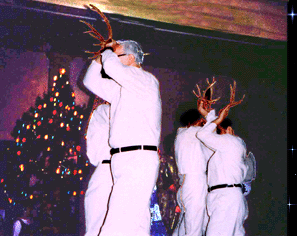


There are several theories concerning the roots of this peculiar festival. It may well have begun as a Winter Solstice ritual, but it has also been suggested that it was born when King Henry I (1100-1135 AD) granted hunting rights to the people of the area. The dance was supposed to have been created as a mark of gratitude.

The hunting rights theory is suspect, however, because the Horn Dance shows signs of having had a much earlier, pre-Christian beginning when magic and fertility ceremonies were very much aspects of the lives of ordinary people. It's interesting to note that some of the figures to be seen in the world-famous cave paintings at Lascaux look very like the Abbots Bromley Horn Dancers. These figures are over 20,000 years old, so perhaps the true origins of the dance you can see today at Abbots Bromley are far more ancient than most people realize.


The Abbots Bromley Variations

1. Tony Hall - The Abbot's Bromley Horn Dance
2. Martin & Jessica Simpson & Lisa Ekstrom - Abbotts Bromley Horn Dance/In Winter's Shadow
3. Andrew Cronshaw - Wheelwright Robinson's tune for the Abbots Bromley horn dance
4. Trotto - Abbotts Bromley Horn Dance
5. Leif Alpsjö - The Abbots Bromley
6. Richard Greene & Beryll Mariott - Abbot's Bromley Horn Dance

Tony Hall's and Trotto's versions are probably the most traditional forms of the tune, though one with just tin whistle and drum would be even moreso. And yes, I do realize that Jessica Simpson's voice on "In Winter's Shadow" is totally annoying. But it's a fine poem, and a damn good tune. Richard Greene's version is, unsurprisingly, totally gorgeous.

So. Turn off your lights. Go outside. Look at the moon. Then come in, light a candle, and put the tune on, and drift off into the otherworld. And at the high point of each musical phrase, imagine antlered men clashing heads, locked in a stately, solemn dance.


And, as an extra wintery bonus, some poems:

from FOUR QUARTETS: East Coker by T.S. Eliot
O dark dark dark. They all go into the dark.
The vacant interstellar spaces......
I said to my soul, be still, and wait without hope
For hope would be hope for the wrong thing; wait without love
For love would be love of the wrong thing; there is yet faith
But the faith and the love and the hope are all in the waiting.
Wait without thought, for you are not ready for thought:
So the darkness shall be the light, and the stillness the dancing.


HAIKU by Basho
Turn this way,
I also am lonely
This evening of winter.

from OUR QUIET TIME by Nancy Wood
In our quiet time
We do not speak, because the voices are within us.
It is our quiet time.
We do not walk, because the earth is all within us.
It is our quiet time....
We rest with all of nature....

I AM SINGING THE COLD RAIN
A Cheyenne Poem
I am singing the cold rain
I am singing the winter dawn
I am turning in the gray morning
Of my life
Toward home.


FIRST SNOW by mary oliver

the snow 
began here

this morning and all day

continued,
its white

rhetoric everywhere

calling us back to why,
how,

whence such beauty and what

the meaning;
such

an oracular fever!
flowing 
past windows,
an energy it seemed

would never ebb,
never settle

less than lovely!
and only now,

deep into night,

it has finally ended.
the silence

is immense,

and the heavens still hold

a million candles;
nowhere 
the familiar things:

stars, the moon, 
the darkness
we expect

and nightly turn from.
trees 
glitter like castles

of ribbons, the broad fields

smolder with light, a passing

creekbed lies

heaped with shining hills;
and though the questions

that have assailed us all day

remain--not a single

answer has been found--
walking out now

into the silence and the light

under the trees,

and through the fields,

feels like one.

- from new and selected poems.