Donate to the Grapevine

Express your thanks by leaving the pirate a tip!
Showing posts with label Guitar. Show all posts

February 15, 2011

Rene Heredia - Alborada Flamenca


Scalding flamenco from one of Sabicas' students.

“The guitar playing of René Heredia is in the finest tradition of flamenco, creating a flaming intensity that cannot fail to arouse.”  —Denver Post

“If any musician on the local Denver scene deserves the moniker of legend, it would have to be René Heredia. Simply put, the man is a living history of the art of Gypsy flamenco guitar. He is both a link to its glorious past through his early association with legendary greats such as Carlos Montoya and Sabicas, and a bridge to its future through his love of teaching and performance…. René Heredia is an artist who is as passionate about the music as the music is itself…. René is a local artist of international stature … without a doubt, one of the greatest proponents of flamenco guitar music alive today….” —Classically Speaking, Music for All

“René Heredia is the most sensational young flamenco guitarist in the United States.” —Sabicas

“The audience wouldn’t let him quit.” —Los Angeles Times

“René Heredia is a brilliant guitarist.” —Walter Terry, New York Saturday Review

René with Sabicas
René and his Flamenco guitar have been together for so many years of his lifetime that there seems to be no separation of the two.  He formed a bond with the guitar as a child.  His life, his character, his loves and aspirations have all developed through the instrument.

He began his training with his father, a Gitano Puro (pure Gypsy).  As a boy, René was taught the rudiments of Flamenco Guitar and Spanish Gypsy Dance.  He brings a unique view of both sides of the art form to his audience. 

As a little boy, René remembers always having the house full of flamencos such as Carlos Montoya, Vicente Escudero, Mario Escudero, José Greco’s dance Company, Carmen Amaya, Sabicas, La Chunga and her Company.  They were\all close friends of José Heredia and his family.  Sabicas would help and teach René the secrets of Flamenco at his mother’s kitchen table.

At thirteen, he was performing with his sisters, Fátima, Sarita, Zoraida, Carmen, and brother Enrique.  “Los Heredia” were doing concerts, television shows and supper club performances.  His international recognition came when he was seventeen and the incomparable Flamenco dancer Carmen Amaya (Spain’s greatest dancer of this century) heard him play.  She immediately took him to be her lead guitarist.  He toured many years doing concerts in the major capitals of Europe and the United States with the famous Amaya Ballet.  While he was in Spain, René was invited to perform with the singing and motion picture star Antoñita Moreno, in “Los Reinos de España”.  He was then invited to perform in the Festival de Cante Grande with Fosforito, Jarrito, Juanito Varea, Chocolate, and Gordito de Triana; some of Spain’s most outstanding singers.  As his reputation grew, the famous Spanish dancer José Greco invited him to be his lead guitarist for several seasons.  René has played for such outstanding dancers as El Güito, Mario Maya, Los Pelaos, Manuela Vargas, Luisita Triana, María Rosa, Ciros, Rosa Montoya, Lutys de Luz, María Benitez, Los Heredia, and many more.

While living in Paris, René’s distinguished L.P. album, Alborada Flamenca, was awarded the Gran Prix de Disque of France.  In the United States, René was invited to perform the world premiere of his symphony composition and Flamenco suite for Guitar and Orchestra “Alborada Gitana”(a Farruca), which he performed with the Denver Symphony and Denver Chamber Orchestra at Red Rocks Amphitheater.

René has performed live concerts and T.V. shows with his Flamenco Fusion Group and his Flamenco Fantasy Dance Theatre.  He performed solo concerts at such prestigious venues as New York’s Carnegie Recital Hall four years in a row, where he received standing ovations; the Champs Elysee Theatre in Paris; Westminster Theatre in London; Teatro Barcelona; Teatro La Zarzuela and Teatro Maravilla in Madrid, Spain; and the Dorothy Chandler Pavilion and Greek Theatre in Los Angeles.


René has performed concerts with his Flamenco Fantasy Dance Theatre in Kansas City, where he was awarded the “Keys to the City”  (sister city of Seville, Spain).  He was recognized as one of Colorado’s best-known composers in a special tribute to Colorado artists at the Kennedy Center in Washington, D.C.

René was awarded the prestigious Governor’s Award of Colorado for excellence in performance and education, as well as the Mayor’s Award of Denver for excellence in the arts.  He has done command performances for such dignitaries as Prince Rainier and Princess Grace of Monaco, Armand Hammer, Prince Bandar of Saudi Arabia, Queen Noor of Jordan, and Presidents Gerald Ford and Jimmy Carter.

René was invited to be the lead guitarist and guest artist with Stewart Copeland, founder of “The Police” in his national tour of the U.S.A. in “The Rhythmatists”.  René was invited by Colorado Performing Arts Center to be the musical director for the play “Romeo and Juliet” (set to early colonial California).

René has appeared on numerous national radio and television shows, including The Ed Sullivan Show with Duke Ellington, The Steve Allen Show with Sabicas, and The Art Linkletter Show with Donald O’Connor and Abbie Laine, The George Goble and Eddie Fisher Show with Carmen Amaya, and The Ann Southern Show with César Romero.  René appeared in the Spanish Movie “Balcón de Luna” with Paquita Rico, Carmen Sevilla, and Lola Flores.  His N.E.T. concert specials and opening acts for such outstanding artists as Bill Cosby, Hal Linden, and Peter Nero have put René in the forefront as one of the leading Flamenco Guitarists in the United States today.   


Rene Heredia - Alborada Flamenca
Label: Gypsy Productions, Inc.


*out-of-print & impossible to find


January 9, 2011

Debashish Bhattacharya - Live in Calcutta


More music from the best slide guitarist in the world! The last track on this album is seriously one of the best fusions of east and west that I've ever heard, with fearful symmetry to match any Fahey composition. That's all I can say!


The Jesuit maxim ‘Give me the child until he is seven and I will show you the man’ could just have easily have been coined in India, where the tradition of immersing children in music from birth is a natural result of them growing up within musical dynasties. In fact, Debashish Bhattacharya learnt to sing in the Gwailor classical vocal style his parents were steeped in even before he could talk. Oddly, the instrument he was first drawn to as a three-year-old was a Hawaiian lap steel guitar left lying around the house. As he recalls, “it was love at first touch.”

As a boy, Debashish learned western guitar as well as sitar, but his most rigorous training was a ten-year stint during his twenties studying with Pandit Brij Bhushan Kabra, the great pioneer of Indian raga slide guitar. It was during this time that he realised his vocation would be ‘to serve as a bridge between raga’s past and future’.

Now 43, and officially a Pandit (master musician) since turning 40, he is widely acknowledged as one of the world’s greatest slide guitarists, and has invented his own ‘Trinity of Guitars’. His Chaturangi has 22 strings, which enable it to suggest the timbres of violin, sitar, sarod and veena. The Ghandarvi is a 14-stinged guitar that can sound like a veena, sarangi, saz or flamenco guitar, and the tiny 4-stringed Anandi is basically a slide ukulele. He also has his own three-fingered style of playing which gives him an edge over others when it comes to speed and dexterity, and in 2003, he established a music school in his hometown of Kolkata.


Debashish Bhattacharya
World renowned Master of the Hindustani Slide Guitar

Debashish Bhattacharya is one of the world’s most amazing music personalities whose dynamism of artistry and creativity place him as a Genius. As a performer he is one of the worlds most powerful Slide Guitarists. He is creating a genre already in India and around the world.

As a composer he believes there is no east, and west in music, only Universal Human music which gives peace and joy to the believers.


As a creator he has become perhaps the only phenomenon in the History of World Music by creating TRINITY OF SLIDE GUITARS by name CHATURANGUI, GANDHARVI, and ANANDI.
As Debashish is perhaps the only Musician who has created such TRINITY in India too. As a recording artiste Debashish is a perfect Virtuoso matches in all the categories of Music starting from Indian Classical, Semi Classical, Folk to any Kind of World music.

Genetically Debashish carries music of his Devotee parent, who was singers by generations. His brother Subhasis is an extraordinary Tabla and other rhythm instruments. Sutapa his sister is a very popular singer who at her first abroad tour has been quiet popular in Japan And Canada.


As a disciple Debashish feels extremely fortunate to be associated with his Gurus, Pundit Ajoy Chakrabarty,the exponent vocalist and Pundit Brij Bhushan Kabra, the living legend and pioneer of Indian Classical Guitar.

As a performer Debashish began his debut at the age of four at All India Radio, Calcutta, late Ustad Karamatullah Khan of Farukhabad Gharana accompanied him on tabla was blessings from Ustadji

As he was twenty Debashish received President of India Award for wining National Music Competition of All India Radio. At his thirties Debashish has been awarded Top Grade, the ultimate honor by the Ministry of Information and Broadcasting of India, Prasar Bharati.

As a Classical Guitarist He is the best, as all the Gurus say today in India.


Debashish Bhattacharya visualised his customised guitar right back when he was sixteen years old. It took him the best part of two decades to solidify this fantasy into a range of axes with augmented strings, a collection that still look like guitars, but possessing trimmings that call to mind a sitar. He's added sympathetic resonating strings, raised high from the guitar body, and decorated his tuning knobs with bulbed carving. He plays with the axe laid flat, its strings caressed by a metal sliding bar. Could this be another version of the blues, to sit beside those manifestations from the Sahara and the Mississippi Delta?

Since signing to Riverboat Records, Debashish Bhattacharya's UK profile has been higher, particularly in the light of his duo disc Mahima, with serial collaborator Bob Brozman. The latter guitarist is obsessed with any string that slides, so his teaming with Debashish was almost inevitable. Now, Bhattacharya has just released his own album, Calcutta Chronicles, subtitled an Indian Slide Guitar Odyssey. It's refreshing to hear an artist verge on advising his audience not to buy the disc that's on sale at his gig. Well, not quite, but Debashish does issue a warning that it features capsule, or even compromised, versions of his crucial raga material, mentally edited for the purpose of audio home comfort.

In the onstage setting, Bhattacharya is more concerned with the expected lengthy unfolding of a traditional raga, though he's not going to take as much time to unwind as many of his peers. The average length of Debashish's journey is about thirty minutes per piece, instead of the oft-attained hour-long exploration. He drapes himself with the mantle of preservationist, viewing the old ways as being beleaguered in the face of modern technology (Bhattacharya has a curious obsession with citing GPS as the bane of the itinerant musician!). It's not that Debashish is particularly advanced in years, but he's set on preserving the ancient Indian classical system, and not just as a performer. His principle concern is that the audience needs to consciously battle, in order to find a quiet space for extended contemplation. He doesn't want you to play your disc whilst driving/eating/cleaning/procreating. He's right, of course. To solely listen requires a deliberate resolution...

Debashish is partnered by his tabla-playing brother, Subhasis, who observes silently as the opening alap is delicately formed by the sliding strings. He enters more prematurely than most, speaking with the deeply-rubbed tones of his bass skin. Debashish escalates quite quickly, plucking and picking, as he scatters single-note phrases against a backdrop of his own simultaneous jangle-cascade. It's highly intricate, and at its climax, incredibly speeding, with the pair displaying a uniquely bonded sense of improvising precision. Bhattacharya uses each of his three guitars in turn, the last being of ukulele size, and demonstrated on an even shorter piece. Close the eyes, and his sound is not so far removed from that of a sitar or veena, but Bhattacharya is nevertheless in possession of his own particular style, and has rapidly become one of the most impressive players on the Indian classical circuit.


RockOm's Tom Crenshaw had the privilege to interview Debashish in early 2008 and to witness a phenomenal concert in Savannah, Georgia, at the Savannah Music Festival, where Debashish debuted his "Song of Life" composition as performed by master guitarists Derek Trucks, Jerry Douglas, Bob Brozman, and Debashish himself. Tom remarks, "For close to ten minutes these giants of slide guitar held the audience in the palm of their hands trading licks back and forth, and singing dynamically through strings and fingers something entirely unheard-of up until that moment. I've never before witnessed or heard anything like these four masters speaking through their music in such a passionate and moving manner. There was a time when all four guitarists and the tabla percussionist were playing simultaneously and every single note, every beat made perfect sense! When the composition was over the audience erupted in a resounding, almost deafening applause. It was quite a moment- one I'll never forget!"

RockOm: I sometimes say that music is spiritual in nature- in that what flows through us musically seems to come from a higher realm. Do you agree?

Debashish Bhattacharya: No, not at all. Music is man's hard work with extreme passion. When it pleases us, it transports us to a level of the mind where we feel disconnected with all material things momentarily. If you call this spirituality, so be it. Spirituality lies in the philosophy shaping up any music and or true practice of humanity; it is not a package or brand to sell a product.

RockOm: Do you feel that your spirituality is communicated through your music and if so, how?

Debashish Bhattacharya: As I said, spirituality lies in the philosophy shaping up any music. Spirituality is also related to non-fake humanity. Of course, my music is deep-rooted in philosophy, which is why Indian classical or raga music has survived thousands of years. That so many people are learning, practicing, and listening to it all over the world is a percolation of its spirituality. My music is liked by millions around the world, so the aesthetics rooted in philosophy transcribes spiritual feelings in their minds; it is the music itself. In true presentation it shows what it is. This is a natural process of communication, but only possible in the hands of a dedicated and true artist.

RockOm: What do you think it is about music that breaks down barriers and divisions between people?

Debashish Bhattacharya: I call it emotional attachment. Subconscious self-identification with one and all. Only music evokes the realization that we are all human beings, "Brothers and Sisters," as the great Swami Vivekananda addressed audiences at the Chicago World's Religions meeting decades [ago.]

RockOm: Besides your own music, is there any one artist or album that you continually return to (more than others) for inspiration, depth, or spiritual revelation and why?

Debashish Bhattacharya: I always fall back upon Ustad Ali Akbar Khan, Pandit Ravi Shankar, and Ray Charles. Why? I think they shape my thinking, intellect, heart, hands, eyes, and all organs like vitamins.

RockOm: Is there a difference between hearing music and feeling music? How do you explain this?

Debashish Bhattacharya: I think that is a radical issue, which needs to be addressed rather seriously. Do you relate to your feelings phone ringtones, horns, jingles, lounge, titillating promos, and squeaks and squirms? All that comes without philosophy of life is "passing sound."

RockOm: Just as you've invented new musical instruments to express what you hear and feel inside, what do you think future master musicians will come up with?

Debashish Bhattacharya: I have invented sounds deep rooted in Indian tradition and use them to trans-create music that is eternal. I have been able to do something though I did not have any role model in front of me. I can't say for others.

RockOm: How are we limited here in the West with regard to writing and performing music of a spiritual nature?

Debashish Bhattacharya: Try to find an answer to why you think you are limited, if you believe so. I think only then you can get your answer of the question.

RockOm: How important is it for you to "get out of your own way," so to speak, when performing? Do you lose yourself while performing or must you remain fixated and aware of what you are doing at all times?

Debashish Bhattacharya: I do not believe in talking while performing. That's not done. I am deeply absorbed while performing, as I believe that I must deliver my best to my audience.

RockOm: Is playing music similar to praying or meditating?

Debashish Bhattacharya: Yes. If one concentrates while praying will he not do so while playing music?

RockOm: Does music have the power to heal and can you give any example of healing you have witnessed?

Debashish Bhattacharya: Healing varies from person to person. Yes, many of my fans listen to a certain piece of mine, at a certain time, to feel good. That's surely healing. But a general remedy is difficult to formulate in such abstract fine arts.

RockOm: Is everyone inherently musical to some degree?

Debashish Bhattacharya: Well, not really. I know of many who are least musical but make tons of money by selling music!

RockOm: What is the most important thing we should know about you and your music, Pandit?

Debashish Bhattacharya: The most important thing about me to know is my name Debashish Bhattacharya and my music - classical raga, music of India.

http://www.debashishbhattacharya.com/

Debashish Bhattacharya - Live in Calcutta

Year: 2010
Label: Rough Guide

This album is only issued as a bonus disc to the Rough Guide to India. You cannot purchase it by itself, and the rough guide isn't even half as good.

Tracks:
01. Raga Maru, Bihag Aalaap 13:41
02. Mahu Bihag, Jod-Jhala 9:29
03. Maru Bihag, Gat In Madhyala Rupak Tala 12:22
04. Maru Bihag, Gat And Jhala In Drut Tintala 13:20
05. Raga Khamaj, Aalaap 7:41
06. Anandam In Anandi (Raga: Mishra Shivaranjani) 7:07

if any of you have Debashish Bhattacharya - Calcutta to California, I'd love to hear it.

January 8, 2011

Joseph Spence - Living on the Hallelujah Side


Another album from this blog's guardian angel: Joseph Spence! As I've already said all that I can say about this fountain of joy and grizzly grumbles, I'll leave it at just the pure music. Enjoy!


Joseph Spence - Living on the Hallelujah Side

Year: 1987
Recorded 1972-1978
Label: Rounder

Product Description
Joseph Spence's music is a style unto itself. Working with songs learned from hymnals, from the radio and from local tradition in his native Bahamas, Spence developed an astounding guitar style with wild, syncopated rhythms and a unique but sophisticated sense of harmony, while he casually growled out excerpts of lyrics. Spence was a major influence on Ry Cooder. These are '70s recordings made near his home in Nassau and in concert in the U.S.


Review by Ron Wynn
Bahamian guitarist/vocalist Joseph Spence's humming, flailing, sensational singing and playing combined secular flair and spiritual fervor in a manner close to that of the brilliant Blind Willie Johnson and Rev. Gary Davis. This set of 1970s performances, reissued on CD, included evocative renditions of "A Closer Walk with Thee," "More and More with Jesus," and "When the Saints Go Marching In," plus equally arresting versions of "Irene Goodnight" and the holiday ditty "Santa Claus Is Comin' to Town." Spence was incapable of self-indulgence or fakery; his lines, phrasing, riffs, and solos are enchanting, while his vocal effects and accompaniment often come close to surpassing his playing. This was simply magical material, the kind that comes only from a genuine original.


A customer said:
It's almost impossible for me not to smile while listening to this wonderful record. There are many times in fact, when I have laughed with joy and amazement at the pure, unadulterated music-making of this amazing man. 'Neighbor Gone Home' and 'I'll Be A Friend To Jesus' are among my favourites here, with the latter in particular having me in hysterics when Joseph pulls up abruptly at the high notes, leaving his friend Blooming Rosalie Roberts to carry the tune. All through the album Joseph's half-sung, half-grunted, half-mumblescatted vocals (a new term that fits, I think!) are just amazing and delightful. Trust me, you have never heard ANYTHING like the singing of Joseph Spence! It is absolutely outrageous!

For the uninitiated, Joseph Spence played guitar exclusively in something called 'Dropped D' tuning, and his beautiful, syncopated Calypso fingerstyle is inimitably great. He was a gem of a musician, and a true original. Joseph was not as young as he used to be by this time, but don't let that deter you. This is a wonderful album. Check out "More and More With Jesus", "I'll Overcome Someday", or "Where Shall I Go" for some wonderful Joseph Spence guitar performances.

This album is a complete blast of infectious, wonderful, guitar-and-voice simplicity. There's some kind of joy and delight that just comes out in Joseph Spence's music. It's unique, and something hard to explain; you just have to hear him. And you MUST hear him! The Book of Proverbs says that "A merry heart does good like a medicine." With this in mind I have no hesitation in recommending to everyone a good listen to Mr. Joseph Spence. His music and his spirit will do you a power of good. Absolutely unmissable!


Tracks:
1. I'll Overcome Some Day 2:06
2. A Closer Walk With Thee 3:00
3. Where Shall I Go 3:20
4. I'll Be A Friend to Jesus 2:42
5. More And More With Jesus 4:08
6. Santa Claus Is Comin' To Town 2:58
7. On My Way To Heaven 2:15
8. Neighbor Gone Home 2:05
9. Jesus On The Mainline 3:58
10. Living On The Hallelujah Side 2:26
11. When The Saints Go Marching In 2:57
12. Irene Goodnight 3:06

January 6, 2011

Peter Finger - The Elf King: Acoustic Rock Guitar


Like Andres Segovia, John Fahey started a genre and inspired generations of musicians to take up his instrument and play it in a new way. This could have made him proud. Yet one thing always nagged at him. 90% of the people who claimed to be influenced by him were making pathetic, overly-sweet acoustic guitar ditties that bore little or no resemblance to the dark & mysterious depths he brought out of the guitar. And of those 10% that did actually incorporate his ideas and not just skim his style, most of them sounded like imitations of him (Peter Lang, etc.).

However, a few guitarists took the flame he had lit and brought it to new places, discovering new territories for the guitar just as he had. One of those was Peter Finger. With about 85 pounds of technique in his namesakes, this man could play the shit out of the guitar. And such a restless spirit, continually challenging himself and looking for new sounds to draw out of the guitar. This is his third album, and it's totally fantastic. Sounds nothing like Fahey, but is just as probing, unrepentant, steeled, and fascinating.

Biography
by Greg Prato
Acoustic guitarist Peter Finger was born in Weimar, Germany, in 1954 (his father was a conductor). Before beginning guitar lessons at the age of 13, Finger studied both violin and piano. Since the mid-'70s, Finger has been issuing albums (1975's Detlef & Finger and Bottleneck Guitar Solos, plus 1977's Acoustic Rock Guitar), and toured the world on a regular basis, including shows in his native Germany, as well as the U.S.A., Canada, Japan, England, Switzerland, Austria, Belgium, Holland, Luxembourg, France, Italy, Finland, Poland, Estonia, and Russia. The guitarist then branched out into other areas, including producing music for both TV, radio, and film, plus composing for orchestras. In 1988, Finger founded his own publishing company and record label (Acoustic Music Records), and in 1995, he became the publisher of Akustik Gitarre magazine. The '90s also saw further solo releases from Finger, including such titles as 1990's The Colors of the Night, 1995's Innenleben and Solo, 1999's Open Strings, and a ten-track 2001 compilation, The Collection.


Peter Finger - The Elf King: Acoustic Rock Guitar

Year: 1977
Label: Kicking Mule

Tracks:
1 Wishbone Ash
2 Hope & Memory
3 Just A One Man Band
4 A Berryman's Tune
5 Elf King, the
6 Sabine
7 For Ladies I Couldn't Get
8 Petermann's Polka
9 Magicians's Apprentice, the
10 Shepherd's Pie

November 26, 2010

VA - Rural Parlor Guitar - Recordings from 1967-1971


So by now most of you have gotten used to this pirate disappearing for 3-month stretches, with little-to-no notice. This was another one of those, also involving travel and relocation. Thanks for your patience! I'm beginning to get settled into my new home, and may perhaps soon begin posting all the vinyl I ripped the last time I was at my parent's house. Until then, rest assured that all is well on the stormy seas, and enjoy this little ditty from time immemoral:

Parlor Guitar. This is the original American guitar style. The first Guitar Soli. This is where blacks and whites first came together and combined their heritage into a new innovation. Without Parlor Guitar, there would be no John Fahey, no Elizabeth Cotten, no John Hurt, no Norman Blake. The tunes are from a time when there was no radio or records. If you wanted music, you had to make it yourself. If you have been reading this blog, I probably don't need to tell you that you need to hear this. Humility suffuses the music. Grace too. Old virtues we don't think too much about in the modern era, now that we worship the ego. Let this gift be a reminder that the best things in life are free, homemade, imperfect, and full of surprises. And if you don't play an instrument, maybe you should start. It's easier than you think.

a bit of a bio:
Like so many great musicians in what we generally term ‘folk music’, I don’t feel that Estil Ball got as much recognition as he deserved during his lifetime. It wasn’t that nobody was aware of his existence - as early as 1941 he had been recorded by Alan Lomax, and possibly even two or three years prior to that. Lomax had apparently met Ball at an early Galax Fiddler’s Convention. Ball lived roughly 30 or so miles from Galax in the tiny community of Rugby, Virginia, a few miles from where he was born and where he and his wife Orna continued to live until hiss untimely death in July 1978. It was at Rugby where Lomax recorded Ball on the porch of the Henderson household. Sylvia Henderson is a cousin to Orna and the house occupied by her and her husband was the only one in Rugby at that time to have electricity.

Lomax again recorded Estil and Orna Ball during his well documented field trips in 1959 and 1960. It was a BBC/Lomax documentary programme featuring recordings made on this trip that first introduced me to his wonderful fingerpicking guitar style, I had never heard anybody make an acoustic guitar swing like that. Lomax announced him as “my friend E C Ball, a school bus driver from Virginia”, and the sound just blew me away. I couldn’t then understand how a musician of that calibre should have to drive a bus for a living. Since that time however I have found that it was not an unusual occupation for musicians in the South. Fiddling Fred Price over in Trade, Tennessee was another.


VA - Rural Parlor Guitar - Recordings from 1967-1971

Label: COUNTY CD-2744
Artists: E. C. Ball, Earl Blair, Lena Hughes, Lewis Thomasson

RURAL PARLOR GUITAR is the one of the very few commercial recording to focus on this genre, and the only one to include multitude artists from different regions. Each of the four musicians was raised in rural areas in the early 1900s: Lena Hughes in northwest Missouri; Earl Blair in the Arkansas Ozarks; Lewis Thomasson in the open plains of Coryell County, Texas, and E. C. Ball in the southwest mountains of Virginia. They learned to play — without sheet music, radio or recordings – from family and other musicians.

All the defining characteristics of the parlor guitar genre are here: open tunings; the use of three and four fingers, arpeggios, hammer-ons, pull-offs, slides and harmonics. Many of the tracks have never been available commercially before; each is an excellent representation of parlor guitar. The tuning for each song is included.

“The guitar styles depicted in this CD are all different, yet very representative of what one might have found in the rural south eighty or more years ago. Only a handful of guitarists in the 1920s, such as Roy Harvey and Leonard Copeland, made commercial recordings in this flavor, making this collection an invaluable resource for parlor-style guitar.” - Jeremy Stephens

“19th century parlor guitar was the foundation or an influence for the playing of early rural guitar players as diverse as Elizabeth Cotten and Sam McGee. Probably even the early blues players. This CD presents some of the last players of this rarely recorded style.” - Mike Seeger

All the recordings, save for E. C. Ball’s two self-recordings, were made by Charlie Faurot on his trips to their homes from 1967 to 1971. The format is a guitar based follow-up to his highly successful Clawhammer Banjo Series, originally released on County LPs. The Clawhammer digital release was equally successful. Produced by Charlie Faurot and Jeremy Stephens, RURAL PARLOR GUITAR was digitally edited by Jeremy Stephens. It was mastered by Dave Glasser, twice a Grammy winner.


Customer Review:
If you're interested in blues guitar or country guitar, you should own--no, you MUST own this cd. This is where the history of American guitar begins.

Until about 1875, guitars were handmade and expensive. About that time, industry began applying to the guitar the same manufacturing techniques it had earlier applied to the fiddle (making it cheap and affordable--and a common folk instrument). This made guitars affordable. Unfortunately, hardly anyone knew how to play them.

In stepped a series of entrepreneurs who turned out books on how to play guitar. They aimed at the same market as had bought the piano--young, middle class ladies. The books included light classics, intermezzos, novelties, and numbers written especially for teaching the instrument. Later, when the syncopated music craze began to hit in the 1890s, cakewalks and rags were included in the books. Many of the numbers were in standard tuning. But, to help make learning more simple, many were also written in various opening tunings, particularly G, C, and D tunings.

Now, what does this have to do with country music and blues? Country first. One of the young ladies who started playing parlor guitar, about 1881, was Alice DeArmond Jones of Muhlenberg County, Kentucky. Later, she taught her son, Kennedy Jones, to play the instrument as she had learned it. Kennedy taught many youngsters in the area, including Mose Rager. And Rager, too, had a student--Merle Travis. And Travis became the model for Chet Atkins.

Now blues. Two of the most popular songs in the parlor guitar guitar repetoire were "The Spanish Fandango" and "The Seige of Sebastopol" (both included here). "The Spanish Fandango" was typically played in G tuning, and "Sebastopol" (as it was often known) was played in D tuning (here, however, it's in C tuning). To this day, country bluesmen still describe the open G tuning as "Spanish" tuning and the open D as "Vastapol." So, somebody sure was listening. Delta blues styles probably weren't greatly influenced by parlor guitar, except that some of the upper-register slides and devices that parlor guitarist played with fingers, the Delta players played with a slide. Also, listen to "Cannon Ball Rag" on this cd and compare it to Mississippi John Hurt's "Louis Collins." Spooky. If you want to hear a style midway between parlor guitar and blues, check out Elizabeth Cotton's two cds on Smithsonian Folkways, Freight Train And Other North Carolina Folk Songs and Tunes and Shake Sugaree.

The performances on this cd were recorded 1967-1971 by four musicians who grew up in the early part of the century. The songs are, by our standards, sedate. They display, however, impeccable musicianship and an unmatched musical pedigree. The history of the American popular guitar begins here.

Tracks:
1 - Spanish Fandango - 2:41 - Lena Hughes
2 - Dewdrop - 2:19 - Earl Blair
3 - Sevastopol - 2:42 - Lewis Thomasson
4 - Walking The Wires - 1:23 - E.C. Ball
5 - Alone In My Rocking Chair - 2:24 - Lena Hughes
6 - Midnight Fire Alarm - 1:53 - Earl Blair
7 - Arlington - 2:52 - Lewis Thomasson
8 - Cannon Ball Blues - 2:20 - E. C. Ball
9 - Old Spinning Wheel - 2:08 - Lena Hughes
10 - Winter's Waltz - 3:06 - Lewis Thomasson
11 - Mother's In Heaven - 2:15 - Lena Hughes
12 - Home Sweet Home Waltz - 1:41 - Earl Blair
13 - Virginia Rag - 1:47 - E. C. Ball
14 - Echoes - 1:33 - Lewis Thomasson
15 - Lamplighting Time In The Valley - 2:10 - Lena Hughes
16 - Lewis Thomasson's Schottische - 2:04 - Lewis Thomasson
17 - Sioux City Sue - 2:17 - Lena Hughes
18 - Grandfather's Clock - 3:23 - E. C. Ball
19 - San Saba - 1:12 - Lewis Thomasson
20 - Wild Rose Medley - 1:44 - Earl Blair
21 - Pearly Dew - 2:35 - Lena Hughes


July 19, 2010

John Jackson - Rappahannock Blues


I haven't really posted much of anything lately, owing to the fact that I now have two jobs and little time for reviews... so I also neglected to post this news which is now a month late, about a newly-released album by folk-blues troubador John Jackson, which was sent to me by Smithsonian Folkways. Without further ado:

John Jackson represented, if anything, the crossroads. No, not the silly Robert Johnson devil-styled crossroads. I mean the place where different traditions meet. Blues, Folk, Minstrel/Medicine-Show Tunes and Appalachian banjo styles all came together in a single man with a warm Virginia country voice. John Jackson is the place where Blind Blake meets Mississippi John Hurt, Furry Lewis, Brownie McGhee, the Delmore Brothers, Blind Boy Fuller, and Hobart Smith. John Jackson is the place where they all sit down on a shady southern mountain house porch and pick some guitars after they've done all the picking of cotton & corn. There is nothing about this music that is not raw. Like fresh-picked wheatgrass, it will wake you up. Like a fresh-dug grave, it will lay you to rest in a deep, warm, earthy bed. And you'll be dreaming of candy on a stick, rocks and gravel, and a long Cadillac car with a little bump in the back-left wheel.


Biography by Barry Lee Pearson
For much of his life, John Jackson played for country house parties in Virginia, or around the house for his own amusement. Then in the '60s he encountered the folk revival, becoming the Washington, D.C. area's best-loved blues artist. Undoubtedly one of the finest of traditional Piedmont guitarists, Jackson exemplified the songster tradition at its best. His eclectic repertoire embraced the music of his guitar heroes Willie Walker (who once visited his father's house), Blind Boy Fuller, and -- most notably -- Blind Blake. Besides the blues, rags, and dance tunes associated with these masters, Jackson played ballads, country songs, and what he termed "old folk songs," such as "The Midnight Special." His confident fingerpicking, down-home Virginia accent, and contagious good humor marked his performances, live or on record, as something special. A world-class storyteller and party-thrower as well as a National Heritage Award-winning musician, Jackson recorded a half-dozen albums and toured the world as often as he wanted to. He died of liver cancer on January 20, 2002.


John Jackson
By Greg Johnson

For over 36 years, John Jackson was arguably the purest exponent of Piedmont Blues working the festival circuit. An artist in possession of a wealth of musical knowledge, along with his strong baritone vocals, he kept the sound of the traditional southeastern United States alive. Passing on the songs of artists such as Blind Blake and Blind Boy Fuller to younger generations, as well as introducing his own finely-crafted material. His recent death has left a void that'll surely be hard to replace.

John Jackson was born in Woodville, Virginia, at the foothills of the Blue Ridge Mountains in Rappahannock County on February 25, 1924, the seventh of fourteen children. His parents were farmers by trade, but they also were working musicians who played for parties on holidays and weekends. This exposure captured young John's attention early and he began teaching himself to play his father's guitar by the age of four. It was evident to his family that there was something magical in the child's desire and an older sister purchased a guitar for him when he was just five.

Along with his family's participation as active performers, John also loved to listen to the collection of records his parents owned. They consisted of early Country and Blues artists; people such as Jimmie Rodgers, Blind Lemon Jefferson, Blind Boy Fuller, and especially Blind Blake. John studied the 78s passionately, learning the chord progressions as closely as he could. Another individual that the youngster found as a teacher came from the unlikely source of a water boy on a chain gang who went by the name of Happy. While working on the construction of I-29-211, Happy found the time to offer lessons to young Jackson.

Jackson never truly had a formal education. He was forced to leave school after only attending a few short months in the first grade to assist his family on the farm. Because of this, Jackson never learned to read or write.

By the time he was in his early teens, he had joined his parents working the local house-parties. He continued to play with them throughout the 1930s and well into the 1940s. But, by the end of the `40s, he became disenchanted with music, feeling that it led to violent behavior and walked away from it altogether.

In 1950, John Jackson moved to Fairfax County, Virginia, near Washington, D.C. Now a family man himself, with his wife Cora and their children, Jackson took work on a dairy farm. In 1954, he took on the occupation of a grave digger at the Oakwood Cemetery in Falls Church, Virginia. It was a job that he enjoyed and would hold onto throughout his life, even well after he became a recognized musician. Music came back into Jackson's life around this same time. A friend in need of money sold his guitar to Jackson and soon he was playing for family friends and local children in his spare time.

While driving through Fairfax County in 1964, folklorist Chuck Perdue stopped at an Amoco gas station. What he didn't expect to find was Jackson, teaching guitar to a mailman. Stunned by the brilliant playing of Jackson, he introduced himself and soon had the guitarist performing in coffee houses in the greater Washington area. It was at the height of the age of "Rediscovery" for Blues and Folk artists and Jackson's knowledge of the Piedmont style was a natural fit.

John Jackson recorded his first album for the Arhoolie label in 1965. Titled, "Blues And Country Dance Songs From Virginia" it was a fine example of his deep repertoire, containing Reels, Rags, Gospel, Hillbilly tunes and Blues. It was the first of eight albums that Jackson would release for Arhoolie during his lifetime and it opened the door for his demand at festivals around the world.

Despite that demand, Jackson very rarely liked to travel far from his home in Falls Church. Over his career, he would play in more than 60 countries, at venues such as Carnegie Hall and the Royal Albert Hall. He would play for royalty and also was a featured performer at the White House for the annual Labor Day Picnic during Jimmy Carter's term as president. In 1986, Jackson was also honored with a National Heritage Fellowship from the National Endowment for the Arts. But, it wasn't until 1999 that he actually played formally for his own hometown when he appeared at the annual Falls Church Watch Night held to celebrate New Year's Eve, an event he would repeat for the remaining two years of his life.

Nineteen ninety-nine also saw the release of Jackson's final recording, "Front Porch Blues" on the Alligator label. The album would recap three W.C. Handy nominations that year, including one for the "Acoustic Album of the Year".

Shortly after Christmas 2001, John Jackson was diagnosed with liver cancer. It was unfortunately in such an advanced state that surgery was not an option. Despite his condition, Jackson appeared at the Falls Church Watch Night celebration a few days later, which would be his final performance. On the afternoon of January 20, 2002, he died while at home of kidney failure. It was reported that he was comfortable and not in pain. He was 77.

On the following Thursday, January 24, the life of John Jackson was celebrated by his friends and family. Many musicians, including the members of Saffire - The Uppity Blues Women and Cephas & Wiggins were all in attendance offering reminiscences of Jackson while his music quietly played in the background. He was later buried at Pleasant Valley Memorial Park, in Annandale, VA.

During his career, John Jackson was called the "King of the Piedmont Blues." But, he was more than just a musician; he was also a strong participant in the Civil Rights movement for Northern Virginia. Falls Church was the location of the first rural chapter of the NAACP and Jackson was a key member from its inception. He very rarely turned down any offer to perform as a benefit for this cause. He also wished to see the tradition of Piedmont's music to be remembered and to prosper as well. During the last month of his life, Jackson had began planning for a Center for Piedmont Blues in Falls Church in association with the local Tinner Hill Heritage Foundation. His musical legacy will surely carry on through this endeavor.


Obituary by John Pareles:

John Jackson, a master of the Piedmont tradition of blues, country and ragtime, died on Jan. 20 at his home in Fairfax, Va. He was 77.

The cause was kidney failure, but he had also suffered from lung and liver cancer, said his manager, Trish Byerly.

In a honey-cured Virginia drawl, backed by the gentle, spunky fingerpicking of his acoustic or steel guitar, Mr. Jackson sang a repertory that summed up rural life in the early 20th century. There were sly blues, hoedown tunes, storytelling ballads and God-fearing warnings of mortality. Mr. Jackson had only a first-grade education, and he continued to work as a gravedigger for decades after he was discovered during the 1960's blues and folk revival. In 1986 he was given the National Heritage Fellowship by the National Endowment for the Arts.

Mr. Jackson was born Feb. 25, 1924, the seventh of 14 children in a farm family in Rappahannock County, Va. His parents, Suttie and Hattie Jackson, played at parties on weekends, and Mr. Jackson started playing guitar when he was 4.

He learned songs from his parents and from the family Victrola, listening to records by rural bluesmen like Blind Lemon Jefferson and Blind Blake, as well as by country singers like Uncle Dave Macon and Jimmie Rodgers. Mr. Jackson learned slide guitar from a chain gang convict named Happy.

He dropped out of school to do farm work and learned to read and write later in life. Mr. Jackson continued performing with his parents into the 1940's, but because he felt music encouraged violent behavior, he quit by 1950.

He married and moved with his wife, Cora, to a dairy farm in Fairfax, Va., where he worked as a cook, driver and caretaker for the farmer.

In the early 60's two friends pawned him a Gibson J50 guitar for $50. Mr. Jackson started playing again, entertaining children. He kept the guitar for the rest of his career, calling it Stand By because, he said, it always stood by him.

A mailman heard Mr. Jackson playing for neighbors and asked for lessons. Mr. Jackson was instructing him at the local gas station, where the mailman had a second job, when the president of the Folklore Society of Greater Washington, Chuck Perdue, pulled in for gas and stayed to listen. He encouraged Mr. Jackson to start performing at coffeehouses around Washington.

Arhoolie Records released Mr. Jackson's first album, ''Blues and Country Dance Songs From Virginia,'' in 1965, and he made his way onto the blues-festival circuit. He performed at a Labor Day picnic at the White House during the administration of President Jimmy Carter.

In 1980 he was part of the United States Information Agency's ''Southern Music U.S.A.'' tour, which went to Asia, the Middle East and the Balkans. Mr. Jackson made albums for Arhoolie (which released more material from his 1964 sessions in 1999), Rounder and Alligator Records, most recently ''Front Porch Blues,'' released by Alligator in 1999. His final show was on Dec. 31 in Falls Church, Va.

Mr. Jackson is survived by two brothers, Freddie and Thomas, and a sister, Roberta Wigington; four children, Lee Jackson, James Jackson, Timothy Jackson and Cora Beth Johnson; seven grandchildren; and five great-grandchildren.

Although he regularly played 100 to 125 shows a year, Mr. Jackson also continued to work as a gravedigger.

''He took pride in being a good gravedigger,'' said Joe Wilson, the executive director of the National Council for Traditional Arts, who produced ''Front Porch Blues.'' ''His holes were always exactly squared off. He was a workman.''

- from the Times

Read an essay called 'Rememberin John Jackson' here.

SMITHSONIAN FOLKWAYS SPOTLIGHTS BLACK APPALACHIAN MUSICIAN JOHN JACKSON'S 'RAPPAHANNOCK BLUES’ OUT JUNE 15

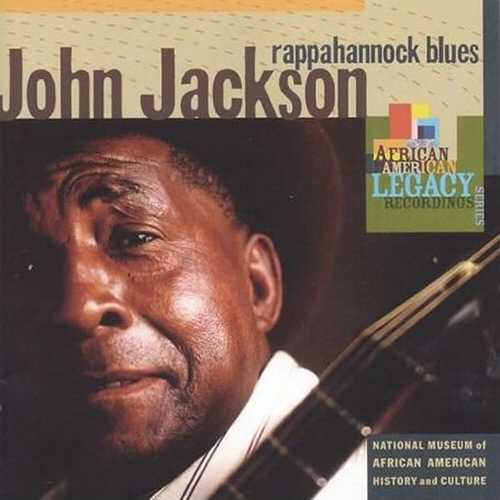
Smithsonian Folkways is releasing 'Rappahannock Blues,' a 20-track album by John Jackson, on June 15. Jackson (1924–2002) was the most important black Appalachian musician to come to broad public attention during the mid-1960s. The album is the latest addition to Smithsonian Folkways African American Legacy Recordings series, co-produced with the Smithsonian National Museum of African American History and Culture.

Raised in a large, musical farm family in Rappahannock County, Virginia, Jackson got his first guitar, bought by his oldest sister Mary for $3.75 from a catalog, when he was nine. He learned a wide-ranging stock of songs from his father, his aunt Etta and from 78-rpm recordings by the Carter Family, Jimmie Rodgers, Blind Blake and Blind Lemon Jefferson, but after a fight at a house party in 1946, didn't touch an instrument for nearly 20 years.

Rediscovered at a gas station by folklorist Chuck Perdue, Jackson was quickly recorded by Arhoolie in 1964, laying down 90 songs in 12 hours in his first session. For the next three decades, he enthralled audiences with his vintage style and repertoire, though he worked day jobs his entire career, including a long-stint as a gravedigger and cemetery caretaker.

Although black Appalachian music never received the attention given to the transition from Delta blues to Chicago blues and then to rock and roll, in the mountains a shared black and white string band tradition served as the basis for American roots music, ranging from bluegrass to regional rockabilly. Emphasizing that shared heritage, Jackson toured Asia in 1984 with Ricky Skaggs, Buck White and Jerry Douglas. Two years later, he was designated a National Heritage Fellow by the National Endowment for the Arts.

Culled from hundreds of live concert recordings in the Smithsonian Folkways archives, the twenty tracks of 'Rappahannock Blues,' which include Blind Blake's "Too Tight Rag," "West Coast Rag" and "Diddy Wah Diddy," Mississippi John Hurt’s “Candy Man," and "Red River Blues," recorded by Josh White as “Blood Red River” and by Blind Boy Fuller as “Bye Bye Baby,” highlight John Jackson the way he said he most wanted to be remembered — as a bluesman. All but two of the tracks are previously unreleased.

The release of 'RAPPAHANNOCK BLUES' will be celebrated at the “2010 Tinner Hill Blues Festival – A Tribute to John Jackson”, June 10-13, 2010 in Falls Church, VA (Washington DC area). For more information, visit http://www.tinnerhill.org/blues/

John Jackson - Rappahannock Blues

Year: 2010
Label: Smithsonian Folkways


Review by Steve Leggett
Appalachian guitarist, banjo player, and singer John Jackson, who died in 2002, was a bona fide American treasure whose recorded work and live performances were amazingly consistent and refreshingly real and unadorned. He was a fine guitarist in several styles -- he could fingerpick in the Piedmont style, then pick up a slide and go Delta -- and his claw-hammer banjo style bubbled with joy, while his singing was strong, warm, and always appropriate to whatever song he was doing. This set is drawn from live performances Jackson did between the mid-'70s and the late '90s, and it focuses on the blues end of his repertoire with solid and refreshing versions of blues pieces like “Rocks and Gravel” and “Frankie and Johnny,” as well as a gorgeous slide guitar take on the traditional “John Henry.” He also tackles a rag with “John Jackson’s Breakdown,” and pulls out the banjo for the string band reel “Cindy,” making this a fine introduction to a remarkably gifted folk musician.

Track Listing
1. Rocks and Gravel (John Jackson) *
2. Too Tight Rag (Blind Blake) *
3. Candy Man (Mississippi John Hurt) *
4. Truckin’ Little Baby (Blind Boy Fuller)*
5. Railroad Bill (traditional)
6. Nobody’s Business (If I Do) (traditional) *
7. Don’t You Want to Go Up There (trad.; arr. John Jackson) *
8. The Year Clayton Delaney Died (Tom T. Hall) *
9. John Jackson’s Breakdown (John Jackson) *
10. Red River Blues (traditional) *
11. Brown’s Ferry Blues (The Delmore Brothers) *
12. Cindy (trad.; arr. John Jackson) *
13. You Ain’t No Woman (Bill Jackson) *
14. John Henry (traditional)
15. Diddy Wah Diddy (Blind Blake) *
16. Just a Closer Walk with Thee (Kenneth Morris) *
17. Frankie and Johnny (traditional) *
18. Don’t Let Your Deal Go Down (trad.; arr. John Jackson) *
19. Step It Up and Go (Blind Boy Fuller; arr. John Jackson) *
20. West Coast Rag (Blind Blake) *

(*denotes previously unreleased track)

Cheers to Smithsonian Folkways for continuing to release these important recordings; check out the album here, where you can listen to all the tracks, download the booklet, and get a free download Frankie and Johnny, plus the opportunity to purchase a physical or downloadable copy of the album. Remember, Folkways is a non-profit. They're good people to support!


also see their Artist Spotlight page on him, with video, text, & rare photos.

also check out the Wirz Discography


May 17, 2010

Russ Barenberg


Ok, on to number 3! This time the best aspects of the previous 2 artists are joined for two truly remarkable albums. To start, let me say that there is something very personal, immediate, and beautiful about Russ's playing. His tone is instantly recognizable. And like Statman, one gets the feeling that there's no separation, no pretension of 'coolness' about his music. He's one of the few artists who can convey such a sense of joy in a purely instrumental setting. Where Statman went to outer-space, to mystery of mysticism to find beauty, Russ finds it in the things close at hand. It is a very ordinary beauty, and an infectious one. It's a treasure to hear someone who can smile so genuinely through his guitar. And the range of moods, sounds, tones! Totally expansive. Exploratory, without ever feeling forced. It's like he lets go of the uptight DRIVE that underpins so much of bluegrass, and settles into a relaxed groove that MOVES, in a slinky stately way - the same groove that Geoff Muldaur and Amos Garrett like to dwell in. Once again, totally unique, fresh, and invigorating. Totally enjoyable. And totally out-of-print, so be thankful you don't have to pay $60 for a used copy at Amazon...


Acoustic guitarist Russ Barenberg is known as one of the most melodic instrumentalists in contemporary acoustic music, and his compositions are among the finest the genre has to offer. He got his start in 1970 with the groundbreaking bluegrass band Country Cooking and since then has been a member of a variety of highly influential groups, most notably his collaboration from 1989 to 2001 in a trio with dobro master Jerry Douglas and bassist Edgar Meyer. Barenberg’s 1979 debut solo album Cowboy Calypso showcased his sophisticated playing and immediately established him as one of the premier composers and arrangers in the emerging new acoustic scene. His work since then, including his most recent collection, When at Last (2007), reflects an ever-deepening musicality with continuing dedication to vibrant, roots-based melodies and ensemble interplay. “Little Monk,” the opening track from When at Last, was nominated for the 2008 GRAMMY for Best Country Instrumental Performance.

Barenberg began playing guitar at the age of 13 in Chester County, Pennsylvania, west of Philadelphia. He took lessons from Alan Miller, the older brother of future band mate, guitarist John Miller, and was inspired early on by guitarists Doc Watson, Mississippi John Hurt, and Clarence White along with a wide range of old-time, bluegrass and contemporary folk and blues artists.

While attending Cornell University in Ithaca, NY, in 1970, Barenberg joined with Peter Wernick, Tony Trischka, Kenny Kosek and John Miller to form Country Cooking. During the four years that Country Cooking was together, the group recorded two influential albums, Country Cooking: 14 Bluegrass Instrumentals and Barrel of Fun and accompanied mandolinist Frank Wakefield on a third album. Barenberg also played on a number of Trischka’s solo albums throughout the 1970’s.

After Country Cooking disbanded in 1975, Barenberg temporarily switched to electric guitar and performed with a jazz-rock band, Carried Away. In 1977 he moved to New York and, together with Trischka, Miller, and fiddler Matt Glaser, formed the eclectic string band, Heartlands. Heartlands backed Barenberg on many of the cuts on Cowboy Calypso.

Moving to Boston in 1979, he joined Glaser and fiddler/mandolinist Jay Ungar in the triple-fiddle band Fiddle Fever, recording two albums with the group. Fiddle Fever’s recording of “Ashokan Farewell” was later used as the centerpiece for the soundtrack to Ken Burns’ celebrated documentary, The Civil War. Barenberg played on the soundtracks for several other Burns’ films as well, including The Brooklyn Bridge, The Shakers and Huey Long. During this time, he also worked with Glaser and mandolinist Andy Statman in the experimental bluegrass-jazz band Laughing Hands. Barenberg recorded his second solo album, Behind the Melodies, in 1983. That album, along with his appearance on Jerry Douglas’s 1982 release, Fluxedo, marked the beginnings of an ongoing series of collaborations between the two musicians. While in Boston, Barenberg was also active in the vibrant contradance scene, playing frequently for dances. He played on fiddler Rodney Miller’s recording, Airplang, which was seminal to the development of contradance music in the late 80’s and 90’s. A number of Barenberg’s own tunes have since become popular standards in the contradance repertoire.

Barenberg moved to Nashville in 1986 and has lived there since. Along with Douglas, he worked for several years accompanying Irish singer, Maura O’Connell, and in 1988 recorded his third solo album, Moving Pictures, another beautiful collection of original instrumentals featuring Douglas, Meyer, banjoist Bela Fleck, and fiddlers Mark O’Connor and Stuart Duncan, among others. The previously mentioned trio with Douglas and Meyer, active throughout the 1990’s, was a highly original ensemble that further reshaped the direction of acoustic music. Their popular 1993 recording, Skip, Hop & Wobble, has been extremely influential with the a new generation of acoustic instrumentalists. In 1996 Barenberg worked with Douglas, fiddler Darol Anger and Los Angeles-based music producer Snuffy Walden to create the soundtrack for Homecoming, a film starring Anne Bancroft.

Barenberg has performed and recorded with many other top acoustic and country music artists including Randy Travis, Emmy Lou Harris, Ricky Skaggs, Tim O’Brien, Sam Bush, Paul Brady, Darryl Scott, Joan Osborne, Bryan Sutton, Aly Bain, Phil Cunningham, Eddi Reader, Natalie McMaster and Sharon Shannon. Many of these musical associations came about through his ongoing work on The Transatlantic Sessions, a series of television shows produced in Scotland beginning in 1994 that bring together top acoustic musicians from the British Isles and the United States for collaborative performances. The fourth and most recent group of Transatlantic Sessions was filmed in March 2009.

Known widely as an exceptional teacher and author of instructional materials, Barenberg is regularly in demand at workshops and music camps throughout the country. He has been on staff at the Telluride and Rocky Grass Academies in Colorado, Steve Kaufman's camp in Tennessee, The Puget Sound Guitar Workshop in Washington, Augusta Heritage in West Virginia, Pinewoods in Massachusetts, and Fiddle and Dance at Ashokan in New York state.

Barenberg currently freelances in Nashville and performs with his own group--The Russ Barenberg Quartet. His 2007 release on Compass Records is described well by music writer Jon Weisberger: “…while ensemble interplay is the foundation of When at Last, its heart and soul ultimately is to be found in Barenberg’s tunes—some dating back to the early 90s, others composed shortly before recording began—and in his glistening playing. Few guitarists so perfectly blend a mastery of roots music traditions with melodic originality, or so finely balance muscularity with delicacy, and each moment of the album is shaped by these artistic dualities…”


Barenberg took up the guitar in his early teens. With Chester County, Pennsylvania as his home, he absorbed the music of such vanguard Americana guitarists as Doc Watson and Clarence White.

“I never thought of pursuing this music as a way to make a living when I was young,” Barenberg said. “I just thought of it as something I was really excited about. One reason would definitely be Clarence White and that whole break free, experimental energy his playing had. That sounded pretty remarkable to me. But that was when I was a teenager.”

From that point on, Barenberg’s career took him to bands that boasted some of the most prestigious string players in the land.

In 1970, while attending Cornell University, he picked with banjo stylists Pete Wernick and Tony Trischka in a bluegrass outfit called Country Cooking. Collaborations with Trischka continued after Barenberg moved to New York. There the two formed Heartlands with fiddler Matt Glaser and Country Cooking guitarist John Miller. Barenberg finished the decade in Boston with fiddler/mandolinist Jay Ungar in the ensemble Fiddle Fever. Their recording of Ashokan Farewell received a new life as part of the soundtrack to the Ken Burns documentary The Civil War.

But it was in the ‘80s that the string sounds Barenberg discovered with new pals like dobroist Douglas began to make serious waves. By 1986, Barenberg relocated to Nashville. Almost familial recording projects ensued with Fleck, fiddlers Stuart Duncan and Mark O’Connor, Irish-born singer Maura O’Connell and an instrumental trio with Douglas and bassist Edgar Meyer. The latter toured extensively in the early ‘90s and gave a remarkable Lexington performance with mandolinist Sam Bush at the long-defunct Breeding’s on Main St. In 1993 came Skip, Hop and Wobble, an album that neatly summarized the broad stylistic scope of the trio’s new grass vision.

“We were just having fun,” Barenberg said. “All of us were interested in different kinds of music and played stringed instruments of one sort or another. There were all kinds of experimentation going on. But it wasn’t even so much like we were trying to experiment. We never set out to do that. It was just part of our natural approach to playing music.”

Curiously, Barenberg lived a double life during these years. By night, he picked behind O’Connell or jammed with Douglas and Meyer. By day, he worked in training development and instructional design for the Saturn car company. While such a seemingly removed work environment didn’t curtail his performance life, it cramped his solo recording career a bit.

To celebrate a recent re-entrance into a full-time music career, Barenberg has released the first recording under his own name in nearly 20 years. Titled When at Last, the record boasts a scrapbook of grassy adventures that mix fiddle tunes, guitar/mandolin romps, French folk music, Irish inspiration and even a suggestion of polka. Topping the list is a nimble bit of breezy picking backed by pals Douglas, Duncan and bassist Viktor Krauss called Little Monk. The tune was nominated earlier this year for a Grammy.

“I don’t know why I waited so long to make another record,” Barenberg said. “I had been working this non-music job for such a long time. But that’s really no excuse. It was definitely time to do one.”

Life away from Saturn has also included trips with Tim O’Brien to Ireland for a TV performance project called The Transatlantic Sessions, an ongoing touring collaboration with fellow bluegrass-bred guitarist Bryan Sutton, teaching duties and occasional recording studio session work in Nashville.

Best of all, there is a return performance in Lexington this week to remind string music enthusiasts of what a pioneering musician Barenberg has been all along.

“I don’t know if working a day job has freshened my perspective on the music, really. The music always leads its own life no matter what I’m doing. All I know is it is definitely invigorating and I’m excited to be doing it.

“It just feels like the right thing.”


Russ Barenberg - Cowboy Calypso


Year: 1979
Label: Rounder

Review by Chip Renner
A good album with Andy Statman and Jerry Douglas.

Tracks
1 Cowboy Calypso
2 Goodbye Eddy Street
3 Gimmicks Ahoy
4 Suave de Samba
5 Cooley's Rest
6 Walking with You
7 Flabston and Chubsby Go South
8 Stringsong
9 You Say You Care
10 You Left the Islands Laughing

* out-of-print, even japanese import is OOP.


Russ Barenberg - Behind the Melodies

Year: 1983
Label: Rounder

Review by Chip Renner
A very good cast: Tony Trischka, Andy Statman.

Tracks
1 The Llama's Dance - Barenberg - 5:12
2 Halloween Rehearsal - Barenberg - 4:16
3 Another Prairie - Barenberg - 2:00
4 A Touch of the Hidalgo - Barenberg - 4:27
5 Many Years Ago - Barenberg - 2:19
6 The Cola Calypso - Barenberg - 4:43
7 Without Words - Barenberg - 5:21
8 The Invisible Choir - Barenberg - 2:59
9 For J.L. - Barenberg - 3:07

* out-of-print

December 6, 2009

Debashish Bhattacharya - Hindustani Slide Guitar - Raga Bhimpalasi


Debashish Bhattacharya - Hindustani Slide Guitar - Raga Bhimpalasi

Year: 1997
Label: Indida Archives

Here's a bit more of the "Best slide guitarist in the world" for you, in case your interest was piqued by the previous music post. As opposed to the previous affair, which was world fusion, this is straight, traditional Indian classical music. Not for the short-of-attention-span! But well worth the investment of listening hours. Epic, fantastic stuff, I tells ya!

Product Description
Debashish Bhattacharya's imaginative renderings and innovative extensions of playing technique and instrument design reveal the kind of provocative re-thinking that has always been at the vanguard of Indian classical music. Raga Bhimpalasi is played in the afternoon, evoking a contemplative sense of peace and the majestic grandeur of creation.

a customer said:
This is one of the best Hindustani recordings of all time. I hope you will not let the guitar factor get in the way of your giving this cd a chance. Make no mistake about it, in the hands of Debashish Bhattacharya his acoustic slide guitar is as "valid" and "authentic" a Hindustani instrument as a sarod or a sitar. Plus he has altered the guitar by adding drone and sympathetic strings so it does indeed have a very "Indian tone" to it. Gorgeous tone actually.
If you never have 70 uninterrupted minutes to dedicate to a cd then actually Debashish's Raga Saraswati cd may be a better choice for you because it has three shorter performances rather than the one long one contained on this cd. Plus, in terms of "performance quality" you aren't sacrificing anything by buying Saraswati. It's an epic recording as well. I give the slight nod to the Bhimpalasi cd because the 48-minute alap, jor, and jhala on this cd is so magnificent, and it so perfectly displays the profound emotional impact and creativity that stands at the heart of a great Hindustani improvisation that I just have to choose this one. Plus the gats are volcanic as well! The Saraswati cd is also amazing, the performances are just more compact so none of the alap's get to stretch out and go quite as deeply as this one does. My advice: Buy them both!

In terms of just sheer improvisational ability and emotional power, Debashish is right up there with Viliyat Khan, Ali Akbar Khan, etc....

If you've never heard of him before, don't worry. Whether you're just a guitar fan who is curious to hear something new or you're a knowledgeable longtime fan of Hindustani music this cd will blow your mind. Debashish and Samir Chatterjee (the tabla player) created one of the pearls of recorded music.

Raga Bhimpalasi is a beautiful raga and they create one of its best-ever versions.

1. Raga Bhimpalasi: Alap, Jor & Jhala (48:24)
2. Raga Bhimpalasi: Vilambit Gat in Rupak Tal (16:42)
3. Raga Bhimpalasi: Drut Gat in Tintal (13:11)

get it.
mp3 >256kbps vbr

dedicated to everyone who enjoys this particular brand of genius...