


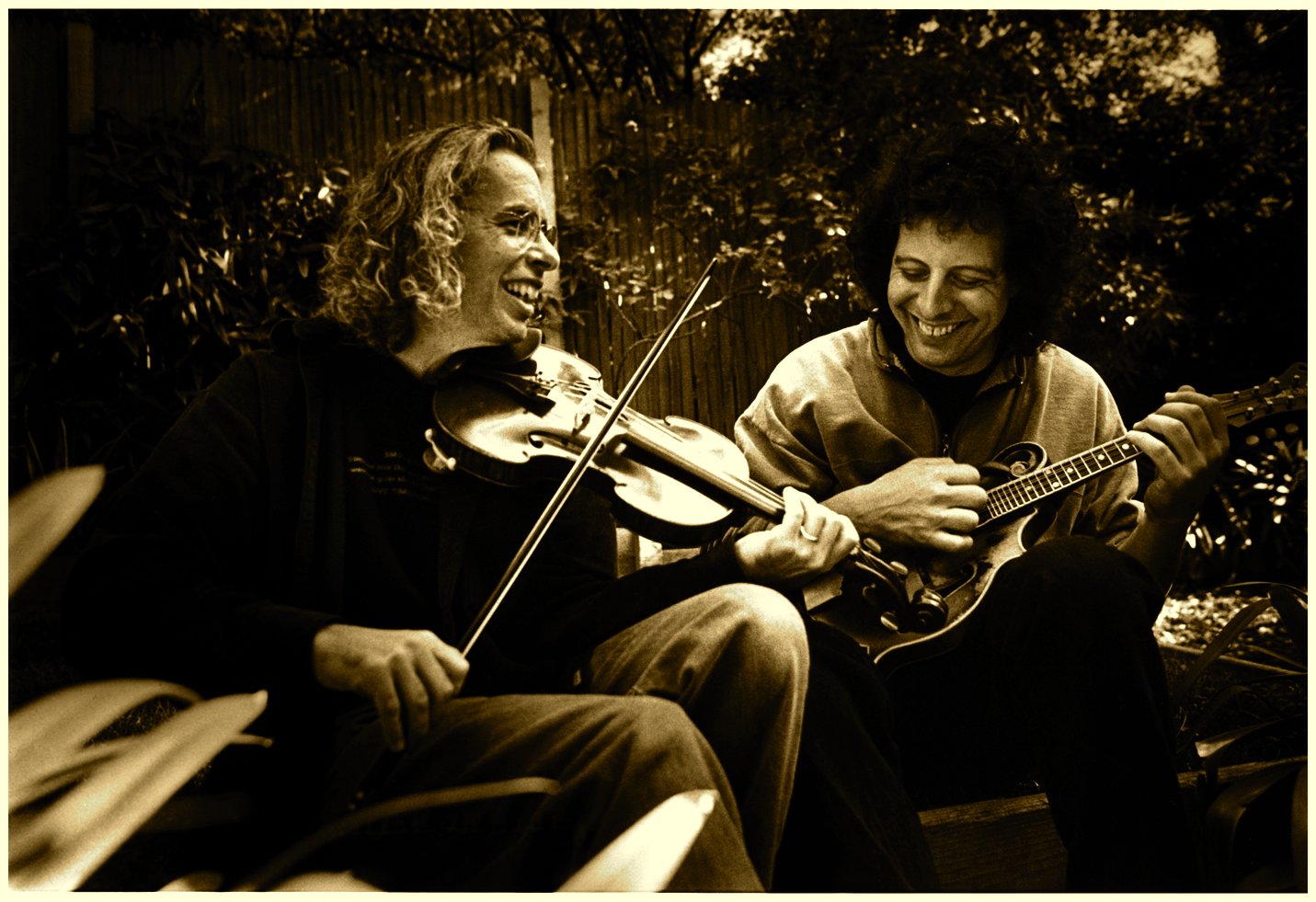
 Yeah, you probably saw this post coming. It was only a matter of time before I posted these two alumns of the David Grisman Quintet.
If there were ever two musicians destined to play together, it is Darol Anger and Mike Marshall. Having collaborated for over 30 years, they have something of a psychic connection when it comes to music. They share an aesthetic approach to music, drawing upon a myriad of styles from classical to jazz to rock to bluegrass to world music, and a similar sense of humor and dawged punstery. They anticipate each others' moves. In their hands, mandolin and fiddle become two voices engaged in a dialogue. Though not as deep as Statman, as spacious as Phillips or Wasserman, or as bouncy as Barenberg, they have a grace and comprehensive vision that unites the rests and notes of a hundred different musical whims, drawing them together into a playful and surprising presence. More than anyone besides perhaps David Grisman (and perhaps more than him), they have defined the sound of New Acoustic music. I saw the duo perform with Väsen last summer. Every single person in the audience was a musician. Need I say more?
Darol Anger - Biography by Steve Huey
Violinist Darol Anger has made his mark on new acoustic music with a number of different groups.
From 1975-84, Anger was a key member of new-acoustic pioneers the David Grisman Quintet, whose blend of folk, bluegrass, and jazz virtually defined the new acoustic genre, as well as advancing the harmonic and instrumental frontiers of traditional musics; as a member of the Turtle Island String Quartet in the late '80s and early '90s, Anger also helped bring virtuosic improvisation and boundless eclecticism to what had been an essentially classical, strictly composed musical format. Additionally, Anger co-founded the Montreux Band, a folk- and jazz-influenced group which recorded for Windham Hill in the mid- to late '80s and had an impact on the formation of so-called New Adult Contemporary radio, and with Grisman alumnus Mike Marshall founded the progressive bluegrass outfit Psychograss, which carried on the eclectic Grisman tradition in the 1990s. Again teaming up with Marshall in the late '90s, Anger co-founded the Anger/Marshall Band, which kept him busy into the 2000s alongside his work on the Heritage Folk Music project, his continued appearances with his previous groups, his founding of the American Fiddle Ensemble, and his work as a producer and arranger for other artists.
Mike Marshall - Biography by Craig Harris
Mike Marshall is one of the most innovative players of new instrumental music. Initially rooted in bluegrass, Marshall has consistently explored all the possibilities of his stringed instruments. During the five years (1985-1990) that he was a member of David Grisman's influential Quintet, Marshall toured with Stephane Grappelli, Mark O'Connor, Tony Rice, Bela Fleck, Jerry Douglas and fellow Grisman band member Darol Anger. Following his departure from Grisman's group, Marshall continued to work with fiddler Anger as a duo and, along with pianist Barbara Higbie and bassist Michael Manring, in a folk/chamber music group, Montreux. Marshall and Anger also collaborated, along with bassist Todd Phillips, banjo player Tony Trischka and guitarist David Grier, in a bluegrass/jazz/classical/folk group, Psychograss. Marshall currently leads the Modern Mandolin Quartet and plays Brazilian music with Choro Famoso. Marshall also periodically collaborates with Edgar Meyer, Jerry Douglas, Mark O'Connor and Sam Bush in a bluegrass superband, Strength By Numbers. Marshall has produced numerous albums including recordings by Laurie Lewis, Alison Brown, Jennifer Berezan and Tony Furtado.
A native of Pennsylvania, Marshall grew up in Lakeland, Florida. At the age of 18, he won the Florida state fiddle and mandolin championships. After performing with the Sunshine Bluegrass Boys, Marshall relocated to the West Coast. Soon after working with Grisman on the film score of The King of the Gypsies in 1985, Marshall was invited to join Grisman's Quintet.
Marshall has recorded two solo albums -- 1989's Gator Strut, which spotlighted his jazz-meets-bluegrass approach, and 1997's Brasil: Duets, which focused on the Brazilian influences on his music and featured duets with Edgar Meyer, Michael Manring and Bela Fleck. In 2003, Marshall teamed up with mandolinist Chris Thile to release Into the Cauldron, a fine record of duets between the two exploring everything from classical and traditional music to conteporary numbers written with each other.
Darol Anger - Fiddlistics
Year: 1979
Label: Kaleidoscope F8
Review by Wilson McCloy
Fiddlistics includes an all-star cast of new-grass musicians, and in many ways it is a continuation of the excellent David Grisman Quintet album. In fact, there is a slowed-down version of the composition "Blue Midnight" which first appeared on the innovative Grisman album, and the new-grass suite "Megatones" could easily have been from that session. However, the uniqueness of this album stems from its eclecticism. Anger and mandolin legend Tiny Moore joyfully swing through Charlie Parker's "Moose the Mooche," and Anger takes two duets: one quiet and meditative with pianist Barbara Higbie, and the other a traditional bluegrass romp, at first, which slowly becomes more progressive with George Stavis on banjo. Fans of the David Grisman Quintet, Mike Marshall, Tony Rice, or any of the other participating musicians will not be disappointed because this album is well-worth searching for. Musicians:
Darol Anger
Tony Rice
David Grisman
Todd Phillips
Mike Marshall
Tiny Moore
Barbara Higbie
Tracks
1 Key Signator
2 Blue Midnight
3 Old Grey Coat
4 Moose the Mooche
5 Ride the Wild Turkey
6 Dysentery Stomp
7 Brann St. Sonata
8 Old Folkies
9 Megatones
Mike Marshall - Gator Strut
Year: 1984
Label: Rounder
Review by Ken Dryden
Mike Marshall is much like Mark O'Connor, a virtuoso on several string instruments, an innovative composer and arranger who refuses to be pigeonholed stylistically, and also an alum of David Grisman's band. Numerous Grisman alumni turn up on this 1984 release, including violinist Darol Anger, bassists Todd Phillips and Rob Wasserman, guitarist Tony Rice, and even Grisman himself, along with dobro player Jerry Douglas, Béla Fleck on banjo, violinist David Balikrishan (who would later co-found the Turtle Island String Quartet with Anger), and pianist Barbara Higbie. Marshall sticks primarily to mandolin on this mostly progressive bluegrass date, though he's also heard on mandola, mandocello, violin, and guitar. Highlights include the funky original "Gator Strut," "Ravel" (a solo effort featuring the leader overdubbed on several instruments while adapting a theme by the French Impressionist composer), a joint arrangement with Anger of John Coltrane's infrequently performed "Giant Hornpipe," and a brilliant interpretation of Thelonious Monk's "'Round Midnight."
Another Review:
In the mood for something a bit unique, random, diverse, spontaneous, and interesting? If so, then check out Mike Marshall’s Gator Strut with Darol Anger and featuring artists like David Grisman on mandolin, Bela Fleck on banjo, and Tony Rice on guitar.
The all-star group travels around music history ranging from classical composers like Ravel and Bach to Jazz masters like Coltrane and Thelonious Monk. They even stop in pop land on one of my all-time favorite Beatles numbers like Because. There are other songs here specifically written by Marshall, who plays mandolin, mandocello, guitar and sometimes violin, while in most cases Darol Anger is on violin or low violin. There are some other talented artists involved as well such as Rob Wasserman on bass, Mike Wollenberg on guitar, Barbara Higbie on synthesizer, Jerry Douglas on dobro, and Todd Philips on bass. With a stack of individuals like this, a vast accompaniment of instruments, and a unique selects of material, this particular recording is unlike any other out there.
Tracks
1 Dance of the Planktons - Marshall - 3:32
2 We Three - Marshall - 4:43
3 Gator Strut - Marshall - 6:07
4 Chief Sitting in the Rain - Traditional - 3:23
5 Assez Vif-Tres Rythme -1:50
6 Giant Hornpipe - Coltrane - 2:41
7 Because - Lennon, McCartney - 2:55
8 Scotch & Swing - Marshall - 3:42
9 Bach Partita No. 3 in E Major for Solo Violin - Public Domain - 4:08
10 Ybor City - Marshall - 3:52
11 'Round Midnight - Hanighen, Monk, Williams - 5:02
12 Gator's Dream - Marshall - 7:37
13 Wake Up - Marshall - 4:01
14 We Three (Reprise) - Marshall - 1:03

Darol Anger & Mike Marshall - The Duo
Year: 1983
Label: Rounder
Review by Linda Kohanov
Violinist Darol Anger and mandolinist Mike Marshall were pioneers of the New Acoustic Music movement, which brought folk, jazz, bluegrass and world music influences together in an instrumental acoustic setting. Here is their groundbreaking 1983 album The Duo, which highlights their virtuosity, creativity and humor in a wide-ranging selection of breathtaking duets. Darol Anger and Mike Marshall were snatched up by Windham Hill soon after this early Rounder release.
Tracks
1 Rotagilla - Anger, Marshall - 3:52
2 Lime Rock - Traditional - 2:20
3 Children's Song #6 - Corea - 2:53
4 Golden Slippers - Traditional - 3:35
5 N.K.F. - Marshall - 4:01
6 Wall of Mando Madness - Marshall - 3:47
7 Donna Lee - Parker - 2:24
8 Free D - Marshall - 4:08
9 Bach Partita #3 in E Major for Solo Violin - Bach - 4:07
10 It's Dark - Anger, Marshall - 5:25
11 Gator's Dream - Marshall - 7:37

June 5, 2010
Darol Anger & Mike Marshall

May 21, 2010
Todd Phillips - Released

Another spotlight on a pioneer of Newgrass / New Acoustic music. We've left Country Cooking now and are working back throught the members of the David Grisman Quintet.
This is a very OPEN record. What does that mean? It means that there's no hole in which to pidgeon it, no box to hold it, no label to bear it. Definitely not bluegrass, though there's hints of that in the stellar dobro of Jerry Douglas arcing across 'Nardis'. And it's not quite jazz either, as Tony Rice's guitar will let you know as he burns through the same. But though there's no handle to hang it by, the album is immediatly accessible, warm and beautiful. It is open because it doesn't take you to any foregone conclusions. You may be able to figure out where it came from (i.e. roots), but damned if you can tell where it's going. It's open because you can walk in and out of the music and still be a part of it. The train does not leave at 3:18, and it doesn't travel on a straight line. This music is a river, and it splits and comes back together, just as it caresses the boundaries and slowly erodes them. And it's never the same, even though it follows a pattern - new and renewed sounds bubble forth and linger for a moment before disolving into the ear. It will take your troubles, this river. Take your thoughts and worries. You cannot fight this river. Bathe in it, naked. Immerse yourself in the sweet fresh watery grip of this music and lay down, naked, released. Bassist Todd Phillips’ musical pedigree is unbeatable. He staked his claim in musical history in 1975 as a member of the original Dave Grisman Quintet. He has performed and recorded with some of acoustic music’s most influential artists, including John Gorka, Montreux and Psychograss. On his latest solo album Timeframe, Phillips establishes himself as a multi-instrumentalist and composer capable of blending diverse influences into a seamless musical statement.
Phillips was born in San Jose, California in 1953. He began playing electric bass at age 11 and had his first professional studio recording experience when he was 15. Around the time that he graduated from high school he began playing the acoustic bass and developed an interest in bluegrass and jazz.
Soon afterwards, Phillips began studying with mandolinist David Grisman. This relationship quickly led to his involvement in the development of the original David Grisman Quintet. During his tenure with the group, Phillips had the opportunity to work with many well-known acoustic instrumentalists including Stephane Grappelli,Darol Anger, Mike Marshall, Tony Rice and Richard Greene. He credits the experience as having had tremendous influence on his musical growth. In particular, he says: "Spending so much time with Grisman when I was young both twisted and widened my perspectives (in a creative way) about all music."
In 1984, Phillips recorded his first solo album Released which received critical acclaim. Billboard Magazine wrote: "Todd Phillips makes a winning new acoustic frontman." The San Francisco Bay Guardian heralded Phillips as "one of the most meticulous and musically focused artists of the new acoustic musicmovement." Phillips was also the 5-time recipient of the Frets Magazine readers’ poll award for Best Jazz and Bluegrass Bassist Grammy Award for his work with JD Crowe and the New South.
Throughout the 80’s and into the 90’s, Phillips continued to be involved in a variety of projects. Together with musical associates Mike Marshall and Darol Anger from the David Grisman Quintet, Phillips formed the eclectic jazzgrass group Psychograss. Theband recorded one album for Windham Hill which furthered their individual reputations as leading innovators in new acoustic music. Phillips also continued to build a successful career as a sessionmusician and appeared on dozens of recording projects including records by Alex de Grassi, Tony Rice, Jerry Douglas and Tony Trischka.
In 1991, Phillips began composing and arranging music for Timeframe.His goal was to write, arrange and record in a way that incorporated as much of what he loves about music as possible. The end result is what Phillips labels a "musical hybrid" - a sound that is at once reminiscent of the west coast "cool jazz"scene, the bachelor pad sound, and the new acoustic movement, and draws inspiration from sources as unlikely as Bill Evans, John Coltrane, Steely Dan, Joseph Haydn and Bill Monroe. Together with reed master Paul McCandless (Oregon), violinist Darol Anger (Turtle Island String Quartet), Joe Caploe on vibes and drummer Paul van Wageningen, Phillips delivers a focused and assured take on acoustic jazz which the Nashville Scene described as "music that’s both accessible and beautiful while remaining constantly surprising and fresh." Biography by Craig Harris
Todd Phillips has revolutionized the role of the bass in bluegrass music. A founding member, along with Tony Rice, Darol Anger and Joe Carroll, of the innovative David Grisman Quintet, Phillips has gone on to play with such progressive bands as J.D. Crowe & The New South, Psychograss, Montreaux, The Bluegrass Album Band and Kathy Kallick's Little Big Band. A five time winner of the readers' poll conducted by Frets magazine and a two-time Grammy winner, Phillips has been as effective a jazz bassist as he is playing bluegrass. Phillips' three solo albums
In The Pines, Released and Time Frame -- have blended influences ranging from Bill Monroe to Miles Davis and John Coltrane.
Phillips' first instrument was the electric bass, which he began playing at the age of eleven. By the age of fifteen, Phillips was proficient enough on the instrument to make his recording debut. During his senior year of high school, Phillips became enchanted by bluegrass and jazz and switched to the acoustic, stand-up, bass.
Soon after meeting mandolinist David Grisman, Phillips began taking lessons on the mandolin. Jam sessions on Grisman's back porch soon evolved into the Grisman Quintet. Phillips remained with the group for five years.
Together with Tony Rice, Bobby Hicks, Doyle Lawson and J.D. Crowe, Phillips launched The Bluegrass Album Band in 1980. Phillips was also a founding member of Montreaux and Psychograss. In addition to playing bass on more than fifty recordings, Phillips produced two albums by Kathy Kallick. Since 1995, Phillips has worked, along with guitarist John Reissman, in Kallick's Little Big Band; in 1999, he teamed with guitarist David Grier and mandolininst Matt Flinner for Phillips, Grier & Flinner. Interview by Richard Johnston
“My all-time favorite is Todd Phillips,” proclaimed Union Station bassist Barry Bales in April ’05. “He brought a completely different way of thinking about and playing bluegrass—a really sustained kind of sound, great chops.”
Born in 1953, Todd grew up in San Jose, California, and picked up electric bass around age ten. He and his drumming brother Todd formed a band that started with basic rock & roll and went on to tackle tunes by Crosby, Stills & Nash and the Byrds, “taking me into more advanced harmonies, closer to bluegrass,” Phillips notes. Later in high school he gained his first exposure to jazz and bluegrass, leading him to switch to upright bass. After a few years’ experience playing bluegrass, he fell in with mandolin maven Grisman. “His record collection was phenomenal,” Phillips recalls. “Inside of a year I got a complete education on John Coltrane, Eric Dolphy, all this stuff, and I was listening to [Bill Evans bassist] Scott LaFaro. I was also learning to play mandolin.”
The late LaFaro’s freewheeling accompaniment style continues to echo in Phillips’s work with Psychograss, whose all-star roster includes violinist Darol Anger, mandolinist Mike Marshall, guitarist David Grier, and banjoist Tony Trischka. On the band’s recent Now Hear This, Phillips peppers the raggy “Stroll of the Mudbug” with double-stop accents and raked/pull-off fills, and he gives “Road to Hope” a jazz-ballad treatment with well-placed pickup notes and passing tones. “One Foot in the Gutter” finds Phillips laying down a percolating pedal-tone funk groove, and amid the shifting time signatures and angular chord changes of “High Ham,” he maintains a solid bluegrass-bass feel adorned with upper-register flourishes and sliding fills. Throughout, Phillips’s German upright yields a big bluegrass-approved bottom end balanced by a singing upper register. “Because I played Precision Bass for ten years as a kid, when I first picked up an acoustic I had a tone reference in my head,” notes Phillips. “I wanted a full, little bit percussive sound.”
In addition to his current touring schedule with Psychograss, Laurie Lewis, and Phillips, Grier & Flinner, Phillips maintains a studio at his Northern California home, where he has been working on the latest in his substantial list of production credits: a Rounder Records tribute to folk singer Hazel Dickens. Phillips produced his three solo albums—the jazz-influenced Timeframe and Released [out of print] and the tradition-steeped In the Pines—as well as the Grammy-winning True Life Blues: The Songs of Bill Monroe. He has shared his instrumental insights in the two-volume video Essential Techniques for Acoustic Bass.
When you were getting solid footing as a bluegrass player, you were also listening to Scott LaFaro. Did that mess you up?
If you asked some real strict bluegrass players, it probably did. [Guitarist] Tony Rice loved Oscar Peterson, and I was listening to Bill Evans and John Coltrane, and we were playing with David Grisman, which was real energetic rhythmically. So, we had to tame ourselves down when we played straight bluegrass, but occasionally we would encourage each other to do some crazier things. I can hear the struggle sometimes in that music. “Blue Ridge Cabin Home” and “I Believe in You Darling” [from The Bluegrass Album Band Vol. 1] are good examples of how we played it very straight but also let the impulse of the moment enter into the music.
How did LaFaro’s playing influence yours?
I picked up syncopation—he wove this beautiful thing through the music—and I play syncopations in bluegrass that other people don’t.
What other different approaches do you take to bluegrass?
Using a few more notes—in regular bluegrass the bass player doesn’t use that many leading tones to the next chord. And I like to play with space, leaving notes hanging or skipping a beat. But there’s a misconception about how simple bluegrass bass is. To have that momentum without the drummer and get that feel is not as simple as it looks on paper. I think of it as a kind of Zen thing, a real meditation and a high focus on the rhythm. There’s no place to hide. How do you develop the kind of time you need to carry a group without a drummer?
It’s something you’re born with, but it’s also something you can develop by listening. I remember always being drawn to the rhythmic element—I think that’s why I switched to mandolin for a while. I wanted to play on the other side of the beat.
Did that help your rhythm in general?
It helped it a lot—I got to know what it was like to be on that side of the band, and I understood chords better, which helped my bass playing. When I was playing mandolin, I would wish the bass player was playing more like this or that, so when I switched back, I knew better how to support the guitar and the mandolin.
Switching between bass and mandolin is pretty extreme.
It is weird! But I recently met another bass player who has taken up the mandolin—John Paul Jones from Led Zeppelin. He’s a bluegrass fan, and it’s even weirder to come from his world to bluegrass mandolin. At least I stayed in the same genre.
What about the physical adjustment going from mandolin to bass?
We did one tour with Grisman where I played bass in the bluegrass band that opened and then mandolin in his quintet. At that time I thought one helped the other, like doing different kinds of exercises. But today when I switch back to mandolin it’s just too small and quick. I have stronger, slower fingers now.
Your bass lines often feature techniques like slides, hammers, pulls, and ghost-notes.
A lot of that is creating my own reference points for the rhythm; instead of going thump thump thump, I might go ka-thump ka-thump ka-thump, with a rhythm built into the line. I think that’s so my right hand has a reference for the time—little mechanical motions that help me define where the next downbeat is going to be. It also helps me create momentum. And sometimes I’m just entertaining myself.
You vary your articulation a lot. Is that also a matter of defining your own rhythmic space?
It’s all part of making it musical. When I solo a bass track I’ve done, I hear all the different shapes of the bass notes—it’s not just thump and there it is. When a singer or guitar player does something, somehow I am shaping the note around that. It’s done with how quick or long the note is, or with a little vibrato or sliding into the pitch, that kind of stuff. But I don’t think about it.
Do you use classical left-hand technique, with the ring finger and pinkie working together?
I almost always skip the ring finger, but sometimes using it is unavoidable. I’m completely self-taught and I don’t read—I am really just a folk musician. I grew up on the Fender bass, and it was so big for me that I began to develop fairly proper left-hand technique on my own—I had to skip my ring finger and use my little finger just to get to the next fret. Somehow that applied when I switched to upright.
Do you do any specific warm-ups or exercises?
Every time I pick up the instrument I just try to get my pitch references back. I’ll locate the octaves, like a D note on the G string, and I’ll play notes closed [fingered] and reference them to open strings. I do that for a few minutes to get my ear and my hand connected. That’s about it.
Do you use a bow for pitch location?
I really don’t bow. I’ll do it on a record now and then, but I’m faking it. I might spend two hours to do one little passage.
As a bass player, what do you bring to the producer’s role?
Bass players have an overview of the whole ensemble, whereas the singer is focusing on the lyrics, the lead player is focused on his role, things like that. Since I’m playing a fretless bass I’m aware of pitch, plus I’m aware of the rhythm and the structure of the music. That serves me well when we’re recording and mixing. I think I have a good perspective on when we have a solid take, when the rhythm section’s good, when the singer’s on pitch—all that kind of stuff.
On the Hazel Dickens project you’re working with a lot of different singers.
It’s a whole different role—I play real minimally. When I got together with Joan Osborne I thought, Man, you’d better be on your best behavior! You want to do the right thing to make it work.
Todd Phillips - Released
Year: 1984
Label: Varrick
Review by Ken Dryden
Bassist Todd Phillips is well known as a first-rate sideman who's worked with David Grisman, Tony Rice, and many other greats of progressive bluegrass, so it isn't at all surprising that he has an equally wide-ranging taste on his own record dates. These sessions, made in 1981 and 1982 for Varrick, feature the leader in a dual role on mandolin and bass (frequently on the same track), joined by Rice on guitar, dobro player Jerry Douglas, Darol Anger (on octave violin), and John Reischman (heard on both octave mandolin and mandolin). Douglas is initially in the lead for the compelling treatment of Miles Davis' landmark modal masterpiece "Nardis," though Phillips (on both mandolin and bass) and Rice add brilliant though brief solos. Phillips' bass chops are best heard on John Coltrane's "Miles' Mode." The leader's originals measure up to anything that's available within progressive bluegrass. Highly recommended.
Tracks
1 Fat Kid - Phillips - 3:46
2 Nardis - Davis - 4:12
3 Daniel's Dream - Phillips - 3:34
4 Redhill - Reischman - 3:12
5 Ants (On the Moon) - Phillips - 1:03
6 Alone - Phillips - 5:46
7 Released - Phillips - 5:15
8 T's Please - Carroll - 1:32
9 Miles' Mode - Coltrane - 4:57
* out-of-print
October 8, 2009
Guy Van Duser

If you downloaded the Rounder Guitar compilation I posted a few months ago, you heard Guy Van Duser playing an incredible Fats Waller tune called Viper's Drag. Finally I've managed to get some more of him; some out-of-print vinyls both of him playing solo and with ace clarinetist Billy Novick.
Now, this is not difficult music to listen to (playing it is a whole other story). It's pleasant, balanced, and executed flawlessly. But there is something quite special nonetheless. Like a perfect little gem, these pieces really shine. Also, he picked a niche (stride and early jazz) that very few guitar players ever go near. All the pieces are performed fingerstyle on a nylon-strung guitar, and only on the last album is there vocals, which is generally a good thing because I don't particularly care for most early jazz and pop lyrics. Despite (or perhaps because of?) being stripped of their common musical setting - pianos, brass, etc. - you can really hear the music in a new light - both the melody and the jumping bass lines. Biography:
Fingerstyle guitar virtuoso Guy Van Duser has been heard on National Public Radio for many years as a player of background and theme music, and as a featured performer on Prairie Home Companion. Since the late '70s, his many collaborations with clarinetist, saxophonist, vocalist, and pennywhistler Billy Novick have endeared him to listeners with old-fashioned tastes, for Van Duser's primary working repertoire has always consisted of early jazz, swing standards, and Tin Pan Alley pop tunes. While his lifelong respect for Chet Atkins, some early experience as a bluegrass bassist, and longstanding involvement as a sideman with country musician Bill Staines is proof of his genre-defying versatility, Van Duser is primarily a jazz guitarist who prefers and specializes in warm, reassuring pop and jazz melodies from the '30s.
Guy Van Duser was born in 1948, the son of a concert pianist and a food service worker. As a perceptive, impressionable youngster in upstate New York, he received some instruction on piano and accordion and engaged in guitar duets with his father while coming up under the influence of dad's collection of phonograph records and music taped off of the radio. It was through a taped broadcast that young Van Duser first heard a portion of Atkins' Finger Style Guitar album; the first Atkins LP that he actually owned was Chet Atkins' Workshop, which notably consists of pop and jazz standards. When Van Duser eventually met his idol, he showed off a bit by perfectly replicating a complex passage from one of the Atkins' albums that had originally inspired him to become a professional musician. Legend has it that Atkins paled visibly, sat down and looked at Van Duser with mingled admiration and awe as he said "kid, that album was overdubbed!" Atkins was also wowed by Van Duser's solo guitar arrangement of John Philip Sousa's "Stars and Stripes Forever," and quickly developed his own version of that tried-and-true crowd pleaser, during which one guitar is made to sound like an entire marching band.
Van Duser and Novick originally met during the '70s while composing music for two different dance troupes, and found that their ideas, techniques, and temperaments were pleasantly contrasted and unusually compatible. Novick was heard playing pennywhistle on Van Duser's first album, Finger-Style Guitar Solos (Rounder Records 3021), which was recorded in Newton, MA in 1977 except for the definitive version of "Stars and Stripes" which was taped live at the Nameless Coffee House in Harvard Square in May 1976 and closes out side two of the LP. The album cover features a meticulous pen and ink self portrait by Van Duser. Novick may be heard on most of Van Duser's more than ten albums and the two have spent decades touring and entertaining small but appreciative crowds, mainly in churches, coffee houses, and small clubs. Van Duser's second album, Stride Guitar was recorded in 1980, and epitomizes this artist's musical influences and preferences. The title perfectly describes his Harlem stride piano-inspired jazz guitar technique, while the composers tapped for melodies include Fats Waller, Duke Ellington, Richard Whiting, Dorothy Fields, Jimmy McHugh, and Jerome Kern. Released in 1987, American Finger Style Guitar contains excerpts from three early Van Duser albums, which have yet to be reissued in their entirety by Rounder. Van Duser, who also plays piano, bass, mandolin, and electric guitar, collaborated with Novick during the '80s and '90s as arrangers and performers on several albums by vocalists Priscilla Herdman and Jeanie Stahl. Van Duser also wrote arrangements for an album released in 1992 under the name of guitarist Terrence Farrell. In addition to his ongoing partnership with Novick and occasional utility assignments like arranging music for the soundtrack of Sheldon Mirowitz's PBS documentary Columbus and the Age of Discovery, Van Duser serves as part-time professor of the guitar at the Berklee College of Music. ~ arwulf arwulf, All Music Guide
Interview with Guy Van Duser & Billy Novick
The combination of fingerstyle guitar and clarinet is so unique and yet so natural. Did it feel like magic the first time you played together? Did you know that you were onto something?
Billy: Actually, hokey as it may sound, it did feel somewhat magical the first time we had played together. Guy had composed some guitar music for some dance troupes, and I had written an avant-garde jazz piece for another group of dancers. The two pieces appeared on the same concert, and, when I heard Guy play, I was absolutely amazed. We decided we had a lot in common musically, and, when we finally got to play together, the sonority of the two wooden instruments was rapturous! There’s an almost mystical quality to the sound- earthy yet elegant at the same time. Whenever I feel I may be getting into a rut with our playing, I just tune out all the “intellectual” concerns with the music and just focus on the beauty of the sound.
Guy: Mostly we play coffeehouses and many of those happen inside churches, where the qualities of our two instruments are gloriously supported by the acoustics. And after thirty-two years, each of us is very aware of the musical mannerisms and ways of thinking that we each have, to the point where we sometimes spontaneously produce the same musical phrase on both instruments. It’s a little spooky sometimes.
Have you always been drawn to the early jazz era of song?
Billy: My musical tastes are very wide-ranging, but, yes, I have always loved the early jazz era. My older brother played in a Dixieland band in high school, and we went to a record store to get some “Dixieland” records (I hate the term “Dixieland”) and lucked out with our purchases. We got a LP of Jelly Roll Morton and his Red Hot Peppers. Neither of us had any idea who he was (I was 11 at the time), and it turns out that, fortunately, we ended up with 12 of the most highly-regarded New Orleans tunes that were ever recorded.
Guy: My mother was trained as a concert pianist and my dad played guitar a little, but what had probably the strongest influence on my musical development were the countless recordings my father would play in the house on evenings and weekends. Dixieland, big band dance music, cool 50’s jazz... and then when I learned to play some on a guitar of my own, he and I would sing duets together for a couple of hours at least two or three nights a week. He sang and taught me hundreds of tin pan alley songs, what are known to today’s players as “standards”. So I literally grew up on the stuff we’re playing now.
What’s the most “contemporary” song you play?
Billy: Both Guy and I have written a number of songs that we play. Our originals would be the most contemporary — other than that, not much after 1950.
What’s the most unusual venue that you’ve played?
Billy: In 1976, the Boston Pops was doing July 4th down in NYC, where the Statue of Liberty was unveiled after it was refurbished. (Do you actually “refurbish” the Statue of Liberty?)
We “subbed” for the Pops on the Esplanade, playing the Guy’s version of the Stars and Stripes, just the two of us on that huge stage. It was broadcast nationally...
We also opened for the Glenn Miller Orchestra at an outdoor concert in Western Mass, and they never showed up. They actually did eventually show up, but the two of us had to play a set of Glenn Miller tunes to keep the audience from leaving. It was a normal venue, but an abnormal playing situation.
Guy: Billy is forgetting to mention the wedding that he and I played for at the Dolphin Pool of the Aquarium, the reception on top of a ski mountain where we had to get the sound system up via the ski lift, and a few others. ../
Do you have a favorite memory from your days of playing together?
Billy: There were zillions of great moments, and there is no singular memory that jumps out at me. then again, I can barely remember what I did 10 minutes ago, let alone what we did 30 years ago!
Playing Passim was always a memorable event, very electric with the audience being so close. Prairie Home Companion was very exciting, too, but we did a bunch of those. Perhaps it was Guy, myself and Cathal McConnell (wondrous whistle player from the Boys of the Lough) playing a three-part harmony version of “In the Mood” on Prairie Home Companion. What in the world could we have been thinking? And why would they ever let us do that!! It wasn’t great music, but it was a lot of fun — quite quirky, as you might imagine.
“Jamming” with Chet Atkins in his kitchen was fun, particularly when the tour bus came around and everyone peered inside.
Guy: Yeah, Chet thought Billy’s renditions of be-bop jazz on the pennywhistle were very cool, I remember!
I always felt comfortable on the road with Billy; maybe because we were such complete opposites, we never got in each other’s way. He’d be up at six am, I’d be up at ten; he a vegetarian, I a card-carrying carnivore, he a sports fanatic, me a late-season dabbler. But he would drive the van and I would read aloud to him the entire sports section of whatever city’s newspaper we happened to have that morning. That was during the Golden Age of the Boston Celtics— and Billy and I ended up flying back to Boston one Sunday morning with the entire Celtics team on the plane in front of us, returning from a game with Detroit, and Larry Bird’s feet sticking out into the aisles.
Billy, you’ve done a lot of session work with other musicians, any memorable moments from any of those sessions?
Billy: Many! I think Susan Werner is one of the most talented musicians I ever met, and playing on her record was a lot of fun. In my early years (did I really write that?), I toured with David Bromberg and we did a record that Brian Ahern produced. We recorded in this house in Santa Monica, and the whole thing could have been a a parody of the LA music scene. Brian wore this Indian robe the whole time, there were all sorts of substances consumed (need I say more?), and there were all these “guests” hanging around, waiting to record a song or two with us: Bonnie Raitt, Linda Ronstadt, Emmylou Harris, Mac Rebennack (Dr. John), Ricky Skaggs, and Bernie Leadon (of the Eagles).
I did quite a few sessions for Philo records in Vermont, and they were a lot of fun. You’d record and stay in a beautifully refurbished barn, and just hang out for a few days. Particularly memorable were the few days up there with Dave Van Ronk, when we recorded my arrangement of Peter and the Wolf for jug band. It was Dave’s lifelong dream, if you could believe that!
I also was dragged into a portable music studio/trailer in the middle of a music festival in Toronto to do overdubs on a few songs for a demo tape for this singer, who, in fact, was Emmylou Harris. Of course, nobody knew who she was!
A lot of the soundtrack work I do is rewarding, particularly when you get a roomful of great musicians (and people) to semi-improvise some tracks.
I often end up overdubbing on 3 or 4 songs on a record. It’s increasingly rare to have everyone play at the same time now, like a real group. When it does happen, it ‘s a whole different experience. Everyone says there’s a real palpable difference for the listener. At the risk of sounding like a heretic, I don’t think that’s necessarily true. But from the musicians’ standpoint, it’s just a lot more fun.
And, since there are so many musicians spending so much time together, there’s inevitably a lot of food being ordered. At home I tend to eat a very healthy diet, with virtually no junk food. so, in the studio, there are always pizzas being ordered, Chinese food, chips, etc. I know I’m supposed to be transported by the inspiring and spiritual music we’re creating, but most of the time- and I hate to admit this- it’s the food that’s got my attention. “Finish this next take and I can have some more pizza? You got it!”
Now that’s what I call art!
Guy, can you describe what stride guitar is?
Well, the sound of many of the great early jazz recordings owes a lot to the presence of some pretty impressive piano playing, actually. The guitar on those records was always acoustic and just strummed and almost never very audible, while the pianist was performing melodies with his right hand and supplying his own bass and chords with his left, the back and forth movement of the left hand giving the impression of “striding” up and down the keyboard.
That’s what I’m trying to recreate on the guitar, rather than playing it on piano, an improvised backdrop of bass, chords, and melodies as a setting for Billy’s clarinet and vocals. I like to imagine that I’m a little “trio”, chords, bass, and rhythm, and when we both play full out, like on a Benny Goodman “big band” number, we think we’re a “two-man big band”!
- from meandthee.org Guy Van Duser interview
When did you first hear Chet play?
My Dad was the first person around our neighborhood to buy a tape recorder and he taped all kinds of music off the radio. One night, the A side of the Fingerstyle Guitar album was played. I had never heard anything like that and I began to try to find out who the guitarist was. When I found out it was a man named Chet Atkins, I went down to buy that record. But, Chet Atkins Workshop was the only one they had, so it became my first Chet Atkins album which I still have.
Do you still have your first guitar?
Yes I do -- a 1962 dotneck 335. I sanded the original finish off in college, when I decided to change the color. Boy, that was a mistake. I wish I had left it alone”.
How did you become such a good bass player?
While in college I had a friend who played in a bluegrass band. One day he said they needed a bass player that very night, and asked me to play bass for them. I said that I had never played bass, but he assured me that it was easy -- just the four bottom strings of the guitar. So, he borrowed one for me that night and I played bass for about three years in bluegrass bands.
Is music how you make your living today?
Yes, everything I do to make money is associated with music by either writing or playing. I have written some soundtracks for public television in Boston. I’ve done soundtracks for a couple of films and also have written some children’s songs. My first film was when I was called to play old timey slide Dobro like they did down in the strip mines of Kentucky. Then, I was called to do other work, so I got a synthesizer. As more work came in, I purchased more things -- like a drum machine etc. -- and it paid the bills, so that is what I continue to do.
You play stride guitar. What is stride guitar?
In stride piano, the left hand plays the bass notes, moves toward the center of the piano and plays the chords, and then goes back to the bass notes. This is just like we do with our thumb when we alternate the bass strings, and is more free flowing; whereas, ragtime is a more precise way of playing. I put out that album and called it Stride Guitar which was mostly old stride piano tunes and also includes one of the numbers that my parents wrote.
Tell us how Chet came to do your arrangement of “Stars and Stripes Forever?”
Well, in about ‘77 or ‘78, I had a student in Boston who was taking lessons from me, but who actually lived in Nashville. He said that I had to come to Nashville and play this for an instructor friend of his. So, I went to Nashville and he introduced me to John Knowles, who had just gotten a Grammy for arranging “The Entertainer” for Chet, and was doing a lot of arranging and working with Chet at the time. After I was about halfway through the piece, he said, “You have to play this for Chet.” He called him up, we went over to Chet’s office at RCA, and here was Chet with an office full of people -- a photographer, Lenny Breau, and several other people. We walked in and I took my guitar out of the case. About that time, the photographer wanted to take a picture. So, Chet took my guitar, and he and Lenny stood together with Chet holding my guitar for the picture. When I started to play, I just froze up and couldn’t remember what I was going to play, but somehow, I impressed Chet enough that he asked me to come back the next day. I went back the next day and we spent a couple of hours talking about guitars, music, and things in general. I played “Stars and Stripes Forever” along with some other things and made a tape for him. He later called me to come back to Nashville. We sat down in his kitchen and he said, “Now, tell me what I do wrong.” He played it using the same notes with some different positions than those I used, but that was it.
How did you get interested in playing marches on the guitar?
I was tired of playing rags, and discovered that I could replicate the music of other instruments on the guitar. I do several marches, but “Stars and Stripes Forever” is the one that everyone remembers. In the number, “Semper Fidelis,” I bend the bass strings to get a drum sound while I play the melody on the high strings. That is an old flamenco guitar trick.
You play many kinds of music. Which is your favorite kind to play?
I guess jazz standards from the 30’s, because they are balanced 2 or 3 minute gems of harmonic sequence blended with a beautiful melody. Most of them had words, so it is very easy to get a mood or meaning that you can associate with each song.
Name a couple of memorable highlights that have happened to you in your career?
Meeting and becoming friends with my lifelong idol, Chet, and having him do one of my arrangements has to be at the top of the list. I also tell this story of how I was called to replace the Boston Pops Orchestra in 1986. For years, they had played every 4th of July at the amphitheater in Boston, but were called to play for the unveiling of the refurbished Statue of Liberty. Since they couldn’t be in two places at once, it was requested that I play “Stars and Stripes Forever” in their place in Boston to kick off the celebration. It was broadcast on public radio and was a very big event. I also scored all the music for a documentary titled Hiroshima, which was nominated for an academy award in 1988.
What do you think the future holds for fingerstyle guitarists?
There seems to be more guitars than any other instrument and guitars seem to be gaining in popularity all the time. I would like to see more really good song writers so we don’t run out of good, new material to play.
When do you plan to make another CD?
I think that Billy Novick and I will have one coming out after the first of the year. Sometime after that, I plan to make one by myself.
You can purchase Guy Van Duser records and CDs through Rounder Records, 1 Camp St., Cambridge Mass. 02240, or through Daring Records, Marblehead, Mass.
© 2000 - Association of Fingerstyle Guitarists Guy Van Duser - Finger-Style Guitar Solos
Year: 1977
Label: Rounder
1. Chattanooga Choo-Choo
2. Coloured Aristocracy
3. Cheek To Cheek
4. Ain't She Sweet
5. Guitar Boogie Shuffle
6. Medley: Mine; American in Paris; Swanee; Sweet and Low-Down; Embraceable You; I Got Rhythm
7. Sweet Georgia Brown
8. Frog Legs Rag
9. As Time Goes By
10. Great Western TV Medley
11. Haste To The Wedding
12. Stars And Stripes Forever (live)
sousaphonic.
fresh vinyl rip, cleaned | mp3 >256kbps
*out-of-print
Guy Van Duser - Stride Guitar
Year: 1981
Label: Rounder
Guy Van Duser's fingers dance across the fretboard on this collection of classic jazz tunes and American songbook standards. With his "stride guitar" technique (a reference to the piano style of the 1930s and 1940s) Guy reveals a new repertoire for the finger-picked guitar. Guy and clarinetist/soprano saxophonist Billy Novick make a complete ensemble, using their virtuosity in service of the pure joy they find in this music. "His articulation and dynamics are gorgeous, with bouncing bass lines, coy string bends and slick chordal slides....Van Duser swings this one right into the Finger-style Hall of Fame."-Frets
Tracks:
1 That Certain Feeling - Gershwin, Gershwin - 3:16
2 Snowy Morning Blues - 4:43
3 Black Beauty - Ellington - 3:21
4 Alligator Crawl - Davis, Razaf, Waller - 2:36
5 Viper's Drag - Waller - 3:24
6 Stars Fell on Alabama - Parish, Perkins - 4:05
7 Miss Brown to You - Rainger, Robin, Whiting - 3:23
8 I Can't Give You Anything But Love/Goody-Goody - Fields, Malneck, McHugh, Mercer - 2:46
9 Never Gonna Dance - Fields, Kern - 3:08
10 Seneca Slide - 3:05
11 It's Not True - 3:49
12 When I See an Elephant Fly - 3:32
what a drag.
fresh vinyl rip, cleaned | mp3 >256kbps
*out-of-print; only available online.
Guy Van Duser & Billy Novick - Get Yourself a New Broom (And Sweep Those Blues Away)
Year: 1979
Label: Rounder
Review by arwulf arwulf
Get Yourself a New Broom (And Sweep Those Blues Away) was guitarist Guy Van Duser's third album, and the first to be released in full collaboration with his longtime partner Billy Novick. It is significantly different from other Van Duser albums in that he and Novick, who almost invariably perform as a duo, are joined at times by several other players who swell the ensemble to the size of a traditional small-jazz band. The best example perhaps is the "Current Events Medley," which combines Sidney Bechet's "Egyptian Fantasy" with "The Sheik of Araby" and "Panama" to form a three-part collage of headline topics from 1979, the year this album was released on Rounder. The song list is typical for these two, and includes one title written and two popularized by Fats Waller, as well as early jazz standards by Jelly Roll Morton ("Black Bottom Stomp"), Will Marion Cook ("I'm Coming, Virginia"), Philip Braham ("Limehouse Blues"), Gus Kahn ("Ready for the River"), and Paul Dresser ("My Gal Sal"). Long unavailable, New Broom eventually became obtainable as a pricey Japanese import while still overdue for domestic reissue.
Tracks:
1. Black Bottom Stomp
2. Spring Cleanin'
3. Limehouse Blues
4. Ain't Misbehavin'
5. My Gal Sal / Runnin' Wild
6. Get Yourself a New Broom (...and Sweep Those Blues Away
7. I Wish I Were Twins
8. I'm Coming, Virginia
9. I'll Never Say "Never Again" Again
10. Current Events Medley: Egyptian Fantasy/The Sheik of Araby/Panama
11. Ready for the River
Note, tracks 5 & 6 are mis-labeled, and should be each other.
getta litta jelly in yo house.
fresh vinyl rip, cleaned | mp3 >256kbps
*out-of-print (only available as a pricey japanese import)
August 23, 2009
David Grisman

Hey you devoted and lonely readers, I'm back! Sorry for abandoning you without warning like that, but perhaps you took the opportunity to go outside and enjoy the summer. I did! Now getting back to music:
Of course, there's only one person I could post to follow Richard Greene. His compatriot and co-inventor of newgrass, David "Dawg" Grisman. While his chops on mandolin are undoubtably godlike, to me his most enduring worth is as a composer and innovator. There were a great many experiments with combining the worlds of bluegrass and jazz, many of which you have heard through The Grapevine. But it was the sound of the David Grisman Quintet that defined the sounnd of newgrass (also called "Dawg" after Grisman), and cemented his role as lord-king-godhead of the genre. Like Miles Davis, he turned a generation of people onto a musical form, and like Davis or Zappa, you can be pretty sure that everyone who works with him will at some point become a bandleader or legendary musician in their own right. Also, like Miles Davis, his involvement with the world of rock (and Jerry Garcia in particular) brought him a lot more fame than equally skilled and important people like, oh, Richard Greene.
He has also shown himself to be an endlessly inventive and restless explorer of other kinds of music (avantgarde jazz, Jewish/klezmer, rock, gypsy jazz, blues, world music, etc.), all without abandoning his bluegrass roots. He has never been one to rest on his laurels or just play his 'hits'. As a producer/record-label-founder, he has been equally important in recording and re-releasing important acoustic artists, and generally furthering the cause of that much-maligned tiny double-strung lute, the mandolin.
But back to his compositions: so many of them, especially from his early days, have an intensely driving but directionally open quality which renders them simultaneously graceful, powerful and unexpectedly exciting. In a word, timeless.
For nearly 40 years, mandolinist/composer David Grisman has been busy creating "dawg" music, a blend of many stylistic influences (including swing, bluegrass, latin, jazz and gypsy) so unique he gave it its own name. In doing so, David has inspired a whole new genre of acoustic string instrumental musicówith style and virtuosity while creating a unique niche for himself in the world of contemporary music.
Dubbed "The Paganini of the Mandolin" by the New York Times, David has been praised for his mastery of the instrument as well as his varied talents as a composer, bandleader, teacher and record producer. After recording for several major labels, Grisman founded his own company, Acoustic Disc, which he runs from his studio in northern California. Upon launching the label in 1990, David entered the most prolific period of his distinguished career, producing 45 critically acclaimed, high quality recordings of acoustic music (five of which have been nominated for Grammy Awards).
David discovered the mandolin as a teenager growing up in New Jersey, where he met and became a disciple of mandolinist/folklorist Ralph Rinzler. Despite a warning from his piano teacher that it wasn't a "real" instrument, Grisman learned to play the mandolin in the style of Bill Monroe, the father of bluegrass music. He took it with him to Greenwich Village where he studied English at New York University and became immersed in the proliferating folk music scene of the early 1960s.
In 1963 Grisman made his first recordings as an artist (the Even Dozen Jug Band - Elektra) and producer (Red Allen, Frank Wakefield and the Kentuckians - Folkways). In 1966, Red Allen offered David his first job with an authentic bluegrass band, the Kentuckians. While studying the music of his bluegrass mandolin heroes like Bill Monroe, Jesse McReynolds and Frank Wakefield, Grisman began composing original tunes and playing with other urban bluegrass contemporaries like Peter Rowan and Jerry Garcia, with whom he would later form Old & in the Way. David's interests spread to jazz in 1967, while playing in the folk-rock ensemble, Earth Opera. A failed attempt at learning to play the alto saxophone turned him into a lifelong student of jazz musicianship and theory. In the meantime, his burgeoning career as a session musician gave him experience playing various other types of music and opportunities to stretch the boundaries of the mandolin. Today his discography includes recordings with Bela Fleck, the Grateful Dead, Stephane Grappelli, Emmylou Harris, Chris Isaak, Dolly Parton, Bonnie Raitt, Linda Ronstadt, Earl Scruggs and James Taylor.
David's unique instrumental style found a home in 1974 when he formed the Great American Music Band with fiddler Richard Greene. "Nothing against singers," said David, "but it became apparent to me that I could play 90 minutes without one. Besides, Elvis never called." Within that year, Greene moved on to join a pop act, and David met guitar wizard Tony Rice, who moved to California where they started rehearsing a new group, the David Grisman Quintet, which also included bassist/mandolinist Todd Phillips and violinist Darol Anger. The rest is string band history.
Since its auspicious debut in 1976, the DGQ has won numerous polls and awards and has headlined at major jazz, folk and bluegrass festivals around the world. DGQ alumni (including Tony Rice, Mark O'Connor, Mike Marshall and Darol Anger) have gone on to establish successful careers as leaders of acoustic music. Current DGQ members include bassist Jim Kerwin, multi-instrumentalist Joe Craven, flutist Matt Eakle, and Argentine guitarist Enrique Coria.
In 1990, David founded the Acoustic Disc label with his friend and manager, Craig Miller, and two other long-standing friends from New York, Artie and Harriet Rose. To date label has released 45 CDs, including five with Jerry Garcia, all produced or co-produced by Grisman.
David has always been a pioneer. He continues to deeply influenced several generations of musicians through his own musical explorations, and with the blossoming success of Acoustic Disc has helped make artist-owned independent labels a viable force in the modern music business.
Biography by Richard S. Ginell & Steve Huey
David Grisman is normally associated with the bluegrass wing of country music, but his music owes almost as much to jazz as it does to traditional American folk influences. Because he couldn't think of what to call his unique, highly intricate, harmonically advanced hybrid of acoustic bluegrass, folk, and jazz without leaning toward one idiom or another, he offhandedly decided to call it "dawg music" -- a name which, curiously enough, has stuck. A brilliant mandolinist, with roots deep in the Quintet of the Hot Club of France, Grisman's jazz sensibilities were strong enough to attract the admiration of the HCQ's Stephane Grappelli, who has toured and recorded with Grisman on occasion.
Grisman was already playing the piano, saxophone, and mandolin by the time he was a teenager, taking up the latter at age 16. While attending New York University in 1963, he began playing with the Even Dozen Jug Band, which at one time included Maria Muldaur and John Sebastian. In 1966, bluegrass bandleader Red Allen invited Grisman to join his Kentuckians, and the following year Grisman joined Peter Rowan in the progressive-minded Earth Opera, which blended folk, country, rock, pop, and jazz. After two albums, he moved to San Francisco and hooked up with Jerry Garcia, playing on the Grateful Dead's classic American Beauty. He went on to play in Garcia's bluegrass side project, Old & in the Way, along with Peter Rowan, who also reteamed with him in the loose all-star group Muleskinner. In 1974, Grisman co-founded the Great American String Band with Muleskinner fiddler Richard Greene, which first allowed him to explore the lengthy instrumental improvisations that would become his trademark.
Greene didn't stick around for too long, and in 1976 Grisman assembled a new group dubbed the David Grisman Quintet, which featured guitarist Tony Rice, fiddler Darol Anger, bassist Joe Carroll, and mandolinist/bassist Todd Phillips. The Quintet's self-titled debut was released in 1977 on Kaleidoscope and proved a seminal influence on the so-called "newgrass" or "new acoustic" movements, thanks to its progressive, jazz-fueled harmonies and improvisations. The follow-up, 1979's Hot Dawg, was Grisman's breakthrough album; it was released on A&M's jazz imprint, Horizon, and featured guest work by jazz violin legend Stephane Grappelli. By this time, there was already personnel turnover in the Quintet; mandolinist Mike Marshall joined up, and by the time Grisman moved to Warner and recorded Mondo Mando in 1981, bassist Rob Wasserman and violinist Mark O'Connor joined Rice, Anger, and Marshall. In all, Grisman recorded four albums for Warner over 1980-1983; 1982's Dawg Jazz/Dawg Grass was another notable outing with Grappelli that, true to its title, split its repertoire between swing and bluegrass.
By 1984, the original "dawg music" lineup had largely broken up, with most of the members moving on to productive solo and/or collaborative projects (Anger notably joined the Turtle Island String Quartet). Grisman played on a number of sessions in the meantime, including with jazz-minded banjo virtuoso Béla Fleck, who claimed Grisman as a major influence. In 1985, Grisman organized a new group with seasoned jazz musicians: bassist Jim Kerwin, guitarist Dimitri Vandellos, and drummer George Marsh, who backed him on a 1987 duet album with jazz violinist Svend Asmussen, Svingin' with Svend. The more traditional bluegrass outing Home Is Where the Heart Is followed in 1988, before Grisman formed his own Acoustic Disc label in 1990 and got much more prolific.
A steady stream of releases appeared on Acoustic Disc during the first half of the '90s, starting with Dawg '90, which debuted a new core group that included Kerwin, fiddler/drummer Joe Craven, and flutist Matt Eakle, as well as returning alum Mark O'Connor, guitarist John Carlini, and fiddler Matt Glaser. Other notable releases included a 1991 reteaming with Jerry Garcia and two albums of Tone Poems (i.e., duets with Tony Rice and Martin Taylor, respectively). Argentine guitarist Enrique Coria joined the lineup of Grisman, Kerwin, Craven, and Eakle for 1995's Latin-flavored Dawganova. Grisman entered another productive period in 1999, issuing several widely varied projects, and reconvened that quintet for 2002's Dawgnation. A collection of collaborations with other bluegrass musicians recorded over three decades, Life of Sorrow, was released in 2003 by Acoustic Disc, followed by New Shabbos Waltz, a collaboration with Andy Statman, in 2006, also on Acoustic Disc.
The David Grisman Rounder Compact Disc
Release Date: 1993
Label: Rounder
Time: 39:24
Originally released as The David Grisman Rounder Album in 1976
Review by John Uhl
David Grisman is primarily known as a (perhaps even the) pioneer integrator of jazz into the prog-bluegrass/newgrass/whatever-you-call-it ("Dawg Music" to Grisman) branch of the bluegrass family tree. And with a number of other suspect jazz dabblers (fiddler Vassar Clements, guitarist Tony Rice, and banjo picker Tony Trischka, for instance) on hand, one might expect The Rounder Compact Disc (originally released as The Rounder Record) to be a Grappelli-sounding crossbreed experiment in line with Grisman's longstanding quintet. Yet, despite some string-slingin', fancy-licked solos, The Rounder Compact Disc is really a true blue bluegrass record. Why, this record has enough gospel harmonies, Bill Monroe songs, stories of money lost on spend-thriftin' women, string sawin', and other neat-sounding contractions to keep even your most die-hard hillbilly warm as a mug of Grandpappy's moonshine on a cold Kentucky night. The tricky thing, the "how'd he do that?" part, is that in addition to (in spite of?) it's unabashed down-home country feel, this album is anything but traditional. Instrumentals like "Waiting on Vassar," "Op. 38," and "Boston Boy" integrate a complex network of orchestral voicings, solos, and interactive group play, and throughout the album solos by hotshots like Clements, Rice, Jerry Douglas, and Grisman himself betray more than a passing interest in other styles of improvisation. In the coming years, the experimental wings of bluegrass would begin to incorporate electric instruments and more overtly bear the influence of jazz and rock. But The Rounder Compact Disc is some of the earliest evidence that bluegrass can be progressive without sacrificing any of its institutional twang.
Tracks
1 Hello - :22
2 Sawin' on the Strings - 3:17
3 Waiting on Vassar - Grisman - 5:00
4 I Ain't Broke (But I'm Badly Bent) - Public Domain - 1:55
5 Opus 38 - Grisman - 3:15
6 Hold to God's Unchanging Hand - 3:35
7 Boston Boy - Traditional - 2:27
8 Cheyenne - Monroe - 4:45
9 'til the End of the World Rolls 'Round - Thomas - 2:55
10 You'll Find Her Name Written There - Hensley - 2:55
11 On and On - Monroe - 3:43
12 Bob's Brewin' - Grisman - 4:57
13 So Long - :18
opus soap.
mp3 256kbps | w/ cover | 77mb David Grisman Quintet - David Grisman Quintet
Date: 1977
Label: Kaleidoscope Records F-5
Photographs taken by: Robert Schleifer
Album Design: Ted Sharpe
Notes:
For those unfamiliar with "Dawg" music it's a little from column A and a little from column B. A basis in bluegrass with an affinity for jazz and then a whole lot of heart and soul thrown in for good measure. The instruments themselves, with their history and patina of age, could stand alone as the stars here were it not for the clever hands playing them. Each player giving his all and carefully avoiding the feet of his fellow dancers. Grisman may write the letter, but it takes all five members to deliver it successfully. The cover photos, simple as they may be, capture all you need to see. The quintet don't hold back much, what you see is pretty much what you get.
Review by Thom Owens
The David Grisman Quintet's eponymous debut was a stunning achievement, capturing a pivotal point in newgrass history. It was a record that opened up new rhythmic textures and instrumental textures, specifically new, jazzier ways to solo. Grisman -- who wrote the majority of the compositions -- arranged each number as a way for his quintet to shine instrumentally, as a way for each musician to demonstrate their innovative skills. It's not traditional bluegrass -- these instrumental recordings draw as equally from folk, rock, and jazz as they do from bluegrass -- but it was a thrilling new variation on the form that broke down countless doors for the genre.
Line Up:
Darol Anger: violin, mandolin on "Richochet"
Tony Rice: guitar
David Grisman: mandolin
Bill Amatneek: bass
Todd Phillips: mandolin
Front Cover Instruments (Left to Right):
David's 1927 Gibson F-5 Mandolin
Darol's 1856 Guisepe Marconcine "Ferrara" Violin
Tony's 1934 Martin D-28 Guitar
Todd's 1924 Laor-Hart Gibson F-5 Mandolin, on loan
Bill's 1875 Czech Flatback Bass
Tracks:
1 E.M.D. - Grisman - 2:37
2 Swing 51 - Rice - 4:25
3 Opus 57 - Grisman - 2:56
4 Blue Midnite - Grisman - 3:40
5 Pneumonia - Grisman - 4:31
6 Minor Swing [#] - Grappelli, Reinhardt - 2:59
7 Fish Scale - Traum - 7:30
8 16/16 [#] - Grisman - 5:35
9 Richochet - Grisman, Somers - 2:05
10 Dawg's Rag - Grisman - 9:04
[#] = bonus tracks not on original vinyl
how many scales on a fish?
mp3 256kbps | w/o cover | 84mb
 David Grisman Quintet - Quintet '80
Year: 1980
Label: Warner Bros.
Review by Scott Yanow:
Throughout his career, mandolinist David Grisman has performed music that crosses between many boundaries, from "new acoustic" folk to bluegrass and swing-oriented jazz. This set features Grisman's string group (which also includes violinist Darol Anger, Mike Marshall on mandolin, guitar and violin, Mark O'Connor on violin and guitar, and bassist Rob Wasserman) playing six of Grisman's diverse originals, an obscure tune, and a brief rendition of John Coltrane's "Naima." The music is excellent, but Grisman's more jazz-oriented projects would be in the future.
[Actually, this is one of Grisman's most highly rated albums by dawg fans. Nothing but 5*s on Amazon, and it hasn't even been reissued on CD!]
Musicians:
David Grisman - mandolins
Darol Anger - violin, cello, violectra, violin arrangement
Mike Marshall - guitar, mandolin, violin
Mark O'Connor - guitar, violin
Rob Wasserman - bass
Tracks:
1. Dawgma (Grisman)
2. Bow Wow (Grisman) *
3. Barkley's Bug (Grisman)
4. Seal Of Cortez (Grisman)
5. Naima (Coltrane)
6. Mugavero (Carlini)
7. Dawgmatism (Grisman)
8. Thailand (Grisman)
* includes an excerpt from Beethoven's Sonata in C major
the best album of the 80s?
from vinyl, clean | mp3 320kbps | no cover | 94mb
And if you've dug the last 2 dawgs and want to strech your boundaries even more, try this one...
This is also about as far to the margin as David Grisman's Dawg music ever got. pretty interesting stuff, i'd say, with great titles.
David Grisman & Andy Statman - Mandolin Abstractions
Year: 1983
Label: Rounder
Genre: Free-improv, with echoes of tradition channeled through the mandolins & mandolas
Product Description:
A unique document in the history of mandolin music. Fearless mandolinists Grisman and Statman perform spontaneous, unrehearsed improvisations on their original compositions. Mandolin Abstractions finds the common ground between Grisman's clean, melodic style and Statman's skewed juxtaposition of Middle Eastern and European influences.
Tracks
1. Overture - 7:29
2. Apassionata - 3:46
3. Two White Boys Watching James Brown at the Apollo - 2:26
4. Journey to the Center of Twang - 5:01
5. Ode to Jim McReynolds - 2:29
6. March of the Mandolas, Pt. 1 - 7:31
7. March of the Mandolas, Pt. 2 - 9:28
8. 'Til We Meet Again - 3:28
if you liked Tom Cora...
vinyl, cleaned | mp3 >192kbps vbr | no cover | 69mb
All these albums are rare, out-of-print, or generally less available than his current releases. I hope you enjoy this introduction to his music, and be sure to head over to Acoustic Disc and buy albums directly from him to support his lifelong dedication to music.
also see his duet with Svend Asmussen here and his albums with Muleskinner here.
July 26, 2009
Richard Greene - Ramblin'

Ok, so the only person I can reasonably post to follow Scotty Stoneman is his musical successor, Richard Greene. Richard learned from Scotty, studied him until he understood Scotty's unique brand of insane magical fire. And he combined that with his classical training and a willingness to explore other kinds of music. And he emerged in the late 60s and 70s as the greatest fiddler in America. I mean, Vassar Clements was great; he had a lot of skill and was comfortable in a lot of genres. But he didn't have presence the way Richard did. The way Richard plays, by the time he's 5 notes into a tune I'm transfixed. There's something very alive and vivid about his playing: something that is too great to be captured by the mind. His penchant for daring double-stops, his wild energy, and his tactful knack for playing just the right notes at the right time (on par with Clarence White). He played for president Clinton, solo. Played right up in his face, really intense fiddling! I got to see him a few years ago, sitting about 10ft from the stage, and it was a totally electrifying and elevating experience, especially his solo rendition of "What If Mozart Played With Bill Monroe?"
I should, perhaps, mention that this is absolutely the best "New Acoustic" or "Newgrass" or whateveryouwannacallit album ever made. After all, Richard co-invented the genre with David Grisman, and he was the original 'Dawg' fiddler who would have been a part of Old & in the Way but for a prior comittment. In fact, it seems like he has always been at the inception of everything that later, lesser musicians got famous for. Vassar Clements, Darol Anger, Jean-Luc Ponty, Kronos Quartet, Turtle Island String Quartet, Alison Krauss, younameit: Richard blazed the trail and then moved on. Makes you wonder where he'd be if he'da just had a publicity agent.
Though he was never the composer that David Grisman was, he had an unsurpassed skill at reimagining and rearranging material from a wide range of sources and making it indelibly, enduringly his own. This album brings us pieces from opposite sides of the musical spectrum: Bach, Duke Ellington's 'Caravan', Stephen Foster, Bill Monroe tunes, Ornette Coleman's 'Ramblin', 'You Are My Sunshine'… and makes them not only sit side-by-side, but sound like they were never meant to go any other way. The all-time-most-haunting version of 'In the Pines' with Peter Rowan on vocals is a highlight, the perfect foil for 'You Are My Sunshine' with Maria Muldaur singing. And his response to Ornette Coleman's "Ramblin'", itself a response to American vernacular music, is probably the best examble of bluegrass/jazz fusion on record. And the whole album has this classical sensibility, where everything is arranged to full & minute detail, so there is nothing lacking sonically, and nothing wanting. But WAY more energy and drive than any classical musician could give it.
"There's not a man in the country that can do what Richard can do." - Bill Monroe
"Richard Greene has such great tone and fine musicianship, he states a melody the way Lawrence Olivier delivers Shakespeare, clearly and with command of the language and the feelings." - efolkMusic Reviews
"One of America's most influential fiddlers - certainly one of the giants of modern fiddling, with Richard Greene you get the complete Bluegrass fiddle package: great technique, daring invention, sensitivity to the music's inner soul and a fiery presentation." - Bluegrass Unlimited
"I went back to violin when I heard Richard Greene playing with a group called Seatrain that had Peter Rowan in it. I’d gone to see a group called the Youngbloods, which was a great band. By then I was living in Marin County, California, and I heard Richard Greene playing this loud, amplified violin - like, “Orange Blossom Special” and all these amazing tunes really loud. It was just great for a 13 year-old guy. Richard blew my mind, and the guy in the Youngbloods, which is why I went to see the show in the first place. I think I might have been slightly aware of Sugarcane Harris, but Richard blew it all out. I was just discovering bluegrass music. Somebody gave me a Scott Stoneman record, Richard Greene’s “mentor” as far as bluegrass went. They both had that crazy, demented, psychotic style. I thought, “Well, this is how you play fiddle. This is the way to play.” So I learned all that wild, crazy rhythmic stuff, and then started realizing that there was more to it." - Darol Anger
Richard Greene, "one of the most innovative and influential fiddle players of all time," grew up in Los Angeles and studied classical music until his encounter with the pyrotechnic fiddling of Scotty Stoneman; from then on Richard was a fiddler. Scotty, in turn, exposed Richard to the recordings of his hero, Chubby Wise, the greatest of which were made with someone named Bill Monroe. Exposed to the primal bluegrass, Richard Greene started telling anyone who would listen, "I want to play with Bill Monroe. That's the whole focus of my life." His networking worked. In early 1966, Greene got a last-minute call from Ralph Rinzler to join Monroe in Montreal and subsequently landed a full-time job with the Blue Grass Boysas one of Monroe's first "northern" band members. Highly influenced by Stoneman's improvisational pyrotechnics, Richard mad "Orange Blossom Special" very much his own. When Monroe unleashed him on that fiddle tour de force for the first time on the Opry, he knew what the effect would be. As the avalanche of cheers crested, Monroe was already strumming rhythm, lifting Greene into an encore.
After discovering just how hard it was to make a living in Monroe's band, he jumped ship at the invitation of former Bluegrass Boy Bill Keith to join Jim Kweskin's Jug Band, in time to turn their Garden of Joy album into the greatest jug band album of all time (see the first post of this blog).
Richard then went on to found the revolutionary Folk-Rock group Seatrain, pioneering the first use of the electric violin in Rock. His advanced technique and intense yet "cool" tone shocked audiences and prefigured such players as Jean-Luc Ponty and others, influencing a generation of fiddle players including Darol Anger, Alison Krauss, Sam Bush and Stuart Duncan.
Richard's return to acoustic music occasioned the invention of "New Grass" or "New Acoustic" instrumental music, now a mainstay throughout the world's acoustic music festivals. As one of Los Angeles' premier string session players he founded the trailblazing Greene String Quartet creating the first ever amalgam of Jazz-Folk-Rock-Chamber music and producing three seminal albums. His many acclaimed releases in the folk and bluegrass world have been honored with Grammy and IBMA awards, his CD Sales Tax Toddle was Grammy nominated for Bluegrass Album of Year.
Mr. Greene currently leads seminars on all aspects of fiddling and violin playing nationwide, teaching courses at The Mancini Institute, the RockyGrass Academy, the Festival of Fiddle Tunes, the Mark O'Connor Fiddle Camp, the Rocky Mountain Fiddle Camp, The Swannanoa Gathering, and dozens of ad hoc workshops throughout the year. Also last year marked the debut of Richard Greene's Piece for Bluegrass Violin and Orchestra entitled "What If Mozart Played With Bill Monroe?".
Richard Greene is a master at authentic Old Time fiddle music (much of which learned one on one from Bill Monroe, inventor of BlueGrass Music) and New Acoustic (original instrumental compositions). Richard co-invented the genre New Acoustic with David Grisman circa 1974 (The Great American Music Band). Biography by John Bush
A session fiddler with hundreds of credits -- and dozens of bands in which he has performed -- Richard Greene's most famous period was the 1960s, when he played with both Bill Monroe's Blue Grass Boys and Seatrain. He was born November 9, 1942, in Los Angeles, where he studied classical violin beginning at the age of five. By the time he entered high school, though, Greene switched his focus to folk music. He entered the University of California-Berkeley in 1960, and began playing in the Coast Mountain Ramblers and later the Dry City Scat Band. After college, Greene took a job in real estate, but also played with the Pine Valley Boys in San Francisco. On a trip to New York in 1964, he met Bill Keith of the Blue Grass Boys, and the association influenced Monroe's decision to hire the youngster two years later. Greene played at the Grand Ole Opry with Monroe and appeared on his Decca album Bluegrass Time.
After only one year with the Blue Grass Boys, Greene joined the Jim Kweskin Jug Band -- which also included Keith plus Geoff and Maria Muldaur -- and played on that band's 1968 album Garden of Joy. Not content to stay in one place, he split for California after one year and joined the Blues Project, which then evolved into Seatrain. Greene stayed for over three years, playing on the band's self-titled 1969 album for A&M, another self-titled LP for Capitol two years later, and 1972's Marblehead Messenger. With Eric Weissberg, Jim Rooney, and old friend Keith, he then formed the Blue Velvet Band, which recorded only one album, Sweet Moments. Greene spent the rest of the '70s playing with James Taylor, Emmylou Harris, Rod Stewart, Muleskinner, Taj Mahal, David Grisman, and Loggins & Messina, in addition to recording three albums as a solo act with his backing band, the Zone. The first two, Duets (1977) and Ramblin' (1979), appeared on Rounder, while 1980's Blue Rondo was released on the Sierra label. An early-'80s tour of Japan with Tony Trischka and Peter Rowan was documented on the Japanese Nippon label by Bluegrass Album and Hiroshima Mon-Amour (both 1980).
There's a superb interview with Richard Greene that you can read here:
http://www.candlewater.com/interviews/story009a.html
Richard Greene - Ramblin'
Year: 1979
Label: Rounder
'Ramblin'' is groundbreaking fiddler Richard Greene's second solo album, following a couple of years after the innovative 'Duets.' As eclectic as they come, Greene was a member of Seatrain, Jim Kweskin and the Jug Band and Bill Monroe's Blue Grass Boys and a session player with artists ranging from Gary Burton to Con Funk Shun, Jerry Garcia and Al Kooper. In recent years, he has backed Linda Thompson, Rodney Crowell and appeared on an increasing number of soundtrack albums. His tour de force album 'Ramblin'' was cut in 1979 and features Andy Statman and Buell Neidlinger, with appearances by Maria Muldaur, Peter Rowan, Tony Rice, Larry McNeely and others. Tracks:
1 Ramblin' 03:41
2 New Orleans 03:24
3 Caravan 03:35
4 Bach Violin Concerto in E Major 02:38
5 Limehouse Blues 01:56
6 Steven Foster Medley 04:26
7 You Are My Sunshine 02:59
8 Uncle Pen 02:43
9 In the Pines 03:21
10 The Walls of Time 04:06
sunshine through the walls of pine.
vinyl, cleaned | mp3 >192kbps vbr | w/ cover & liner notes | 45mb
oh, and definitely go to his website and get his more recent albums. worth every penny.
and if any of you have a source on any recordings of The Great American Music Band (Richard, Grisman, sometimes Jerry Garcia, Taj Mahal, etc.), let me know. They never officially recorded but there might be live tapes out there somewheres.